

4.2: Theories and Components of Love
- Page ID
- 296164
\( \newcommand{\vecs}[1]{\overset { \scriptstyle \rightharpoonup} {\mathbf{#1}} } \)
\( \newcommand{\vecd}[1]{\overset{-\!-\!\rightharpoonup}{\vphantom{a}\smash {#1}}} \)
\( \newcommand{\dsum}{\displaystyle\sum\limits} \)
\( \newcommand{\dint}{\displaystyle\int\limits} \)
\( \newcommand{\dlim}{\displaystyle\lim\limits} \)
\( \newcommand{\id}{\mathrm{id}}\) \( \newcommand{\Span}{\mathrm{span}}\)
( \newcommand{\kernel}{\mathrm{null}\,}\) \( \newcommand{\range}{\mathrm{range}\,}\)
\( \newcommand{\RealPart}{\mathrm{Re}}\) \( \newcommand{\ImaginaryPart}{\mathrm{Im}}\)
\( \newcommand{\Argument}{\mathrm{Arg}}\) \( \newcommand{\norm}[1]{\| #1 \|}\)
\( \newcommand{\inner}[2]{\langle #1, #2 \rangle}\)
\( \newcommand{\Span}{\mathrm{span}}\)
\( \newcommand{\id}{\mathrm{id}}\)
\( \newcommand{\Span}{\mathrm{span}}\)
\( \newcommand{\kernel}{\mathrm{null}\,}\)
\( \newcommand{\range}{\mathrm{range}\,}\)
\( \newcommand{\RealPart}{\mathrm{Re}}\)
\( \newcommand{\ImaginaryPart}{\mathrm{Im}}\)
\( \newcommand{\Argument}{\mathrm{Arg}}\)
\( \newcommand{\norm}[1]{\| #1 \|}\)
\( \newcommand{\inner}[2]{\langle #1, #2 \rangle}\)
\( \newcommand{\Span}{\mathrm{span}}\) \( \newcommand{\AA}{\unicode[.8,0]{x212B}}\)
\( \newcommand{\vectorA}[1]{\vec{#1}} % arrow\)
\( \newcommand{\vectorAt}[1]{\vec{\text{#1}}} % arrow\)
\( \newcommand{\vectorB}[1]{\overset { \scriptstyle \rightharpoonup} {\mathbf{#1}} } \)
\( \newcommand{\vectorC}[1]{\textbf{#1}} \)
\( \newcommand{\vectorD}[1]{\overrightarrow{#1}} \)
\( \newcommand{\vectorDt}[1]{\overrightarrow{\text{#1}}} \)
\( \newcommand{\vectE}[1]{\overset{-\!-\!\rightharpoonup}{\vphantom{a}\smash{\mathbf {#1}}}} \)
\( \newcommand{\vecs}[1]{\overset { \scriptstyle \rightharpoonup} {\mathbf{#1}} } \)
\(\newcommand{\longvect}{\overrightarrow}\)
\( \newcommand{\vecd}[1]{\overset{-\!-\!\rightharpoonup}{\vphantom{a}\smash {#1}}} \)
\(\newcommand{\avec}{\mathbf a}\) \(\newcommand{\bvec}{\mathbf b}\) \(\newcommand{\cvec}{\mathbf c}\) \(\newcommand{\dvec}{\mathbf d}\) \(\newcommand{\dtil}{\widetilde{\mathbf d}}\) \(\newcommand{\evec}{\mathbf e}\) \(\newcommand{\fvec}{\mathbf f}\) \(\newcommand{\nvec}{\mathbf n}\) \(\newcommand{\pvec}{\mathbf p}\) \(\newcommand{\qvec}{\mathbf q}\) \(\newcommand{\svec}{\mathbf s}\) \(\newcommand{\tvec}{\mathbf t}\) \(\newcommand{\uvec}{\mathbf u}\) \(\newcommand{\vvec}{\mathbf v}\) \(\newcommand{\wvec}{\mathbf w}\) \(\newcommand{\xvec}{\mathbf x}\) \(\newcommand{\yvec}{\mathbf y}\) \(\newcommand{\zvec}{\mathbf z}\) \(\newcommand{\rvec}{\mathbf r}\) \(\newcommand{\mvec}{\mathbf m}\) \(\newcommand{\zerovec}{\mathbf 0}\) \(\newcommand{\onevec}{\mathbf 1}\) \(\newcommand{\real}{\mathbb R}\) \(\newcommand{\twovec}[2]{\left[\begin{array}{r}#1 \\ #2 \end{array}\right]}\) \(\newcommand{\ctwovec}[2]{\left[\begin{array}{c}#1 \\ #2 \end{array}\right]}\) \(\newcommand{\threevec}[3]{\left[\begin{array}{r}#1 \\ #2 \\ #3 \end{array}\right]}\) \(\newcommand{\cthreevec}[3]{\left[\begin{array}{c}#1 \\ #2 \\ #3 \end{array}\right]}\) \(\newcommand{\fourvec}[4]{\left[\begin{array}{r}#1 \\ #2 \\ #3 \\ #4 \end{array}\right]}\) \(\newcommand{\cfourvec}[4]{\left[\begin{array}{c}#1 \\ #2 \\ #3 \\ #4 \end{array}\right]}\) \(\newcommand{\fivevec}[5]{\left[\begin{array}{r}#1 \\ #2 \\ #3 \\ #4 \\ #5 \\ \end{array}\right]}\) \(\newcommand{\cfivevec}[5]{\left[\begin{array}{c}#1 \\ #2 \\ #3 \\ #4 \\ #5 \\ \end{array}\right]}\) \(\newcommand{\mattwo}[4]{\left[\begin{array}{rr}#1 \amp #2 \\ #3 \amp #4 \\ \end{array}\right]}\) \(\newcommand{\laspan}[1]{\text{Span}\{#1\}}\) \(\newcommand{\bcal}{\cal B}\) \(\newcommand{\ccal}{\cal C}\) \(\newcommand{\scal}{\cal S}\) \(\newcommand{\wcal}{\cal W}\) \(\newcommand{\ecal}{\cal E}\) \(\newcommand{\coords}[2]{\left\{#1\right\}_{#2}}\) \(\newcommand{\gray}[1]{\color{gray}{#1}}\) \(\newcommand{\lgray}[1]{\color{lightgray}{#1}}\) \(\newcommand{\rank}{\operatorname{rank}}\) \(\newcommand{\row}{\text{Row}}\) \(\newcommand{\col}{\text{Col}}\) \(\renewcommand{\row}{\text{Row}}\) \(\newcommand{\nul}{\text{Nul}}\) \(\newcommand{\var}{\text{Var}}\) \(\newcommand{\corr}{\text{corr}}\) \(\newcommand{\len}[1]{\left|#1\right|}\) \(\newcommand{\bbar}{\overline{\bvec}}\) \(\newcommand{\bhat}{\widehat{\bvec}}\) \(\newcommand{\bperp}{\bvec^\perp}\) \(\newcommand{\xhat}{\widehat{\xvec}}\) \(\newcommand{\vhat}{\widehat{\vvec}}\) \(\newcommand{\uhat}{\widehat{\uvec}}\) \(\newcommand{\what}{\widehat{\wvec}}\) \(\newcommand{\Sighat}{\widehat{\Sigma}}\) \(\newcommand{\lt}{<}\) \(\newcommand{\gt}{>}\) \(\newcommand{\amp}{&}\) \(\definecolor{fillinmathshade}{gray}{0.9}\)Classical and Philosophical Perspectives on Love
In a less-modern and scientific approach to love, philosophers and writers have addressed love and its origins over the millennia of years. The ancient Greeks spoke of a few types of love that we define similarly in our society today.
- Eros is the love of the body, touch, senses, and sexual pleasuring. Eros proves in our culture to be a significant part of a long-term relationship. Eros, in combination with other love types, can be very satisfying to those in intimate relationships.
- Agape love is a pure love felt at the soul level where one person loves another at a profound level. Agape love may be what we feel for others when we hear about their tragedies, when we hear about their accomplishments, or when we hear about positive normal life events. John Lee drew upon these love types for his work in the U.S. in the 1970s.
- Philia is often referred to as brotherly love (e.g., Philadelphia = city of brotherly love) or love without passion. It addresses the component of love between family members, where needs are mutually met by members of the family. Plato's definition of love (often called Platonic Love) included a nonsexual relationship that could include deep levels of trust and intimacy and could be found among many types of relationships (couples, families, friends, even strangers; for more information, Google Greek love types, Platonic Love, and/or philosophy of love). Plato gave a test for true love when he claimed that true love will endure over space and time, or when two people are not together for a while.
John Lee's Styles of Love
Psychologist John Lee is perhaps the most quoted researcher on love with his six love types. Lee assumed we all share 6 core components of love and that our current loving relationship can be assessed and measured. Lee also claimed there are qualities of love types—some more long-lasting and supportive of relationships, and some pathological and defective which inhibit relationships (see Lee, John, A (1988). “Love Styles” in The Psychology of Love; Sternberg, R. & Barnes, Meds. New Haven CT: Yale U. Press). Lee's love types are widely used to help people understand their love styles. Lee claimed that six types of love comprised our loving experiences.
- Eros is the love of sensuality, sex, taste, touch, sight, hearing, and smell. Eros love is often what we feel when turned on. Eros love is neither good nor bad. It is simply part of the overall love composite we experience with another person.
- Storgé love is the love of your best friend in a normal casual context of life. Storgé is calm and peaceful, surprising to some who might have simply hung out together at one point but suddenly discovered that their friendship deepened and became more important than other friendships. “We started needing to be together, talking on the phone for hours, and missing each other when apart,” are common descriptions of storgé love. Many believe that most young couples marry within storgé relationships in the U.S. today.
- Pragma love is the love of details and qualities in the other person. Pragma lovers are satisfied and attracted by the other because of their characteristics (e.g., athleticism, intelligence, wealth, etc.). Pragma lovers feel love at a rational level—thinking to a certain degree about the good deal they are getting in the relationship.
- Agapé love is the love that is selfless, other-focused, and seeks to serve others rather than receive from others. Lee referred to a Christian love when he originally wrote the chapter cited above. Since then, this type of love can be identified across cultures and religions.
Lee identified two defective love types that come from a damaged sense of self: Ludus and Mania.
- Ludus is an immature love that is more of a tease than a legitimate loving relationship. Ludic lovers trick their mates into believing that they are sincerely in love, while all the while grooming 1, 2, or even 3 other lovers at the same time. Ludic lovers artificially stroke their sense of self-worth by playing a cruel game with their lovers who end up feeling used and betrayed.
- Mania is an insecure love that is a mixture of conflict and artificially romantic Eros expressions. Manic lovers are horrified of being abandoned and simultaneously terrified by the vulnerabilities they feel when intimate with their lover. Thus their daily routines are typically make out…argue…sweet talk…slap fight…make out…verbal yell fest…make love…stop talking…sweet talk…break up…make out…
Sternberg's Triangular Theory of Love
We typically love the people with whom we form relationships, but the type of love we have for our family, friends, and lovers differs. Robert Sternberg (1986) proposed that there are three components of love: intimacy, passion, and commitment. These three components form a triangle that defines multiple types of love: this is known as Sternberg’s triangular theory of love (See Figure 4.1). Intimacy is the sharing of details and intimate thoughts and emotions. Passion is the physical attraction—the flame in the fire. Commitment is standing by the person—the “in sickness and health” part of the relationship.
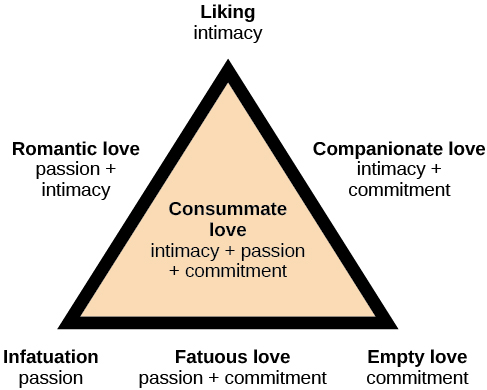
Figure 4.1: According to Sternberg, consummate love describes a healthy relationship containing intimacy, passion, and commitment. (credit: Kerry Ceszyk)
Psychologist Robert Sternberg (1986) triangulated love using intimacy, passion, and commitment on the three corners of the triangle and by measuring the intensity of each and how intense it was for the couple. To Sternberg, it was important to consider how each partner's triangle matched the other partner's. He said that a couple with all three components of love, balanced and in sufficient magnitude, would have a rare yet rewarding type of love that encompassed much of what couples seek in a loving relationship, called consummate love (Google Robert Sternberg, Triangular Theory of Love, Consummate Love).
Sternberg (1988) suggests that there are three main components of love: Passion, intimacy, and commitment (Figure 4.1). Love relationships vary depending on the presence or absence of each of these components. Passion refers to the intense, physical attraction partners feel toward one another. Intimacy involves the ability the share feelings, personal thoughts and psychological closeness with the other. Commitment is the conscious decision to stay together. Passion can be found in the early stages of a relationship, but intimacy takes time to develop because it is based on knowledge of the partner. Once intimacy has been established, partners may resolve to stay in the relationship. Although many would agree that all three components are important to a relationship, many love relationships do not consist of all three. Let's look at other possibilities below.
Different aspects of love might be more prevalent at different life stages. Other forms of love include liking, which is defined as having intimacy but no passion or commitment. Infatuation is the presence of passion without intimacy or commitment. Empty love is having commitment without intimacy or passion. Companionate love, which is characteristic of close friendships and family relationships, consists of intimacy and commitment but no passion. Romantic love is defined by having passion and intimacy, but no commitment. Finally, fatuous love is defined by having passion and commitment, but no intimacy, such as a long term sexual love affair.
Can you describe other examples of relationships that fit these different types of love? Let's examine these possibilities of love below.
Liking: In this relationship, intimacy or knowledge of the other and a sense of closeness is present. Passion and commitment, however, are not. Partners feel free to be themselves and disclose personal information. They may feel that the other person knows them well and can be honest with them and let them know if they think the person is wrong. These partners are friends. However, being told that your partner “thinks of you as a friend” can be a devastating blow if you are attracted to them and seeking a romantic involvement.
Infatuation: Perhaps, this is Sternberg's version of "love at first sight". Infatuation consists of an immediate, intense physical attraction to someone. A person who is infatuated finds it hard to think of anything but the other person. Brief encounters are played over and over in one's head; it may be difficult to eat and there may be a rather constant state of arousal. Infatuation is rather short-lived, however, lasting perhaps only a matter of months or as long as a year or so. It tends to be based on physical attraction and an image of what one “thinks” the other is all about.
Fatuous Love: However, some people who have a strong physical attraction push for commitment early in the relationship. Passion and commitment are aspects of fatuous love. There is no intimacy and the commitment is premature. Partners rarely talk seriously or share their ideas. They focus on their intense physical attraction and yet one, or both, is also talking of making a lasting commitment. Sometimes this is out of a sense of insecurity and a desire to make sure the partner is locked into the relationship.
Empty Love: This type of love may be found later in a relationship or in a relationship that was formed to meet needs other than intimacy or passion, including financial needs, childrearing assistance, or attaining/maintaining status. Here the partners are committed to staying in the relationship for the children, because of a religious conviction, or because there are no alternatives. However, they do not share ideas or feelings with each other and have no physical attraction for one another.
Romantic Love: Intimacy and passion are components of romantic love, but there is no commitment. The partners spend much time with one another and enjoy their closeness, but have not made plans to continue. This may be true because they are not in a position to make such commitments or because they are looking for passion and closeness and are afraid it will die out if they commit to one another and start to focus on other kinds of obligations.
Companionate Love: Intimacy and commitment are the hallmarks of companionate love. Partners love and respect one another and they are committed to staying together. However, their physical attraction may have never been strong or may have just died out over time. Nevertheless, partners are good friends and committed to one another.
Consummate Love: Intimacy, passion, and commitment are present in consummate love. This is often perceived by western cultures as “the ideal” type of love. The couple shares passion; the spark has not died, and the closeness is there. They feel like best friends, as well as lovers, and they are committed to staying together.
Social Exchange Theory
Love is also a function of our choices and the decisions we make while measuring the “rewards-costs” formula in our lives. Regardless of the love type you experience, you will find some types of relationships to be rewarding while others appear to be expensive. Understanding how needs and love interact is essential to the study of love.
In any relationship, we keep a mental balance sheet where the rewards and costs are measured in an overall evaluation of the worth of that relationship to us. Being in love means that each partner receives safe, nurturing acceptance of their sense of self, even if the relationship hits a few bumps in the road.
What determines whether we are satisfied with and stay in a relationship? One theory that provides an explanation is social exchange theory. According to social exchange theory, we act as naïve economists in keeping a tally of the ratio of costs and benefits of forming and maintaining a relationship with others (See figure below) (Rusbult & Van Lange, 2003).

Figure \(\PageIndex{5}\): Acting like naïve economists, people may keep track of the costs and benefits of maintaining a relationship. Typically, only those relationships in which the benefits outweigh the costs will be maintained.
People are motivated to maximize the benefits of social exchanges, or relationships, and minimize the costs. People prefer to have more benefits than costs, or to have nearly equal costs and benefits, but most people are dissatisfied if their social exchanges create more costs than benefits. Let’s discuss an example. If you have ever decided to commit to a romantic relationship, you probably considered the advantages and disadvantages of your decision. What are the benefits of being in a committed romantic relationship? You may have considered having companionship, intimacy, and passion, but also being comfortable with a person you know well. What are the costs of being in a committed romantic relationship? You may think that over time boredom from being with only one person may set in; moreover, it may be expensive to share activities such as attending movies and going to dinner. However, the benefits of dating your romantic partner presumably outweigh the costs, or you wouldn’t continue the relationship.
In the overall evaluation of the relationship, the loss of that safe and nurturing relationship where the self is threatened signals a very high cost to the individual, who must weigh that cost against the rewards and potential outcomes. Again, when people fall out of love, they are essentially falling out of the Zone of Vulnerability and the safety for self that was once enjoyed there by both partners. This is why many short-term relationships end abruptly and why many long-term ones continue even when things look and feel really bad between lovers.
The Culture of Love: Gary Chapman’s Five Love Languages
A popular psychologist named Gary Chapman spoke of the culture of our love and addressed love in the same way you or I would address how you'd prepare to travel to or live in another country. You wouldn't just up and go to Mexico without first familiarizing yourself with the language, customs, and traditions. In the same line of reasoning, you would be wise when you fall in love to study the other person's culture of expressing love and then study your own. Chapman spoke of how we express:
- Verbal love (words of affirmation)
- Love in physical touch
- Love through acts of service
- Love by spending quality time together
- Love by receiving gifts given to us by those who love us
(See Gary Chapman The Five Love Languages: How to Express Heartfelt Commitment to Your Mate).
Love Assessments
Go here to assess your love language if you want to learn more about your love language. These are not diagnostic tools, simply tools for personal insight and self-awareness.
- Speaking and Hearing Your Love Types assessment:
- Complete the assessment yourself, then have your partner take the partner version.
- Do not discuss your findings until both of you have finished the assessment.
- Ideal versus Practical Love Styles assessment:
- Helps you understand how grounded you are in your love style and your approach to relationships.
Romantic Love
Romantic love is based on continual courtship and physical intimacy. Romantic lovers continue to date long after they marry or move in together. They often express the strong sexual attraction to the other that was there from the beginning. Romantic lovers are idealistic about their relationship and often feel it was destined to be. They often define mundane activities such as grocery shopping or commuting to work as escapades of two lovers.
Companionate Love
Companionate love is a love that is loyal and devoted. Two lovers may share committed love with or without physical affection, romance, friendship, trust, loyalty, acceptance, caring, concern, selflessness, and/or infatuation. Companionate lovers have a long-term history with one another and typically combine caregiving, concern for one another's well-being, and spending much time thinking of the other. Companionate lovers are there when needed by the other person.
Romantic Love vs. Companionate Love
Below are characteristics of romantic love vs. companionate love.
Romantic Love
Beginning of relationship
Idealistic about partner
Less committed & more insecure
Passionate & exciting
Live in a "2-person world"
Companionate Love
Grows over time
Realistic about partner
More committed & secure
Friendship & support
Share in "ordinary life"
Infatuation
Infatuation is a temporary state of love where the other person is overly idealized and seen in narrow and extremely positive terms. An infatuated person may think obsessively about the other, feel a strong emotional response when they are together, see their entire world as revolving around the other, see them being together for the rest of their lives, find one or two qualities of the other as being near perfect, or may be seen by others as having a crush on the other person. Regardless of the details, infatuations rarely last very long. This love develops quickly much like a firework launches quickly into the night sky, puts on an emotional light show, then burns out quickly. Many define infatuation as an immature love experienced by those who are younger and perhaps a bit gullible.
Unconditional Love
Unconditional love is the sincere love that does not vary regardless of the actions of the person who is loved. Unconditional love is so deep and profound that it lets us forgive and still love. Some of this love type is found in almost all relationships. You often hear it expressed in greater measure among parents of children whose misbehaviors embarrass or make them ashamed. Perhaps you recall this being said to you as a child or have said this as a parent, "I love you, but right now I don't like you."
Friendship Love
Friendship love includes intimacy and trust, and often occurs among close friends. In our day, most long-burning or enduring love types form among people who were first close friends. Friendship lovers tend to enjoy each other's company, conversation, and daily interactions. They consider one another to be “go-to” friends when advice is needed or when problems need to be talked about together. Not all friendship lovers become a couple. Many are just close or best friends. Yet many who spend the rest of their lives together will start out their relationship as friends.
Criteria or Realistic Love
Criteria or realistic love is the love feelings you have when your list of a potential mate's personal traits is met in the other person. Women often desire their man to be taller. Men and women often desire to find a homogamous relationship, meaning a relationship in which partners share similar traits (e.g., same religion, political leanings, hobbies, etc.). Each of us has an ideal for a partner, and we tend to get some of those characteristics with people we become intimate with and eventually marry.
Obsessive Love
Obsessive love is an unhealthy love type where conflict and dramatic extremes in the relationship are both the goal and the theme of the couple's love. Obsessive lovers live for storms and find peace while they rage. They are often violent or overly aggressive at different levels. A few couples bring complementary traits to the relationship which light the other's fire of madness. In other words, she may be angry and violent with him, but not with some other men. He may feel simultaneously drawn to her and repulsed, but not with other women. Their personality chemistry contributes to the insanity and lack of peace.
Please note, these couples most likely need professional counseling and would probably be better off if they broke up immediately and never saw one another again. At the same time, why would they seek help or leave the person whose entanglements bring them such occupation with drama and conflict that they are freed from their boredom and entertained at the same time?
Unrequited Love
Among all these love types lies an underlying truth mentioned before: loving is a risky business where hurt feelings and pain are far too common, and wounds and scars from past relationships haunt some long after they form a permanent relationship. Part of that haunting past for lovers is unrequited love, which is the result of one person deeply wanting an intimate relationship with another who simply is not interested and does not reciprocate. Unrequited love is common among younger lovers who misread verbal and nonverbal cues and who often have yet to learn about their own love needs and wants.