

5.2: Primate Classification
- Page ID
- 258628

\( \newcommand{\vecs}[1]{\overset { \scriptstyle \rightharpoonup} {\mathbf{#1}} } \)
\( \newcommand{\vecd}[1]{\overset{-\!-\!\rightharpoonup}{\vphantom{a}\smash {#1}}} \)
\( \newcommand{\dsum}{\displaystyle\sum\limits} \)
\( \newcommand{\dint}{\displaystyle\int\limits} \)
\( \newcommand{\dlim}{\displaystyle\lim\limits} \)
\( \newcommand{\id}{\mathrm{id}}\) \( \newcommand{\Span}{\mathrm{span}}\)
( \newcommand{\kernel}{\mathrm{null}\,}\) \( \newcommand{\range}{\mathrm{range}\,}\)
\( \newcommand{\RealPart}{\mathrm{Re}}\) \( \newcommand{\ImaginaryPart}{\mathrm{Im}}\)
\( \newcommand{\Argument}{\mathrm{Arg}}\) \( \newcommand{\norm}[1]{\| #1 \|}\)
\( \newcommand{\inner}[2]{\langle #1, #2 \rangle}\)
\( \newcommand{\Span}{\mathrm{span}}\)
\( \newcommand{\id}{\mathrm{id}}\)
\( \newcommand{\Span}{\mathrm{span}}\)
\( \newcommand{\kernel}{\mathrm{null}\,}\)
\( \newcommand{\range}{\mathrm{range}\,}\)
\( \newcommand{\RealPart}{\mathrm{Re}}\)
\( \newcommand{\ImaginaryPart}{\mathrm{Im}}\)
\( \newcommand{\Argument}{\mathrm{Arg}}\)
\( \newcommand{\norm}[1]{\| #1 \|}\)
\( \newcommand{\inner}[2]{\langle #1, #2 \rangle}\)
\( \newcommand{\Span}{\mathrm{span}}\) \( \newcommand{\AA}{\unicode[.8,0]{x212B}}\)
\( \newcommand{\vectorA}[1]{\vec{#1}} % arrow\)
\( \newcommand{\vectorAt}[1]{\vec{\text{#1}}} % arrow\)
\( \newcommand{\vectorB}[1]{\overset { \scriptstyle \rightharpoonup} {\mathbf{#1}} } \)
\( \newcommand{\vectorC}[1]{\textbf{#1}} \)
\( \newcommand{\vectorD}[1]{\overrightarrow{#1}} \)
\( \newcommand{\vectorDt}[1]{\overrightarrow{\text{#1}}} \)
\( \newcommand{\vectE}[1]{\overset{-\!-\!\rightharpoonup}{\vphantom{a}\smash{\mathbf {#1}}}} \)
\( \newcommand{\vecs}[1]{\overset { \scriptstyle \rightharpoonup} {\mathbf{#1}} } \)
\(\newcommand{\longvect}{\overrightarrow}\)
\( \newcommand{\vecd}[1]{\overset{-\!-\!\rightharpoonup}{\vphantom{a}\smash {#1}}} \)
\(\newcommand{\ket}[1]{\left| #1 \right>}\)
\(\newcommand{\bra}[1]{\left< #1 \right|}\)
\(\newcommand{\braket}[2]{\left< #1 \vphantom{#2} \right| \left. #2 \vphantom{#1} \right>}\)
\(\newcommand{\braopket}[3]{\left< #1 \vphantom{#2}\vphantom{#3} \right| #2 \vphantom{#1}\vphantom{#3} \left| #3 \vphantom{#1}\vphantom{#2} \right>}\)
\(\newcommand{\qmvec}[1]{\mathbf{\vec{#1}}}\)
\(\newcommand{\op}[1]{\hat{\mathbf{#1}}}\)
\(\newcommand{\expect}[1]{\langle #1 \rangle}\)
\(\newcommand{\dfn}[1]{\emph{\textbf{#1}}}\)
Primate Classification
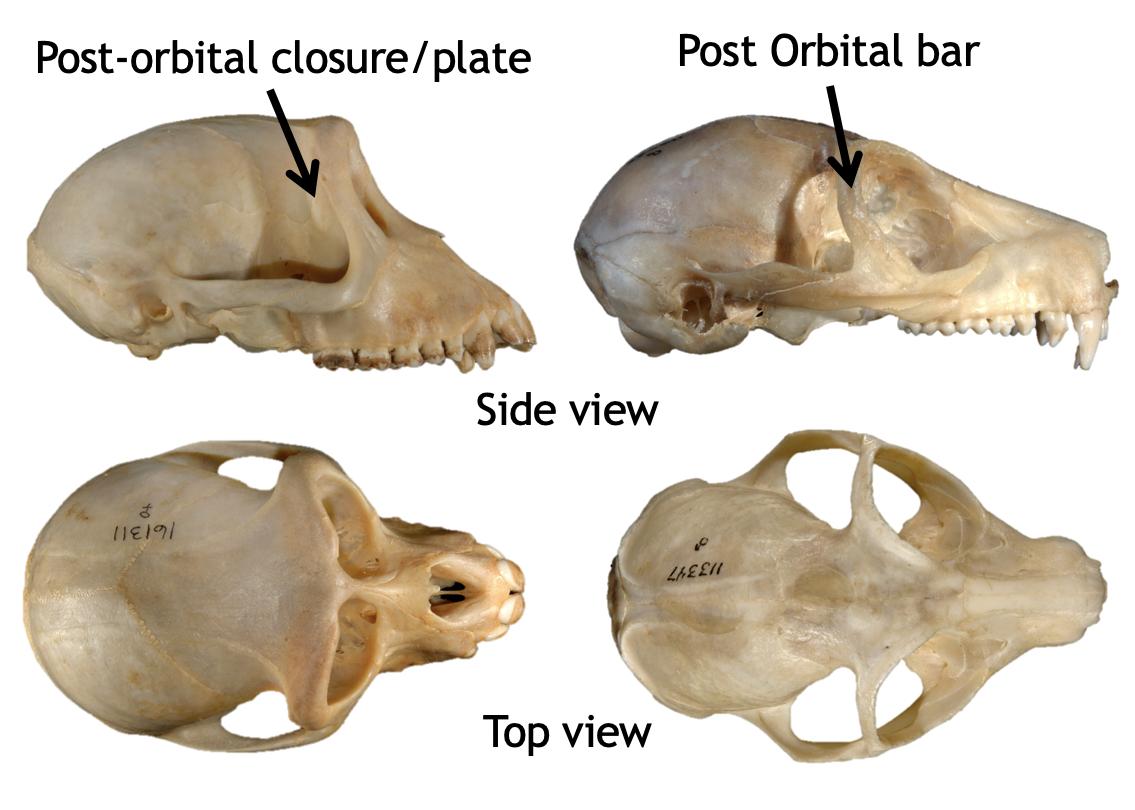
Side and top views of postorbital closures and bars.
Primate Classification Worksheet
Introduction
Station 1: Primate Versus Non-Primate Postcrania
| Non-Primate | Primates |
|---|---|
|
|
|
Non- Primate |
Primates |
|
|---|---|---|
| Hands and feet | ||
| Claws or nails | ||
| Vertebral column and rib cage | ||
| Clavicle | ||
| Pelvis |
Station 2: Non-Primate and Primate Teeth and Skulls
| Non-Primates | |
|---|---|
|
|
|
| Primates | |
|
|
|
| Non-Primates | Primates | |||
|---|---|---|---|---|
| Whitetail Deer | Dog | Colobus Monkey | Human | |
| Distinguishing features of the teeth | ||||
| Describe the tooth row shape | ||||
| Probable diet |
| Non-Primates | |
|---|---|
|
|
|
| Primates | |
|
|
|
| Non-Primates | Primates | |||
|---|---|---|---|---|
| Jackrabbit | Dog | Squirrel Monkey | Human | |
| Eye orbit structure and orientation | ||||
| Foramen magnum position | ||||
| Size and complexity of nasal region | ||||
| Rely more on vision or smell? |
Station 3: Primate Suborders: Strepsirrhini and Haplorrhini
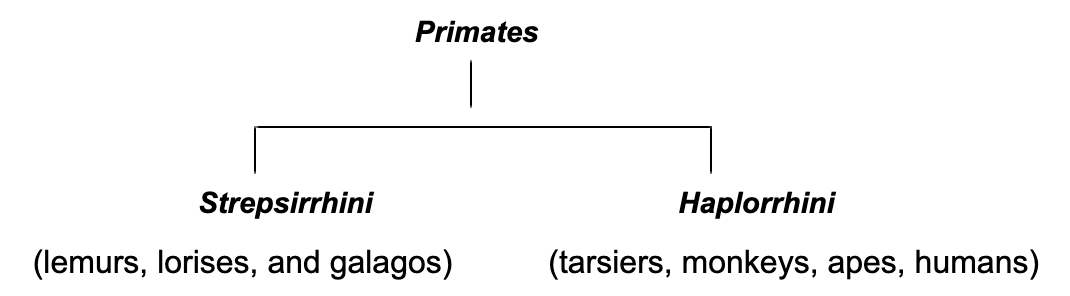
Strepsirrhine- Ring-tailed Lemur |
Haplorrhine- Baboon |
|
|---|---|---|
| Nails or claws? Which digits? | Claw on second digit, nails on others | Nails only |
| Postorbital bar or plate? | ||
| Orientation of eye orbits (forward or toward the side) | ||
| Snout length relative to brain size | ||
| Presence or absence of tooth comb | ||
| Geographic location (read intro above) |
Station 4: Tarsiers
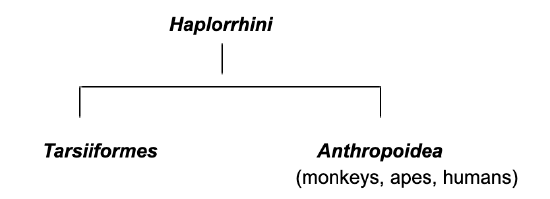
| Tarsier
|
Is this trait more like strepsirrhines or haplorrhines, or is it unique? | |
|---|---|---|
| Nails or claws? Which digits? | Grooming claw, and nails on other digits | |
| Postorbital bar or plate? | ||
| Orientation of eye orbits (forward or toward the side) | ||
| Snout length relative to brain size | ||
| Presence or absence of tooth comb | ||
| Geographic location | Asia | N/A |
Station 5: New World Monkeys
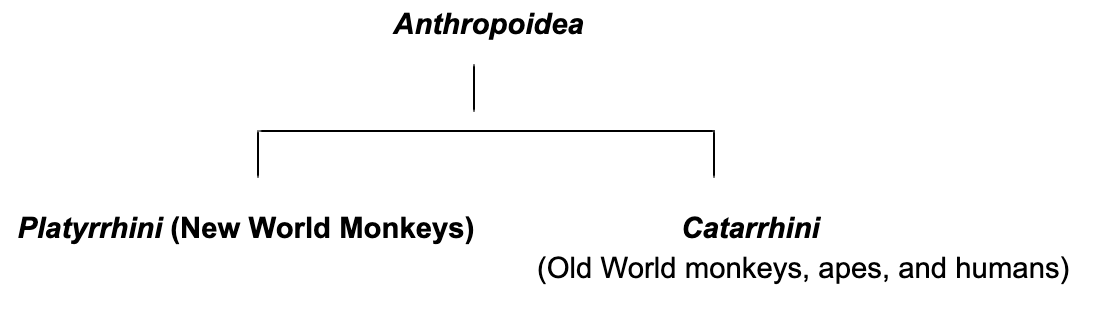
Platyrrhini- Brown Howler Monkey |
Catarrhini- Hamadryas Baboon |
|
|---|---|---|
| Meaning of scientific name | ||
| Direction nostrils face | ||
| Dental formula | ||
Questions:
Station 6: Old World Monkeys and Hominoids
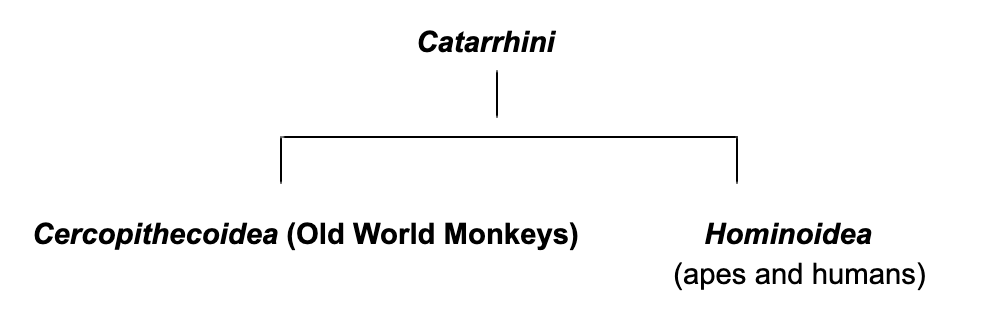
| Cercopithecoid | Hominoids | |
|---|---|---|
|
|
|
|
| Old World Monkey- Rhesus Macaque | Ape- Gorilla | Human | |
|---|---|---|---|
| Shape of rib cage | |||
| Length of forelimb (arm) relative to trunk | |||
| Length of clavicle and location of scapula | |||
| Presence or absence of tail |