

Social Sci LibreTexts

Theoretical Perspectives on Environmental Problems

  • Page ID
    255506
    • Anonymous
    • LibreTexts

    \( \newcommand{\vecs}[1]{\overset { \scriptstyle \rightharpoonup} {\mathbf{#1}} } \)

    \( \newcommand{\vecd}[1]{\overset{-\!-\!\rightharpoonup}{\vphantom{a}\smash {#1}}} \)

    \( \newcommand{\dsum}{\displaystyle\sum\limits} \)

    \( \newcommand{\dint}{\displaystyle\int\limits} \)

    \( \newcommand{\dlim}{\displaystyle\lim\limits} \)

    \( \newcommand{\id}{\mathrm{id}}\) \( \newcommand{\Span}{\mathrm{span}}\)

    ( \newcommand{\kernel}{\mathrm{null}\,}\) \( \newcommand{\range}{\mathrm{range}\,}\)

    \( \newcommand{\RealPart}{\mathrm{Re}}\) \( \newcommand{\ImaginaryPart}{\mathrm{Im}}\)

    \( \newcommand{\Argument}{\mathrm{Arg}}\) \( \newcommand{\norm}[1]{\| #1 \|}\)

    \( \newcommand{\inner}[2]{\langle #1, #2 \rangle}\)

    \( \newcommand{\Span}{\mathrm{span}}\)

    \( \newcommand{\id}{\mathrm{id}}\)

    \( \newcommand{\Span}{\mathrm{span}}\)

    \( \newcommand{\kernel}{\mathrm{null}\,}\)

    \( \newcommand{\range}{\mathrm{range}\,}\)

    \( \newcommand{\RealPart}{\mathrm{Re}}\)

    \( \newcommand{\ImaginaryPart}{\mathrm{Im}}\)

    \( \newcommand{\Argument}{\mathrm{Arg}}\)

    \( \newcommand{\norm}[1]{\| #1 \|}\)

    \( \newcommand{\inner}[2]{\langle #1, #2 \rangle}\)

    \( \newcommand{\Span}{\mathrm{span}}\) \( \newcommand{\AA}{\unicode[.8,0]{x212B}}\)

    \( \newcommand{\vectorA}[1]{\vec{#1}}      % arrow\)

    \( \newcommand{\vectorAt}[1]{\vec{\text{#1}}}      % arrow\)

    \( \newcommand{\vectorB}[1]{\overset { \scriptstyle \rightharpoonup} {\mathbf{#1}} } \)

    \( \newcommand{\vectorC}[1]{\textbf{#1}} \)

    \( \newcommand{\vectorD}[1]{\overrightarrow{#1}} \)

    \( \newcommand{\vectorDt}[1]{\overrightarrow{\text{#1}}} \)

    \( \newcommand{\vectE}[1]{\overset{-\!-\!\rightharpoonup}{\vphantom{a}\smash{\mathbf {#1}}}} \)

    \( \newcommand{\vecs}[1]{\overset { \scriptstyle \rightharpoonup} {\mathbf{#1}} } \)

    \(\newcommand{\longvect}{\overrightarrow}\)

    \( \newcommand{\vecd}[1]{\overset{-\!-\!\rightharpoonup}{\vphantom{a}\smash {#1}}} \)

    \(\newcommand{\avec}{\mathbf a}\) \(\newcommand{\bvec}{\mathbf b}\) \(\newcommand{\cvec}{\mathbf c}\) \(\newcommand{\dvec}{\mathbf d}\) \(\newcommand{\dtil}{\widetilde{\mathbf d}}\) \(\newcommand{\evec}{\mathbf e}\) \(\newcommand{\fvec}{\mathbf f}\) \(\newcommand{\nvec}{\mathbf n}\) \(\newcommand{\pvec}{\mathbf p}\) \(\newcommand{\qvec}{\mathbf q}\) \(\newcommand{\svec}{\mathbf s}\) \(\newcommand{\tvec}{\mathbf t}\) \(\newcommand{\uvec}{\mathbf u}\) \(\newcommand{\vvec}{\mathbf v}\) \(\newcommand{\wvec}{\mathbf w}\) \(\newcommand{\xvec}{\mathbf x}\) \(\newcommand{\yvec}{\mathbf y}\) \(\newcommand{\zvec}{\mathbf z}\) \(\newcommand{\rvec}{\mathbf r}\) \(\newcommand{\mvec}{\mathbf m}\) \(\newcommand{\zerovec}{\mathbf 0}\) \(\newcommand{\onevec}{\mathbf 1}\) \(\newcommand{\real}{\mathbb R}\) \(\newcommand{\twovec}[2]{\left[\begin{array}{r}#1 \\ #2 \end{array}\right]}\) \(\newcommand{\ctwovec}[2]{\left[\begin{array}{c}#1 \\ #2 \end{array}\right]}\) \(\newcommand{\threevec}[3]{\left[\begin{array}{r}#1 \\ #2 \\ #3 \end{array}\right]}\) \(\newcommand{\cthreevec}[3]{\left[\begin{array}{c}#1 \\ #2 \\ #3 \end{array}\right]}\) \(\newcommand{\fourvec}[4]{\left[\begin{array}{r}#1 \\ #2 \\ #3 \\ #4 \end{array}\right]}\) \(\newcommand{\cfourvec}[4]{\left[\begin{array}{c}#1 \\ #2 \\ #3 \\ #4 \end{array}\right]}\) \(\newcommand{\fivevec}[5]{\left[\begin{array}{r}#1 \\ #2 \\ #3 \\ #4 \\ #5 \\ \end{array}\right]}\) \(\newcommand{\cfivevec}[5]{\left[\begin{array}{c}#1 \\ #2 \\ #3 \\ #4 \\ #5 \\ \end{array}\right]}\) \(\newcommand{\mattwo}[4]{\left[\begin{array}{rr}#1 \amp #2 \\ #3 \amp #4 \\ \end{array}\right]}\) \(\newcommand{\laspan}[1]{\text{Span}\{#1\}}\) \(\newcommand{\bcal}{\cal B}\) \(\newcommand{\ccal}{\cal C}\) \(\newcommand{\scal}{\cal S}\) \(\newcommand{\wcal}{\cal W}\) \(\newcommand{\ecal}{\cal E}\) \(\newcommand{\coords}[2]{\left\{#1\right\}_{#2}}\) \(\newcommand{\gray}[1]{\color{gray}{#1}}\) \(\newcommand{\lgray}[1]{\color{lightgray}{#1}}\) \(\newcommand{\rank}{\operatorname{rank}}\) \(\newcommand{\row}{\text{Row}}\) \(\newcommand{\col}{\text{Col}}\) \(\renewcommand{\row}{\text{Row}}\) \(\newcommand{\nul}{\text{Nul}}\) \(\newcommand{\var}{\text{Var}}\) \(\newcommand{\corr}{\text{corr}}\) \(\newcommand{\len}[1]{\left|#1\right|}\) \(\newcommand{\bbar}{\overline{\bvec}}\) \(\newcommand{\bhat}{\widehat{\bvec}}\) \(\newcommand{\bperp}{\bvec^\perp}\) \(\newcommand{\xhat}{\widehat{\xvec}}\) \(\newcommand{\vhat}{\widehat{\vvec}}\) \(\newcommand{\uhat}{\widehat{\uvec}}\) \(\newcommand{\what}{\widehat{\wvec}}\) \(\newcommand{\Sighat}{\widehat{\Sigma}}\) \(\newcommand{\lt}{<}\) \(\newcommand{\gt}{>}\) \(\newcommand{\amp}{&}\) \(\definecolor{fillinmathshade}{gray}{0.9}\)

    The major sociological perspectives offer insights that help us understand problems relating to the environment; however, other perspectives are important for framing and consider strategies to environmental problems. We will first discuss the classical sociological paradigms, then shift to a discussion of other perspectives central to thinking about the environment. The Theoretical Perspectives Snapshot table below summarizes how each of the sociological perspectives frame or explain these problems.

    Theoretical Perspectives Snapshot
    Theoretical perspective Major assumptions
    Structural functionalism Environmental problems are to be expected in an industrial society, but severe environmental problems are dysfunctional.
    Conflict theory The practices of multinational corporations and weak regulation of these practices account for many environmental problems.
    Symbolic interactionism People's social backgrounds affect their perceptions and understandings of environmental issues, which are important to appreciate if environmental problems are to be addressed.


    Structural Functionalism

    Functionalism considers pollution and other environmental problems to be an inevitable consequence of today’s society, but it assumes that environmental problems that are too severe are certainly dysfunctional for society. Functionalists may see industrialization as a positive development for society as it provided industries and jobs, among other benefits. However, industrialization is a leading cause of accelerating global warming, which may cause societal dysfunctions if people are displaced, cannot work, or experience other consequences of environmental problems. Functionalism argues that other concerns such as population growth has implications for the environment, such as using up valuable resources and food supplies necessary for humans to survive and thrive. 

    Since functionalists are interested in the workings and interconnections of social institutions, they may also argue that it is a dysfunction of the institution of the state to allow corporations to engage in polluting practices that harm the environment. The government may limit corporations' use of fossil fuels, for instance, which would slow global warming and its consequences for society. 


    Conflict Theory

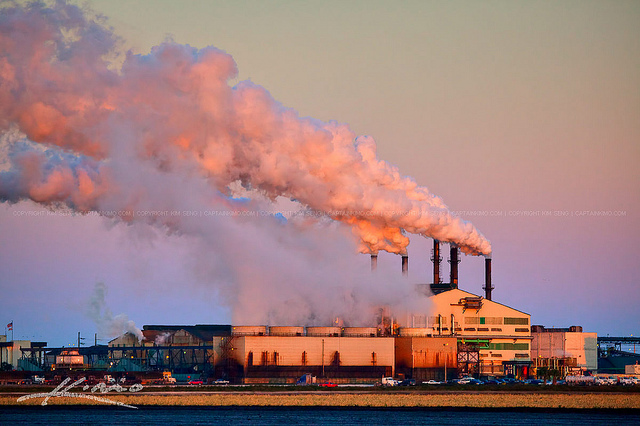
    Conflict theory assumes that the world’s environmental problems are not inevitable and instead arise from two related sources. First, multinational corporations engage in practices that pollute the air, water, and ground. Second, the United States and other governments fail to have strong regulations to limit corporate pollution, and they fail to adequately enforce the regulations they do have. Thus, conflict theory argues that environmental problems reflect decisions by political elites and multinational corporations.
    15.1.0.jpg

    Conflict theory blames many environmental problems on pollution by multinational corporations that occurs because of weak regulations and a failure to enforce the regulations that do exist.

    Kim Seng – Sugar Factory Producing Smoke Pollution into the Earth – CC BY-NC-ND 2.0

    Feminist theories, which overlap with conflict theories, also help explain climate change and environmental inequality. They focus on the documented fact that women and children are disproportionately impacted by climate change and other environmental problems, and see patriarchy and capitalism as the causes. The video below explores this topic in more detail. This strand of feminist theory and action is called ecofeminism.

    In the first 12 minutes of this TED Talk video, Gender inequality is showing up…in climate change, Canadian researcher Amber Fletcher discusses interviewing farm women to demonstrate how climate change impacts agriculture in Canada. How might environmental problems otherwise disproportionately impact women?

    Gender inequality is showing up… in climate change” by Amber Fletcher, TEDxRegina is licensed under CC BY-NC-ND 3.0

    Ecofeminism connects the domination of women and nonbinary people to the domination of the environment. If you would like to learn more, please read the article Ecofeminism: Encouraging Interconnectedness with Our Environment in Modern Society. In it, researchers Mondal and Majumder (2019) write, “bringing together feminism and environmentalism, ecofeminism argues that the domination of women and the degradation of the environment are consequences of patriarchy and capitalism.”

    In response to this and other gendered inequalities, women and nonbinary people are thinking, researching, and taking action, as mentioned on the Strategies page.


    Symbolic Interactionism

    Symbolic interactionism offers four kinds of understandings of environmental problems. First, it seeks to understand why people engage or do not engage in activities related to environmental problems (e.g., recycling, limiting polluting activities). In order to address environmental problems, it is important to understand why people become involved, or fail to become involved, in various activities related to these problems.

    Second, it emphasizes people’s perceptions of environmental problems. To the extent that public attitudes play a key role in the persistence of these problems, it is important to know the reasons for public views on these problems so that efforts to address the problems may be better focused.

    Next, symbolic interactionism assumes that environmental problems are to some extent social constructs, as these problems do not come to be considered social problems unless sufficient numbers of people and/or influential organizations in the public and private sectors recognize them as problems. For example, lead was a serious health problem long before the US government banned it in paint in 1977 and in gasoline in 1990. As early as the first few years of the twentieth century, scientists were calling attention to the toxic properties of lead paint and more generally of lead itself. Still, lead was added to gasoline in 1922 to raise octane levels. Despite growing evidence over the next few decades of lead’s toxic qualities, various industries continued to say that lead was safe for the general public (Michaels 2008). The banning of lead was ultimately due to the efforts of environmental groups and to the fact that the growing amount of scientific evidence of lead’s dangers became overwhelming.

    Finally, symbolic interactionism emphasizes that people from different social backgrounds and from different cultures may have different understandings of environmental problems.


    Other Perspectives

    In addition to the classical sociological theoretical perspectives, two other general frameworks are useful for examining environmental problems. The first directly connects to problems of the environment: The environmental injustice framework. The second we introduced in the Sociology chapter as an alternative to Western scientific knowledge: Indigenous perspectives. 

    Environmental Injustice Perspectives

    Conflict theorists, critical race theorists, and other scholars agree that environmental problems are a product of racist and classist practices. Environmental racism is any environmental policy or practice which disadvantages people or communities based on race. Reverend Dr. Benjamin Chavis created this term in 1982 to describe the experience of Black people in Warren County, North Carolina. Black residents protested the siting of a toxic landfill in a predominantly Black community (Bullard 2000). To be more specific, Chavis (1994) defined environmental racism as:

    "racial discrimination in environmental policymaking and enforcement of regulations and laws, the deliberate targeting of communities of color for toxic waste facilities, the official sanctioning of the presence of life-threatening poisons and pollutants for communities of color, and the history of excluding People of Color from leadership of the environmental movement" (Chavis 1994).

    Environmental sociologist Robert D. Bullard (pictured below), often described as the “Father of Environmental Justice,” expands on Chavis’s work. His book Dumping on Dixie: Race, Class, and Environmental Quality (1990) was the first book describing environmental racism. Bullard discussed a landmark study he conducted in 1979 concerning the locations of all the municipal solid-waste sites in Houston, Texas, related to a lawsuit. The lawsuit Bean v. Southwestern Waste Management was in response to the siting of a landfill in a suburban middle-class neighborhood in which Bullard described as “an unlikely location for a garbage dump – except that over 82 percent of its residents were African American” (Bullard 1990:xiv).

    Headshot of Robert D Bullard, environmental sociologist

    Environmental sociologist Robert D. Bullard is often described as the “Father of Environmental Justice.” What makes his work so powerful?

    Robert Bullard” by Dave Brenner, University of Michigan School for Environment and Sustainability is licensed under CC BY 2.0

    Results from Bullard’s research inspired him to investigate four other Black communities in the South to see if there was indeed a correlation between race and increased exposure to toxic facilities. His research findings revealed that “the siting of local waste facilities was not random” (1990:xiv) but were in fact clear examples of institutional racism – laws and policies that have intentionally and systematically marginalized Black communities for generations.

    Bullard’s groundbreaking research provided convincing evidence of environmental discrimination. At the center of this legacy of discrimination, he argued, was structural and individual racism, which led to the “impoverishment of Black communities... [making] it easier for Black residential areas to become the dumping grounds for all types of health-threatening toxins and industrial pollution” (1990:7). Bullard’s work illustrated how and why past injustices continue to affect and harm historically oppressed communities today.

    Environmental racism also includes the colonialist land theft from Indigenous people. Indigenous scholar Roxanne Dunbar-Ortiz argued in An Indigenous Peoples’ History of the United States, that “everything in US history is about the land,” at least in terms of increasing European and Euro-American wealth and power­ (Dunbar-Ortiz 2014).

    Researcher and activist David Pellow, who wrote the 2017 book What is Critical Environmental Justice?, agrees. He focuses more broadly on environmental injustice, in which environmental policies or practices disadvantage people in marginalized groups (not necessarily by race). He argues that environmental injustice was a major component of the European colonization agenda. From the theft of nearly all Indigenous historical lands; the extermination of entire cultural groups and millions of Indigenous peoples; the control, commodification, and over-exploitation of natural resources; and the enslavement of millions of Indigenous and African peoples to “work the land,” environmental injustice and racism have been a problem in the US from the start. Environmental injustice can be traced much further back in US history to the exploitation and extermination of millions of Indigenous peoples and the violent seizure of their ancestral lands as a result of European and Euro-American colonization and warfare (Jarratt-Snider and Nielson 2020). If you would like to learn more about David Pellow’s work, watch the video Polluting the Voiceless.

    Indigenous Perspectives

    In addition to the classical theoretical perspectives in sociology, other perspectives can help us frame and explain environmental problems. An indigenous perspective offers a different understanding of climate change and environmental inequality. Recall from the Sociology chapter that there are substantial differences between Indigenous and Western worldviews (see the table on the Sociological Concepts page). Another example of these differences can be seen in how we understand what people need to thrive and grow. You may have seen the triangle on the left in the image below at some point in your education – it is Maslow’s hierarchy of needs.

    Image description provided

    This image shows a comparison between Maslow’s Hierarchy of Needs, a Western Perspective, and the First Nations Perspective.

    “Maslow’s Hierarchy and First Nations Hierarchy” from “Connection” by Elizabeth B. Pearce, Wesley Sharp, and Nyssa Cronin, Contemporary Families: An Equity Lens 1e is licensed under CC BY 4.0. Based on research from Rethinking Learning by Barbara Bray

    In 1938, American psychologist Abraham Maslow spent time with the people of the Blackfoot Nation in Canada prior to releasing his hierarchy of needs theory. Historians think he based the teepee-like structure on ideas from the Blackfoot Nation in North America, but westernized it to focus on the individual rather than the community (Bray 2019). Maslow focuses on the needs of the individual, starting with the basic physical needs like food, water and shelter, moving to needs related to relationships and belonging, and then on to the highest level needs of becoming your best self.

    In comparison, the ideas of the Blackfoot nation emphasize community. The well-being of the individual, the family, and the community are based on connectedness. Self actualization is actually the first layer, not at the top. Community actualization reflects our connection to family, friends, community and the world. We thrive when we contribute to and receive from our community. In addition, this model focuses on time. The top of the teepee is cultural perpetuity. It symbolizes a community’s culture lasting forever.

    There are other differences in Indigenous and Western worldviews of nature, land, and community, including those that relate to the social problem of environmental inequality. Let’s look at how capitalism and colonialism causes or exacerbates the social problem of climate change.

    Capitalism requires endless consumption and use of resources, which is not sustainable on a finite planet. When the goal is profit, people must buy more and more things. Creating more and more things uses even more planetary resources. This drive for profit shapes our values and our behaviors. For example, sociologists note that capitalism often requires conspicuous consumption, the purchase of expensive luxury goods or services to display one’s wealth and status. Culturally speaking, it is not enough to have a small house with running water, heat, and electricity. Instead, capitalism requires that people always want more: A big house, two cars, and a nice vacation. We can see conspicuous consumption at work when we examine what people eat around the world.

    Unlike capitalism, Indigenous economic systems do not rely on exponential growth and consumption. Many journals from early colonists describe the Americas as places with lush and ample resources. Indigenous peoples had consistently managed and stewarded the land using techniques perfected throughout generations. This knowledge today is called Traditional Ecological Knowledge, or TEK (NPS 2023a). To learn more about TEK, read Native Knowledge: What Ecologists Are Learning from Indigenous People.

    Three Indigenous men work together to lift a large, carved wooden house post

    Wood carvers Owen James, Herb Sheakley, and tribal member George Dalton, Jr. use Traditional Ecological Knowledge to craft art and homes. Here they hoist the Kaagwaantaan house post.

    Carvers Owen James and Herb Sheakley, and tribal member George Dalton, Jr. hoist the Kaagwaantaan house post” by the National Park Service is in the Public Domain

    In addition to the decimation of Indigenous populations and the land that they lived on, colonization supported a worldview that contributed to ecological devastation today. In this view, land should be owned and subjugated, rather than tended and cared for. In the words of authors Laura Dominguez and Colin Luoma (who write using UK English):

    "The widespread plunder of natural resources was a hallmark of colonisation. Nature was something that was to be commodified in order to enrich the colonial power. In turn, indigenous territories were treated as business enterprises, with seemingly unlimited resources to exploit. Undoubtedly, this had dire environmental consequences… The ideology that emerged was that nature was something that should be first exploited, then preserved, but all without the input, involvement, or participation of indigenous populations" (Dominguez & Luoma 2020).

    Further, colonization supports a Western worldview that leads its participants to value individual well-being above all else. This leads to a lack of action and concern regarding the well being of our neighbors, plants, and animals who surround us, and of the health of the earth at large. An example from Latin America illustrates this mindset. Uruguayan journalist and poet Edwardo Galeano wrote Open Veins of Latin America: Five Centuries of the Pillage of a Continent in 1971. He writes:

    "Latin America is the region of open veins. Everything from the discovery until our times, has always been transmuted into European – or later – United States capital, and as such has accumulated on distant centers of power. Everything: the soil, its fruits and its mineral-rich depths, the people and their capacity to work and to consume, natural resources and human resources" (Galeano 1971: 2).

    The legacy of colonialism and capitalism on climate change continues today. The world markets for beef, soybeans, palm oil, wood products, sugar, and coffee support continued deforestation (Union of Concerned Scientists 2016). In fact, deforestation itself is a cause of climate change.

    Cultural differences in worldviews, in this case relating to economic and power systems, produce varying explanations for climate change and environmental inequality. However, as we see above, the Western perspective of conflict theory agrees with the Indigenous perspective that capitalism is largely responsible for these social problems. Thus, different perspectives are not always in competition and rather may complement each other.


    This page titled Theoretical Perspectives on Environmental Problems is shared under a CC BY-NC-SA 3.0 license and was authored, remixed, and/or curated by Anonymous via source content that was edited to the style and standards of the LibreTexts platform.