
Social Sci LibreTexts

Overview of Sociology

  • Page ID
    256750
  • \( \newcommand{\vecs}[1]{\overset { \scriptstyle \rightharpoonup} {\mathbf{#1}} } \)

    \( \newcommand{\vecd}[1]{\overset{-\!-\!\rightharpoonup}{\vphantom{a}\smash {#1}}} \)

    \( \newcommand{\dsum}{\displaystyle\sum\limits} \)

    \( \newcommand{\dint}{\displaystyle\int\limits} \)

    \( \newcommand{\dlim}{\displaystyle\lim\limits} \)

    \( \newcommand{\id}{\mathrm{id}}\) \( \newcommand{\Span}{\mathrm{span}}\)

    ( \newcommand{\kernel}{\mathrm{null}\,}\) \( \newcommand{\range}{\mathrm{range}\,}\)

    \( \newcommand{\RealPart}{\mathrm{Re}}\) \( \newcommand{\ImaginaryPart}{\mathrm{Im}}\)

    \( \newcommand{\Argument}{\mathrm{Arg}}\) \( \newcommand{\norm}[1]{\| #1 \|}\)

    \( \newcommand{\inner}[2]{\langle #1, #2 \rangle}\)

    \( \newcommand{\Span}{\mathrm{span}}\)

    \( \newcommand{\id}{\mathrm{id}}\)

    \( \newcommand{\Span}{\mathrm{span}}\)

    \( \newcommand{\kernel}{\mathrm{null}\,}\)

    \( \newcommand{\range}{\mathrm{range}\,}\)

    \( \newcommand{\RealPart}{\mathrm{Re}}\)

    \( \newcommand{\ImaginaryPart}{\mathrm{Im}}\)

    \( \newcommand{\Argument}{\mathrm{Arg}}\)

    \( \newcommand{\norm}[1]{\| #1 \|}\)

    \( \newcommand{\inner}[2]{\langle #1, #2 \rangle}\)

    \( \newcommand{\Span}{\mathrm{span}}\) \( \newcommand{\AA}{\unicode[.8,0]{x212B}}\)

    \( \newcommand{\vectorA}[1]{\vec{#1}}      % arrow\)

    \( \newcommand{\vectorAt}[1]{\vec{\text{#1}}}      % arrow\)

    \( \newcommand{\vectorB}[1]{\overset { \scriptstyle \rightharpoonup} {\mathbf{#1}} } \)

    \( \newcommand{\vectorC}[1]{\textbf{#1}} \)

    \( \newcommand{\vectorD}[1]{\overrightarrow{#1}} \)

    \( \newcommand{\vectorDt}[1]{\overrightarrow{\text{#1}}} \)

    \( \newcommand{\vectE}[1]{\overset{-\!-\!\rightharpoonup}{\vphantom{a}\smash{\mathbf {#1}}}} \)

    \( \newcommand{\vecs}[1]{\overset { \scriptstyle \rightharpoonup} {\mathbf{#1}} } \)

    \( \newcommand{\vecd}[1]{\overset{-\!-\!\rightharpoonup}{\vphantom{a}\smash {#1}}} \)

    \(\newcommand{\avec}{\mathbf a}\) \(\newcommand{\bvec}{\mathbf b}\) \(\newcommand{\cvec}{\mathbf c}\) \(\newcommand{\dvec}{\mathbf d}\) \(\newcommand{\dtil}{\widetilde{\mathbf d}}\) \(\newcommand{\evec}{\mathbf e}\) \(\newcommand{\fvec}{\mathbf f}\) \(\newcommand{\nvec}{\mathbf n}\) \(\newcommand{\pvec}{\mathbf p}\) \(\newcommand{\qvec}{\mathbf q}\) \(\newcommand{\svec}{\mathbf s}\) \(\newcommand{\tvec}{\mathbf t}\) \(\newcommand{\uvec}{\mathbf u}\) \(\newcommand{\vvec}{\mathbf v}\) \(\newcommand{\wvec}{\mathbf w}\) \(\newcommand{\xvec}{\mathbf x}\) \(\newcommand{\yvec}{\mathbf y}\) \(\newcommand{\zvec}{\mathbf z}\) \(\newcommand{\rvec}{\mathbf r}\) \(\newcommand{\mvec}{\mathbf m}\) \(\newcommand{\zerovec}{\mathbf 0}\) \(\newcommand{\onevec}{\mathbf 1}\) \(\newcommand{\real}{\mathbb R}\) \(\newcommand{\twovec}[2]{\left[\begin{array}{r}#1 \\ #2 \end{array}\right]}\) \(\newcommand{\ctwovec}[2]{\left[\begin{array}{c}#1 \\ #2 \end{array}\right]}\) \(\newcommand{\threevec}[3]{\left[\begin{array}{r}#1 \\ #2 \\ #3 \end{array}\right]}\) \(\newcommand{\cthreevec}[3]{\left[\begin{array}{c}#1 \\ #2 \\ #3 \end{array}\right]}\) \(\newcommand{\fourvec}[4]{\left[\begin{array}{r}#1 \\ #2 \\ #3 \\ #4 \end{array}\right]}\) \(\newcommand{\cfourvec}[4]{\left[\begin{array}{c}#1 \\ #2 \\ #3 \\ #4 \end{array}\right]}\) \(\newcommand{\fivevec}[5]{\left[\begin{array}{r}#1 \\ #2 \\ #3 \\ #4 \\ #5 \\ \end{array}\right]}\) \(\newcommand{\cfivevec}[5]{\left[\begin{array}{c}#1 \\ #2 \\ #3 \\ #4 \\ #5 \\ \end{array}\right]}\) \(\newcommand{\mattwo}[4]{\left[\begin{array}{rr}#1 \amp #2 \\ #3 \amp #4 \\ \end{array}\right]}\) \(\newcommand{\laspan}[1]{\text{Span}\{#1\}}\) \(\newcommand{\bcal}{\cal B}\) \(\newcommand{\ccal}{\cal C}\) \(\newcommand{\scal}{\cal S}\) \(\newcommand{\wcal}{\cal W}\) \(\newcommand{\ecal}{\cal E}\) \(\newcommand{\coords}[2]{\left\{#1\right\}_{#2}}\) \(\newcommand{\gray}[1]{\color{gray}{#1}}\) \(\newcommand{\lgray}[1]{\color{lightgray}{#1}}\) \(\newcommand{\rank}{\operatorname{rank}}\) \(\newcommand{\row}{\text{Row}}\) \(\newcommand{\col}{\text{Col}}\) \(\renewcommand{\row}{\text{Row}}\) \(\newcommand{\nul}{\text{Nul}}\) \(\newcommand{\var}{\text{Var}}\) \(\newcommand{\corr}{\text{corr}}\) \(\newcommand{\len}[1]{\left|#1\right|}\) \(\newcommand{\bbar}{\overline{\bvec}}\) \(\newcommand{\bhat}{\widehat{\bvec}}\) \(\newcommand{\bperp}{\bvec^\perp}\) \(\newcommand{\xhat}{\widehat{\xvec}}\) \(\newcommand{\vhat}{\widehat{\vvec}}\) \(\newcommand{\uhat}{\widehat{\uvec}}\) \(\newcommand{\what}{\widehat{\wvec}}\) \(\newcommand{\Sighat}{\widehat{\Sigma}}\) \(\newcommand{\lt}{<}\) \(\newcommand{\gt}{>}\) \(\newcommand{\amp}{&}\) \(\definecolor{fillinmathshade}{gray}{0.9}\)
    Learning Objectives
    • Describe what sociology is as an academic field of study.
    • Illustrate the use and benefits of a sociological imagination.
    • Explain what is meant by the claim that social forces shape our lives and choices.
    • Define foundational sociological concepts such as social institutions, culture, and systems of power.
    • Connect social location to social inequality and to how people experience and theorize about social problems.
    • Summarize classical and contemporary sociological theoretical perspectives.
    • Differentiate between approaches to knowledge about the social world.
    • List advantages and disadvantages of specific sociological research methods.
    • Identify the benefits of different types of action research.


    The study of social problems is based in the wider field of sociology, the systematic study of society. Sociology is interested in all things social: Social interactions, social identities, social groups, social institutions, social inequalities, and so on. With systematic data collection and analysis, sociology examines all levels of social phenomena, from two people talking to systems that span the globe.

    In this chapter, we explain the sociological imagination, which guides how sociologists examine society. We then introduce several other foundational sociological concepts that will appear in our discussions on social problems. Next we will explore how sociological theoretical perspectives help to understand why our world works the way it does. We will end with sociological research methods, the broad and specific approaches sociologists take to systematically study society.


    The Sociological Imagination
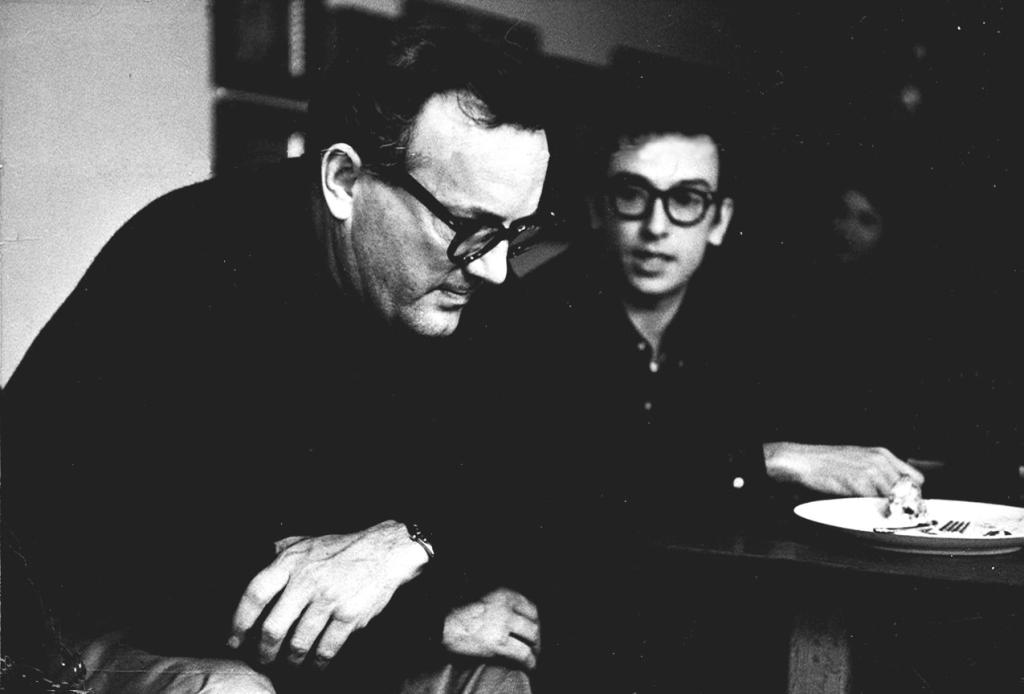
    On the Social Problems overview page, we introduced you to American sociologist C. Wright Mills (pictured below) who wrote the book The Sociological Imagination. Mills helps us to connect our own individual lives to larger social forces, including connecting seemingly individual problems to larger social problems. To review, Mills uses the term personal troubles to describe troubles that individuals experience. He contrasts these with larger social forces and social problems, which he calls public issues.

    Individuals do have personal problems; however, social problems reach beyond any one individual because they impact large groups of people, sometimes even entire nations or the whole world, as we will see in future chapters. We offered examples of how an individual losing their job may be tied to national unemployment rates, how an individual getting divorced may be tied to economic instability, and how an individual being in debt due to student loans may be tied to the national volume of student loan debt. Other examples include that an individual developing an addiction may be tied to the opioid crisis, an individual experiencing eviction may be tied to the national housing crises, or an individual facing the destruction of their home due to a hurricane can be tied to climate change. In each of these examples, we are reframing the personal trouble as a public issue (Mills 1959), or the seemingly individual problem as a social problem.

    The sociological imagination is a quality of mind that connects individual experience and wider social forces. In other words, it is the skill of connecting personal troubles to public issues. Mills writes, “The sociological imagination enables us to grasp history and biography and the relations between the two within society. This is its task and its promise” (1959:6). When we use our sociological imagination, we connect our own lives or other's lives ('biography') to historical and contemporary social forces to explain our current realities. We can also use our sociological imagination to consider what solutions would best resolve social problems in ways that reach beyond helping one individual.

    Sociologist C. Wright Mills sitting with journalist Saul Landau

    This is sociologist C. Wright Mills (on the left), who wrote about the sociological imagination.

    Sociologist C Wright Mills” by Institute for Policy Studies is licensed under CC BY 2.0

    Having a sociological imagination also helps us see that we should not automatically fault individuals for the problems they face. Many people are poor, unemployed, in poor health, have family problems, use drugs, or commit crime. When we hear about these individuals, it is easy to think that their problems are theirs alone, and that their own personal or moral failings are to blame for their situation. Sociology takes a different approach, as it stresses that problems such as these are often rooted in problems stemming from aspects of society itself. In other words, social forces shape people's lives. Mills coined the term sociological imagination to refer to the ability to appreciate the structural basis for seemingly individual problems.

    Let's return to unemployment as an example, which Mills himself discussed. If only a few people are unemployed, Mills wrote, we could reasonably explain their unemployment by saying they were lazy, lacked responsibility, and so forth. If those accusations were accurate, their unemployment would be their own personal trouble. But when millions of people are out of work, unemployment is best understood as a public issue because, as Mills (1959) put it, “the very structure of opportunities has collapsed. Both the correct statement of the problem and the range of possible solutions require us to consider the economic and political institutions of the society, and not merely the personal situation and character of a scatter of individuals.”

    The high US unemployment rate stemming from the severe economic downturn that began in 2008 – the Great Recession – provides a telling example of the point Mills was making. Millions of people lost their jobs through no fault of their own. While some individuals undoubtedly lack employment because they lack good work habits, a more structural explanation focusing on lack of opportunity is needed to explain why so many people were out of work. If so, unemployment is best understood as a public issue rather than a personal trouble.

    1.2.0.jpg

    When only a few people are out of work, it is fair to say that their unemployment is their personal trouble. However, when millions of people are out of work, as has been the case over various periods in the US, unemployment is more accurately viewed as a public issue. As such, its causes lie not in the unemployed individuals but rather in our society’s economic and social systems.

    "The line of hope…" by Rawle C. Jackman is licenced CC BY-NC-ND 2.0

    Picking up on Mills’s insights, William Ryan (1976) pointed out that Americans typically think that social problems such as poverty and unemployment stem from personal failings of the people experiencing these problems, not from structural or social forces in the larger society. Using Mills’s terms, Americans tend to think of social problems as personal troubles rather than public issues. As Ryan put it, they tend to believe in blaming the victim rather than blaming the system.

    To help us understand a blaming-the-victim ideology, let’s consider why poor children in urban areas often learn very little in their schools. According to Ryan, a blaming-the-victim approach would say the children’s parents do not care about their learning, fail to teach them good study habits, and do not encourage them to take school seriously. This type of explanation, he wrote, may apply to some parents, but it ignores a much more important reason: The condition of America’s urban schools, which, he said, are overcrowded, decrepit structures housing old textbooks and dated equipment. To improve the schooling of children in urban areas, he wrote, we must improve the schools themselves and not just try to 'improve' the parents.

    As this example suggests, a blaming-the-victim approach points to solutions to social problems such as poverty and illiteracy that are very different from those suggested by a more structural approach that blames the system. If we blame the victim, we would spend our limited dollars to address the personal failings of individuals who suffer from poverty, eviction, poor health, divorce, drug addiction, discrimination, and other challenges. If instead we take blame-the-system approach, we would focus our attention on the various social forces that account for these difficulties, such as our economic system, failures of our social institutions, cultural values and norms, institutionalized discrimination, and any other social-level phenomena. A sociological understanding suggests that this approach is ultimately needed to help us deal successfully with the social problems facing us today.

    Blame_The_System.jpg

    In this photo, an activist is holding a protest sign stating, "blame the system not the victim." Sociology doesn't assume that individuals have no agency in their lives, but focuses on how social forces shape their lives – the impact of 'the system.'

    "Blame the system not the victim" by Peter via flickr is licensed as CC BY 2.0

    You may think that relying on social forces or a blame-the-system approach may mean that sociologists claim we have no individual agency in our lives or how we handle the social problems we personally face. Although sociologists focus more on social forces, they do realize that individuals have agency in making choices about their lives. However, they also understand that those very choices are constrained by social forces.

    Sometimes social forces shape the way that people make choices. Someone may choose to quit their job because the US lacks universal childcare and the cost of childcare is higher than the pay for that job. Someone may choose to steal food from the store because they pay at their job is so dismal they can't afford much else than rent. Someone may choose to opioids because their doctor prescribed them after an injury and they became physically dependent upon the drug. In these cases, individuals do have agency in making a choice, but social forces shape the choice they make.

    In other cases, social forces limit the very choices available to people. Someone may not be able to 'climb out' of poverty because the only available jobs they have skills for pay minimum wage; they cannot simply choose higher paying jobs. Someone may not be able to access higher education because their state does not have programs to cover the high costs for low-income students; they cannot simply choose to go to college. Someone may not be able to improve their health because they lack insurance coverage and cannot afford costly medical bills; they cannot simply choose to get quality health care. In these cases, the choices that individuals have to them are restricted.

    Thus, the sociological imagination helps us connect our own lives and choices to larger social forces, and helps us reframe seemingly personal problems as social problems. To understand social problems from a sociological perspective – a primary goal of a Social Problems course – use your sociological imagination when we explore the numerous social problems covered in this textbook.

    ––

    The sociological imagination is a foundational concept that illustrates sociology's approach to studying the social world. In this textbook, we use the sociological imagination to (1) examine a variety of social problems, demonstrating how they are in fact social rather than individual problems, (2) explain and frame social problems as they relate to social forces, and (3) imagine and evaluate proposed and existing strategies to address social problems.

    First, however, we must describe other foundational sociological concepts (ideas or conceptions; typically bolded or italicized) that we will use throughout this textbook. Up next we will define and discuss social institutions and social structure, culture and socialization, social identities such as for race, class, or gender, social location and systems of power, and intersectionality. As we introduce these concepts, think of how each is applicable to your own life. For instance, which social institutions are most central to you? How exactly were you socialized into the culture? What are the systems of power attached to your social identities? You may begin to see how your own life is shaped by these larger social forces.


    Overview of Sociology is shared under a CC BY license and was authored, remixed, and/or curated by LibreTexts.