

3: Artistic Development
- Page ID
- 274103

\( \newcommand{\vecs}[1]{\overset { \scriptstyle \rightharpoonup} {\mathbf{#1}} } \)
\( \newcommand{\vecd}[1]{\overset{-\!-\!\rightharpoonup}{\vphantom{a}\smash {#1}}} \)
\( \newcommand{\dsum}{\displaystyle\sum\limits} \)
\( \newcommand{\dint}{\displaystyle\int\limits} \)
\( \newcommand{\dlim}{\displaystyle\lim\limits} \)
\( \newcommand{\id}{\mathrm{id}}\) \( \newcommand{\Span}{\mathrm{span}}\)
( \newcommand{\kernel}{\mathrm{null}\,}\) \( \newcommand{\range}{\mathrm{range}\,}\)
\( \newcommand{\RealPart}{\mathrm{Re}}\) \( \newcommand{\ImaginaryPart}{\mathrm{Im}}\)
\( \newcommand{\Argument}{\mathrm{Arg}}\) \( \newcommand{\norm}[1]{\| #1 \|}\)
\( \newcommand{\inner}[2]{\langle #1, #2 \rangle}\)
\( \newcommand{\Span}{\mathrm{span}}\)
\( \newcommand{\id}{\mathrm{id}}\)
\( \newcommand{\Span}{\mathrm{span}}\)
\( \newcommand{\kernel}{\mathrm{null}\,}\)
\( \newcommand{\range}{\mathrm{range}\,}\)
\( \newcommand{\RealPart}{\mathrm{Re}}\)
\( \newcommand{\ImaginaryPart}{\mathrm{Im}}\)
\( \newcommand{\Argument}{\mathrm{Arg}}\)
\( \newcommand{\norm}[1]{\| #1 \|}\)
\( \newcommand{\inner}[2]{\langle #1, #2 \rangle}\)
\( \newcommand{\Span}{\mathrm{span}}\) \( \newcommand{\AA}{\unicode[.8,0]{x212B}}\)
\( \newcommand{\vectorA}[1]{\vec{#1}} % arrow\)
\( \newcommand{\vectorAt}[1]{\vec{\text{#1}}} % arrow\)
\( \newcommand{\vectorB}[1]{\overset { \scriptstyle \rightharpoonup} {\mathbf{#1}} } \)
\( \newcommand{\vectorC}[1]{\textbf{#1}} \)
\( \newcommand{\vectorD}[1]{\overrightarrow{#1}} \)
\( \newcommand{\vectorDt}[1]{\overrightarrow{\text{#1}}} \)
\( \newcommand{\vectE}[1]{\overset{-\!-\!\rightharpoonup}{\vphantom{a}\smash{\mathbf {#1}}}} \)
\( \newcommand{\vecs}[1]{\overset { \scriptstyle \rightharpoonup} {\mathbf{#1}} } \)
\(\newcommand{\longvect}{\overrightarrow}\)
\( \newcommand{\vecd}[1]{\overset{-\!-\!\rightharpoonup}{\vphantom{a}\smash {#1}}} \)
\(\newcommand{\ket}[1]{\left| #1 \right>}\)
\(\newcommand{\bra}[1]{\left< #1 \right|}\)
\(\newcommand{\braket}[2]{\left< #1 \vphantom{#2} \right| \left. #2 \vphantom{#1} \right>}\)
\(\newcommand{\braopket}[3]{\left< #1 \vphantom{#2}\vphantom{#3} \right| #2 \vphantom{#1}\vphantom{#3} \left| #3 \vphantom{#1}\vphantom{#2} \right>}\)
\(\newcommand{\qmvec}[1]{\mathbf{\vec{#1}}}\)
\(\newcommand{\op}[1]{\hat{\mathbf{#1}}}\)
\(\newcommand{\expect}[1]{\langle #1 \rangle}\)
\(\newcommand{\dfn}[1]{\emph{\textbf{#1}}}\)
One of the most delightful things teachers get to do is be inspired by the creative expression of young children. Whether it's their mighty clay sculptures, their overwhelmingly colorful paintings, or the way they talk about their ideas, adults who pay attention are fascinated by it all. But do we always understand what the significance of their artistic process is? Many do not, and that is where a study of Artistic Developmental Theory comes in. Researchers who have a deep appreciation for the raw creativity of young children have shaped our knowledge and practices regarding the what, why, and how of early artistic development.
Lowenfeld and Brittain
Viktor Lowenfeld (1903–1960) was an Austrian-born art educator and psychologist who emigrated to the United States in the 1930s to escape the Nazi regime. He was a professor at Pennsylvania State University and is best known for his work on children's artistic development. Lowenfeld was deeply interested in how children express themselves through art. He believed that children's drawings are a window into their cognitive, emotional, and perceptual development, not just creative output. His work was influenced by Piaget's stage theory as well as by a desire to advocate for child-centered education.
W. Lambert Brittain (1922- 1987) was an American art educator who worked closely with Lowenfeld. Brittain was a professor of human development and family studies in the College of Human Ecology at Cornell and was locally well known for supervising the Saturday art classes for children, which were offered at Cornell each year. Many of the activities from these classes formed the basis for new directions in the study of creativity and art for children. Brit (as his friends called him) reflected that:
It is only through children’s interactions with adults that positive values are established and reactions to the environment are encouraged. It is this interaction that is crucial in learning; this is particularly true in the area of art expression. It is not the development of transitory skills that is important, but rather the development of a sensitive, creative, involved, and aware child. (as cited in Dodge, Ricciuti, & Bayer, 1960).
Lowenfeld and Brittain sought to understand and document the natural progression of children's art as a developmental process. They were motivated by both psychological insight and a commitment to respecting children’s ways of seeing the world, pushing against rigid or adult-imposed standards in art education. Their theory (1987) took into account children's creative and mental growth. Their stages of artistic development are widely recognized and accepted.
Outlined in their seminal book Creative and Mental Growth (1947), these stages describe the evolution of children’s artistic development as a reflection of their cognitive and emotional growth, not just their motor skills.
1. Scribble Stage (Ages ~1yr–4yrs)
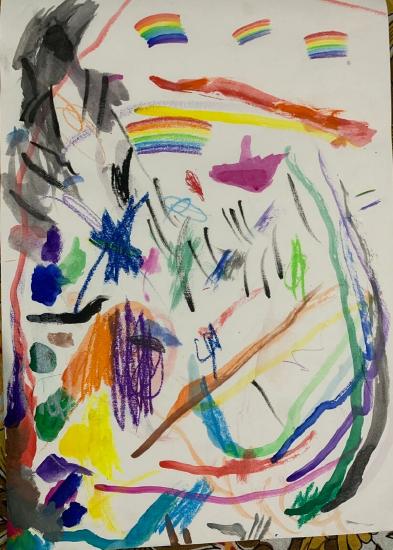
When a child is first introduced to a mark-making tool (Crayon, marker, or paintbrush), they produce random scribbles. The infant or toddler begins with no intention to represent objects. This emerges as an exciting early exploratory mark-making, in which the child is discovering the physical relationship among hand, tool, and surface. Next in the progression comes controlled scribbling, when the child's marks begin to show direction and rhythm, often with many vertical or horizontal lines and loops or swirls. Marks at this stage are more about the joy of movement than meaning, as children repeat gestures to explore variation, pressure, and flow. At the end of this stage comes named scribbling as children begin to name their drawings after they are made or even during the process. During this process, the child engages in an internal dialogue while creating a story that may bear no resemblance to the thing it represents, yet it reflects the child’s emerging capacity to link movement, imagination, and meaning-making.
2. Preschematic Stage (Ages ~4yrs–7yrs)
After many months of enjoyment with scribbling, the first recognizable shapes emerge as children begin to include human figures, often with large heads and simplified limbs, marking an early shift toward symbolic representation. At this stage, art is more symbolic than realistic, as children are not yet focused on proportion or visual accuracy but on meaning and recognition. Nothing is to scale. There is little logic in spatial organization, and objects often appear to float in space, reflecting a world where placement is guided by emotional importance and narrative intent rather than physical realism.
3. Schematic Stage (Ages ~7yrs–9yrs)
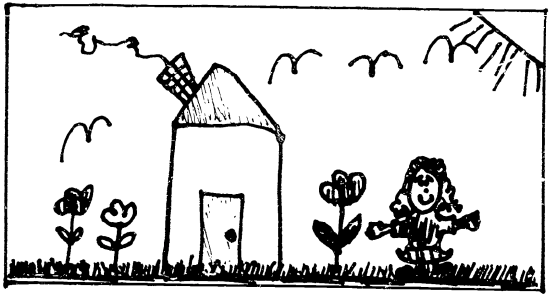
Many adults who may not have understood the preceding stages might find this stage satisfying now that the child is producing images that can be interpreted more easily. It is during this stage that we see the development of a consistent schema as children begin to represent objects such as houses, trees, and people in a stable, repeated way, drawing them in a similar manner across multiple images. The emergence of baseline and skyline marks an important step in spatial organization, as children begin to create a sense of ground and sky to support their visual narratives. At this stage, art reflects the child’s internal logic rather than a realistic perspective, revealing how meaning, order, and structure are constructed from the child’s own understanding of the world rather than external visual accuracy.
4. Dawning Realism / Gang Age (Ages ~9yrs–12yrs)
Increased awareness of proportion, details, and spatial relationships emerges as children begin to attend more closely to how parts of their drawings relate to one another within a whole composition. Children become more self-critical of their art, often comparing their work to others and noticing differences between intention and outcome. Desire for more realism also develops at this stage, which can sometimes lead to discouragement if children feel they “can’t draw,” marking an important emotional shift where confidence and comparison begin to play a larger role in artistic expression.
|
Random Scribble Stage 1yr. 10mos. child |
Controlled scribble 4yr old child |
Named Scribbling 4yrs 5mos child |
|
Pre-schematic stage (Note free floating symbols;not to scale) |
Schematic stage (Note angle of the chimney). |
Dawning Realism (Note side of house and hills) |




How Their Work Is Used Today
Lowenfeld and Brittain’s stage model continues to play an important role in art education curriculum, where it is used by educators to design developmentally appropriate art activities and to assess children’s artwork in context rather than by adult standards of realism or technical skill. In teacher training programs, the theory is often introduced to help educators understand how children’s art reflects cognitive, emotional, and perceptual development, and how these domains are expressed through visual form. Their work also supports a strong advocacy for creativity, grounded in the belief that every child is naturally creative and that pressuring children toward realism too early can limit or hinder authentic self-expression. Overall, Lowenfeld and Brittain helped shift art education toward a more child-centered philosophy, moving the focus away from copying and perfection and toward nurturing imagination, exploration, and emotional expression as central purposes of children’s art-making.
Rhoda Kellogg
Rhoda Kellogg was a psychologist and nursery school teacher who studied over one million children's drawings from around the world, aged 2 to 8. Her observational and comparative research focused on identifying universal patterns in young children’s art. She classified these patterns into stages and forms, believing that children's drawings express an internal need to organize and communicate their experiences, rather than merely imitate the external world.
Kellogg collected artworks from more than 30 countries as part of her large-scale study, aiming to understand early artistic development. She led the Institute of Child Study in San Francisco, where she and her team systematically sorted, categorized, and documented the drawings using her own classification system. Her structured approach organized drawings into scribbles, shapes, and symbols, which she viewed as universal stages of graphic development.

Kellogg’s Key Ideas
Scribbling Is Purposeful
Kellogg demonstrated that what adults often dismiss as "scribbles" are, in fact, the early foundations of artistic and cognitive development. These marks reflect motor control, repetition, and joy in movement, as well as the child's growing awareness of space and form.
Basic "Form Patterns"
She identified 20 basic scribbles (variations on circles, lines, and loops) and 17 "designs" (combinations of these forms) that appear universally. These patterns represent a visual language that children invent naturally, much like babbling in speech development.
Art Reflects Inner Growth
Kellogg believed that children’s drawings reveal inner mental and emotional processes, rather than attempts to copy real-world objects. Her work emphasized developmental self-expression over realistic representation.
Artistic Development Is Universal
By comparing drawings from children worldwide, Kellogg concluded that the progression of artistic forms follows a common developmental path, regardless of culture or environment. This supported her belief in an innate visual language of early childhood. (Kellogg, 1970)
How Her Work Is Used Today
Kellogg’s work (1970) has direct application in the Early Childhood Classroom. Teachers with an eye to the work and insights of Kellogg:
- Value All Stages of Drawing: Teachers can respect and celebrate scribbles and abstract art as meaningful developmental steps, avoiding the pressure to push children into representational drawing too early.
- Provide Open-Ended Materials: Offer crayons, markers, paint, and paper without giving directions. This encourages free exploration of lines, shapes, and forms.
- Observe, Don’t Judge: Educators can observe children’s drawings to better understand their developmental stage and emotional state, using artwork as a window into the child’s thinking and feelings.
- Honor Artistic Voice: By providing space for self-directed drawing, teachers foster creativity, problem-solving, and self-expression—all essential for cognitive and emotional growth.
Brain Development and the Foundations of Creativity
At birth, the human brain contains approximately 100 billion neurons, the raw material for everything we think, feel, and do. But neurons alone are not enough. During the first years of life, children's brains form trillions of synaptic connections through interactions with people, objects, and experiences. This early wiring process is experience-dependent, meaning the brain physically develops in response to the child’s environment and relationships (Center on the Developing Child, 2007).
When children experience moments of curiosity, neurons in their limbic systems, a part of the brain beneath the cortex that processes emotion, begin to fire. This activates a dynamic exchange of neural signals between the brain’s higher-order areas, such as the prefrontal cortex, and the lower, more reactive regions involved in emotion and instinct. Because children’s prefrontal cortices are not yet fully developed, they have limited capacity to regulate impulses. As a result, they may respond to curiosity in ways that seem unpredictable to adults—gleefully splashing water out of a sink, painting a red streak on a sibling’s shirt, or expressing themselves in other unfiltered ways. While such behavior is typical, it’s not universal. When impulsivity does emerge, adults can support healthy brain development by using thoughtful language and expressive facial cues to help strengthen neural connections and guide self-regulation.
Here is an example: In a Transitional Kindergarten classroom exploring life science, children have been engaged in planting and tending a class garden. One day, 4.5-year-old Yanyan discovers a snail slithering along a leaf. Bursting with excitement, she quickly plucks it from the plant and runs toward her teacher, accidentally knocking over little Eliott in the process. “Look, teacher! I have a baby snail to share at circle time!” she exclaims. Her teacher, Ms. Estelle, considers herself a brain-based educator and understands that Yanyan’s curiosity and excitement signal active learning at the neural level, engaging both the lower emotional centers and the higher reasoning areas of the brain. This is a wonderful sign of development. What’s not ideal, however, is removing the snail from its habitat and accidentally knocking over another child in the process. With calm presence, Ms. Estelle kneels beside Yanyan and says gently, “Yanyan, this is exciting! I see that you found this snail in our garden.” While speaking, she softly places an arm around Yanyan’s waist to offer grounding and support for emotional regulation. “Yanyan,” she continues, “when you got excited about the snail, your body bumped into Eliott, and he got hurt. Do you see his face? He looks upset. Let’s check on Eliott first. Then we can talk more about the snail.” Later, during circle time, Ms. Estelle returns to Yanyan’s discovery with an open heart and an open mind. She might ask, “What do you think the snail wants to eat?” or “Where do you think the snail sleeps at night?” These open-ended questions encourage Yanyan to reflect, hypothesize, and build new neural pathways, fostering deeper cognitive development through the joy of curiosity.
This kind of behavior is typical in classrooms with children under the age of seven. The brain’s higher-order centers—responsible for impulse control, empathy, and reflection—take approximately seven years to reach early maturity. Because of this developmental timeline, young children depend on adults who can guide them with patience, empathy, and consistency, without resorting to shame or punishment. When adults respond in this way, they help children build the neural foundations for emotional regulation, social awareness, and lifelong learning. Creative thinking (problem solving, imagination, and flexibility) is shaped by the quality of those early experiences. When young children are given time, space, and encouragement to explore and express themselves, they build brain pathways that support lifelong learning, emotional regulation, and original thinking.
So, how can early childhood teachers create brain-based environments that foster creative minds, both now and for years to come?
Cultivating Creativity in the Classroom:
- Allow for child voice and problem-solving The example above illustrates this.
- Create a rich sensory environment
- Sensory input fuels brain development. Consider the soundscape (gentle music, quiet nooks), visual stimuli (natural light, open-ended displays), and tactile materials (sand, clay, fabric, natural elements) that support exploration. Avoid overstimulating or overly themed decorations that may limit imagination.
- Offer choices and time to reflect
- Children need opportunities to self-select materials and engage in open-ended play. This supports autonomy and encourages divergent thinking. Also allow for mental processing time. Children often revisit ideas days or even weeks later. Avoid rushing them through creative tasks just to complete a product.
- Honor and extend children's original ideas
- When teachers respond with curiosity and encourage children’s unique perspectives, it sends a clear message: Your ideas matter. Rather than steering a child toward a “correct” outcome, ask open-ended questions, document their thinking, and provide materials that support further exploration.
Reflecting Thoughts
For those who take children's creative expression seriously, there is a joy and excitement in watching children's early marks, looping scribbles, symbolic figures, and dawning realism emerge through the open-ended materials we offer them. Artistic developmental theory invites us to shift the question from "Can the child draw well?" to "What is the child discovering through drawing right now?" When we view children's art this way, our role is not to shape or train artists, but to honor the development of thinkers in their earliest form. My hope is that this chapter has inspired in you a reverence for those named and unnamed scribbles, along with a commitment to continue offering children abundant opportunities for mark-making with a wide variety of tools and materials.