

4: Providing Creative Experiences
- Page ID
- 274115

\( \newcommand{\vecs}[1]{\overset { \scriptstyle \rightharpoonup} {\mathbf{#1}} } \)
\( \newcommand{\vecd}[1]{\overset{-\!-\!\rightharpoonup}{\vphantom{a}\smash {#1}}} \)
\( \newcommand{\dsum}{\displaystyle\sum\limits} \)
\( \newcommand{\dint}{\displaystyle\int\limits} \)
\( \newcommand{\dlim}{\displaystyle\lim\limits} \)
\( \newcommand{\id}{\mathrm{id}}\) \( \newcommand{\Span}{\mathrm{span}}\)
( \newcommand{\kernel}{\mathrm{null}\,}\) \( \newcommand{\range}{\mathrm{range}\,}\)
\( \newcommand{\RealPart}{\mathrm{Re}}\) \( \newcommand{\ImaginaryPart}{\mathrm{Im}}\)
\( \newcommand{\Argument}{\mathrm{Arg}}\) \( \newcommand{\norm}[1]{\| #1 \|}\)
\( \newcommand{\inner}[2]{\langle #1, #2 \rangle}\)
\( \newcommand{\Span}{\mathrm{span}}\)
\( \newcommand{\id}{\mathrm{id}}\)
\( \newcommand{\Span}{\mathrm{span}}\)
\( \newcommand{\kernel}{\mathrm{null}\,}\)
\( \newcommand{\range}{\mathrm{range}\,}\)
\( \newcommand{\RealPart}{\mathrm{Re}}\)
\( \newcommand{\ImaginaryPart}{\mathrm{Im}}\)
\( \newcommand{\Argument}{\mathrm{Arg}}\)
\( \newcommand{\norm}[1]{\| #1 \|}\)
\( \newcommand{\inner}[2]{\langle #1, #2 \rangle}\)
\( \newcommand{\Span}{\mathrm{span}}\) \( \newcommand{\AA}{\unicode[.8,0]{x212B}}\)
\( \newcommand{\vectorA}[1]{\vec{#1}} % arrow\)
\( \newcommand{\vectorAt}[1]{\vec{\text{#1}}} % arrow\)
\( \newcommand{\vectorB}[1]{\overset { \scriptstyle \rightharpoonup} {\mathbf{#1}} } \)
\( \newcommand{\vectorC}[1]{\textbf{#1}} \)
\( \newcommand{\vectorD}[1]{\overrightarrow{#1}} \)
\( \newcommand{\vectorDt}[1]{\overrightarrow{\text{#1}}} \)
\( \newcommand{\vectE}[1]{\overset{-\!-\!\rightharpoonup}{\vphantom{a}\smash{\mathbf {#1}}}} \)
\( \newcommand{\vecs}[1]{\overset { \scriptstyle \rightharpoonup} {\mathbf{#1}} } \)
\(\newcommand{\longvect}{\overrightarrow}\)
\( \newcommand{\vecd}[1]{\overset{-\!-\!\rightharpoonup}{\vphantom{a}\smash {#1}}} \)
\(\newcommand{\ket}[1]{\left| #1 \right>}\)
\(\newcommand{\bra}[1]{\left< #1 \right|}\)
\(\newcommand{\braket}[2]{\left< #1 \vphantom{#2} \right| \left. #2 \vphantom{#1} \right>}\)
\(\newcommand{\braopket}[3]{\left< #1 \vphantom{#2}\vphantom{#3} \right| #2 \vphantom{#1}\vphantom{#3} \left| #3 \vphantom{#1}\vphantom{#2} \right>}\)
\(\newcommand{\qmvec}[1]{\mathbf{\vec{#1}}}\)
\(\newcommand{\op}[1]{\hat{\mathbf{#1}}}\)
\(\newcommand{\expect}[1]{\langle #1 \rangle}\)
\(\newcommand{\dfn}[1]{\emph{\textbf{#1}}}\)
Before creating an artistic environment for young children, it is crucial to consider those who have made significant contributions to the field. The three thought leaders in this chapter will help you shape your work for best practices in creativity. There are many voices in the field of creativity who aim to inspire teachers and because of this vastness, we will focus on the three voices below, all of whom speak directly to our work with young children.
Thought Leaders in Early Artistic Development
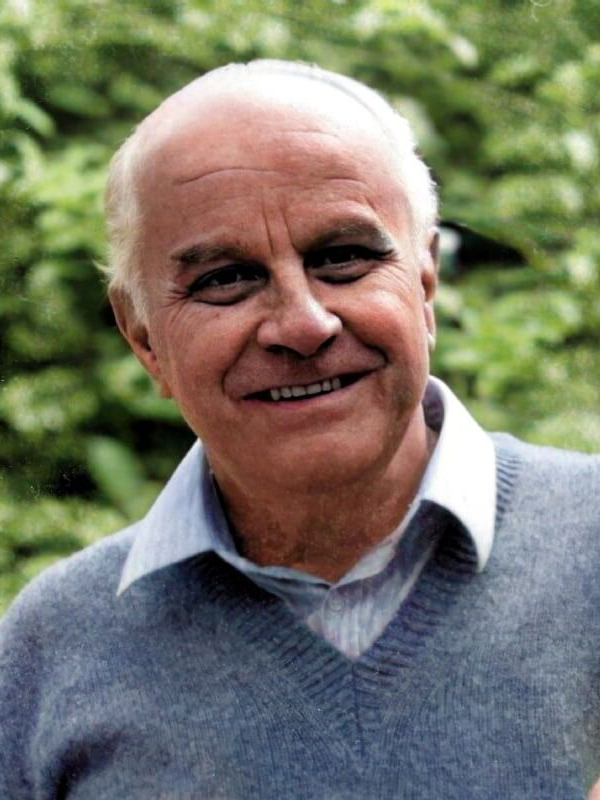
Loris Malaguzzi (1920-1994): The Reggio Emilia Approach Rooted in Respect
A continually emerging contribution to artistic development comes from the work of Loris Malaguzzi, an Italian educator who helped develop the Reggio Emilia approach, an inspiring educational philosophy. After World War II, families in the town of Reggio Emilia, Italy, wanted to build new schools that supported peace, democracy, and the full potential of children. Malaguzzi joined their efforts and worked with teachers to create schools where creativity, self-expression, and collaboration were central to learning. He and his colleagues saw children as strong, capable, and full of ideas, and that artistic materials, namely clay, paint, and drawing, help them explore their thinking in deep and meaningful ways. The Reggio Emilia approach encourages us to see creativity as a way of thinking, communicating, and learning rather than the completion of a craft or activity that has a predetermined outcome. (Edwards, Gandini, & Forman, 2012).
The Reggio Emilia approach is guided by a set of principles that support creativity, exploration, and collaboration. Early education programs around the world, including many in the United States, have been inspired to apply these principles in their classrooms. "Reggio-inspired" schools, as they are typically called, uphold the following values:
- Children are capable and wildly creative thinkers.
Educators in Reggio-inspired settings believe that children are strong, competent individuals with powerful ideas. This belief influences every aspect of teaching, from how intently teachers listen to children to how dynamic materials and learning spaces are prepared (Malaguzzi, 1996). - The environment is seen as the “third teacher.”
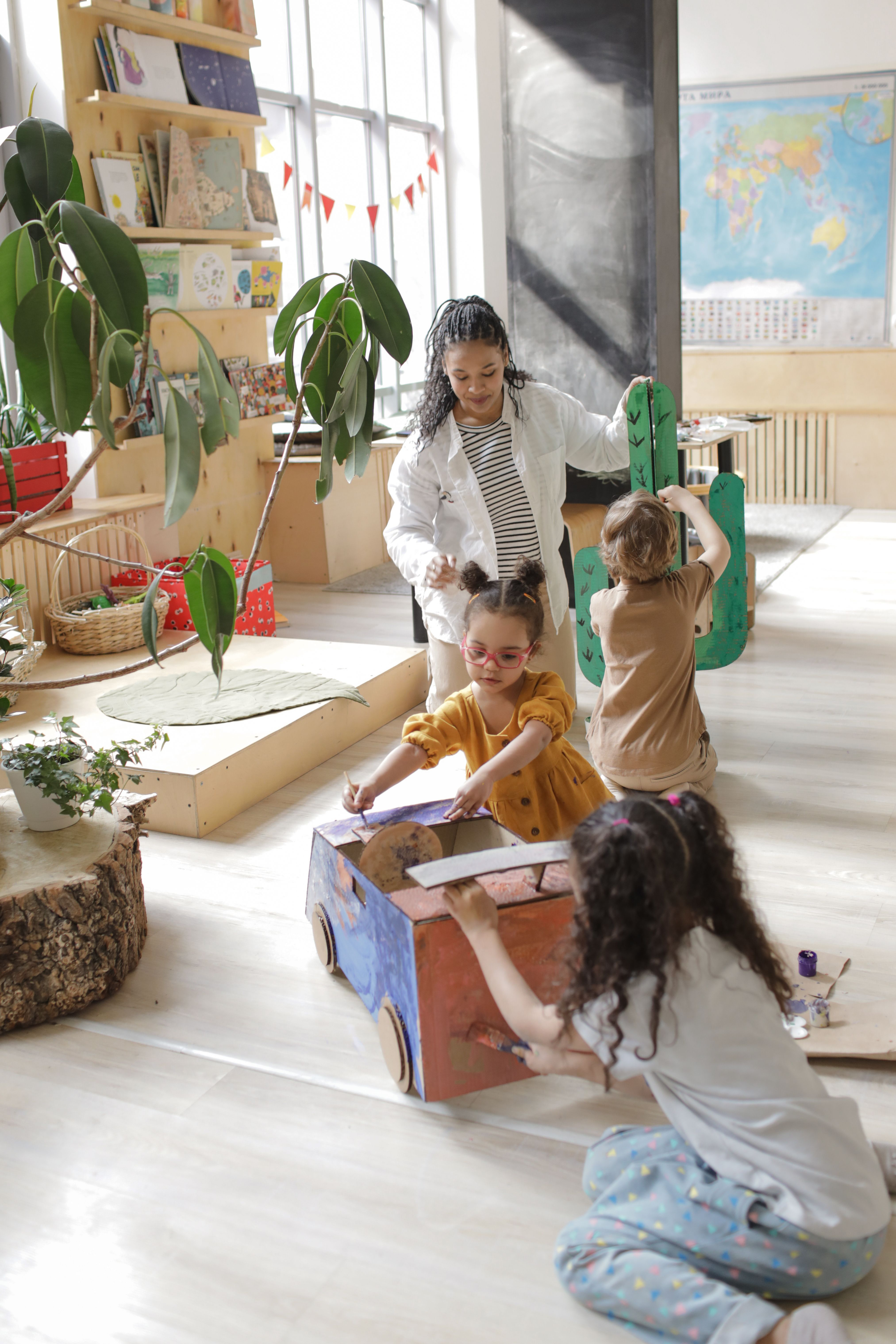
Classrooms are carefully designed to invite exploration and communication. Natural light, living plants, mirrors, and neutral colors help create a calm, focused atmosphere. The goal is not only aesthetic beauty but also to support relationships and discovery. A well-designed environment encourages children to collaborate, problem-solve, and express themselves (Gandini, 2012). The environment's aesthetics is also of interest to educators in Reggio Emilia Schools. If you ever find yourself in one you will note it's well-lit and nature based elements such as large windows and live plants with furniture that does not compete for attention with all the activity of the space, rather the furnishings and walls take on a muted or neutral tone and the color comes from the children themselves as well as their work and the live plants often found in these spaces. - The teacher is the “second teacher” and the child the "first teacher".
In Reggio Emilia classrooms, a term used to highlight the educator’s role as a co-learner and co-researcher is "second teacher". This teacher listens closely, observes and documents children’s thinking, and helps extend their ideas through dialogue and further documentation rather than delivering fixed or disconnected lessons like you might see in a published "curriculum guide". - Families are active participants in the learning process.
Parents are seen as partners in education. Communication is open and ongoing, and families are invited to contribute to curriculum decisions and classroom life. This value creates a sense of community and shared responsibility for the child’s development (Edwards et al., 2012). - Art and creativity are central to learning.
Reggio Emilia programs typically include an atelier (art studio) and an atelierista (a trained art specialist) who collaborates with teachers and children. The atelier provides a dedicated space for children to explore a wide range of materials and media. Projects often unfold over days or weeks, encouraging deep thinking, thougtful elaboration and multiple forms of expression. Malaguzzi referred to this as “the hundred languages of children” — a belief that children express themselves in many different ways, including drawing, movement, sculpture, and storytelling (Malaguzzi, 1996).
Can your classroom become "Reggio-Inspired"?
- Do you see children as capable and creative? What is one change you can make so that your classroom reflects that and, in doing so, subsequently engages learners in more robust ways?
- Is your classroom filled with an aesthetic beauty with natural light flowing in, plants, mirrors and, neutral colors. Not all schools are built for this kind of aesthetic. (Some teachers find an alternative to large open windows by bringing in soft lamp lighting. How does the aesthetic support discovery and relationships?
- How is children’s thinking documented to extend their ideas and build the curriculum?
- Do parents enjoy a partnership in your classroom with ongoing communication and invitations for their contributions (some may be great in the classroom, and others may opt t build or sew for the classroom. Do parents feel like a vital part of what goes on in your room?
Tara Govender: How culture affects artistic development
Tara Govender is an educator and researcher who highlights the vital role that culture and social context play in children's artistic expression. Her work encourages teachers to move beyond traditional ideas of artistic “development” and recognize that what children create is often shaped by their families, communities, and cultural stories. Govender reminds us that children’s art reflects their lived experience. For example, a child who sees henna patterns at family celebrations might draw spirals and symbols that carry meaning in their home life. Another child might use bold colors or create images inspired by stories passed down through oral tradition. These expressions are valid and meaningful, even if they don’t follow a typical developmental sequence seen in Western art education. In early childhood settings, teachers need to create inclusive spaces that honor this diversity of artistic voice. This means offering materials, books, visuals, and conversations that reflect a wide range of cultures and ways of making art, and avoiding the idea that one way of drawing or representing is “better” or more advanced than another.
How can teachers recognize and support the cultural identities children bring into their artwork? Think about your own cultural background and experiences with art growing up. How might those influence the way you interpret children’s artwork today? What steps can teachers take to make sure all children's creative expressions are honored and understood?
Govender’s work supports the idea that cultural identity and artistic development are deeply connected, and that educators have a responsibility to make room for every child’s story to be seen and heard through art.
Explore & celebrate cultural influences in children's art.
- Using a wide range of collage materials that reflect diverse cultures (patterned papers, magazines, photos of textile designs, symbols, cultural art pieces, natural materials, etc.)
- Create a collage inspired by your own culture or one you would like to learn more about.
- As you work, reflect on how these materials and images tell a story.
- Present your collage to friends of family telling them:
- What inspired your choices
- How you think children might respond to the materials
- How an activity like this can promote a feeling of inclusion for children in group settings
Christine Marmé Thompson: Children's visual storytelling
I have heard many of my students worry about what to say when a child has produced a work of art. If simple praise or asking "what is it?" is frowned upon, what should the caring teacher say?
Christine Marmé Thompson’s work on children’s visual storytelling gives us a deeper understanding of children’s meaning-making through visual languages. Her research positions young children as active narrators (not passive scribblers) who use visual forms to explore and communicate meaning. Thompson challenges traditional developmental checklists and instead emphasizes the relational, imaginative, and narrative aspects of children's art making. Thompson urges educators to view children's art as a form of storytelling, not just as a stage in their developing realism. Children's visual storytelling is symbolic and deeply personal. According to Thompson, children draw to explore, explain, and connect with their world.
Drawings as Narratives, Not Simply Representations
“Children’s images do not arise merely as representations of what they see, but as responses to what they know and imagine.” — Thompson.
The Importance of Dialogue: Art as Conversation
Drawing is not always a solitary experience. Thompson emphasizes the social and conversational nature of art making. Children’s art becomes more meaningful when they engage in conversation with peers, adults, and materials. Below is an example of the visual storytelling Thompson's invites:
Instead of the teacher focusing primarily on identifying the subject ("It's a whirlpool?"), the conversation can begin with careful observations of the visual elements and then invite the child to reveal the narrative that already exists within the artwork.
For example:
Adult: I notice you've made lots of sweeping blue lines that move across the page. Some are thick, some are thin, and they all seem to swirl toward this large circle. You also added these small red shapes around the outside.
Child: They're boats!
Adult: The way you've arranged them makes me wonder if something is happening. Can you tell me the story your picture is telling?
Child: The boats are trying to get away because the water is spinning really fast.
Adult: What made the water start spinning?
Child: A giant sea dragon went under the ocean and made a whirlpool.
Adult I hadn't thought about a sea dragon. What happens to the boats next?
Child: One gets stuck, but the others throw it a rope. Then everybody escapes before the dragon comes back.
Adult It sounds like your picture tells a whole adventure. I can see how the swirling lines help show all the movement in your story.
This interaction reflects that the adult values the child and their work. Instead of applying praise or judgment, "That's beautiful", the adult begins by noticing the artwork's visual language, such as line, color, shape, composition, and movement, rather than trying to identify what the picture represents. Instead of asking, "What is it?" the teacher assumes that the artwork already contains a meaningful narrative and invites the child to share it. The child's story unfolds naturally, revealing that the drawing is not simply a representation of objects but a vehicle for imagination, memory, and meaning-making. In this way, the artwork becomes a visual narrative, illustrating the belief that children are active storytellers who use art to explore, construct, and communicate their understanding of the world.
Multiple Modes of Expression (100 Languages)
In line with Malaguzzi, Thompson supports the idea that drawing is one of many languages children use. She expands this idea to highlight that visual storytelling includes gesture, voice, sequence, texture, material choice, and movement. and symbolic integration (Example to follow)
Althea’s Monster Story: 4½-year-old Althea is drawing at an easel. She’s using mixed media: crayons, collage scraps, and paint. A teacher sits nearby, observing and occasionally asking open-ended questions. Let’s take a look at Althea’s Process:
Gesture & Movement
As Althea draws sharp zigzags for monster teeth, her hand movements become fast and jagged. She stomps a little and widens her eyes, mimicking the monster's energy. “These teeth are going CHOMP CHOMP!” she exclaims, moving her arms like jaws.
Voice
She narrates the story as she draws: “The monster is hiding in the dark cave… but it’s not scary. He’s just lonely.” Her voice softens during the lonely part and gets louder and more dramatic during the chase.
Visual Sequence
She moves to another page and continues the drawing, adding a “next scene” with a girl giving the monster a cookie. “Now he’s happy and not chasing anymore.”
She’s not just making random pictures—she’s building a visual sequence of events, like panels in a comic.
Texture & Material Choice
She glues cotton balls around the monster to create a “fluffy fog in the cave,” choosing materials that reflect the atmosphere and emotion. The texture helps set the scene, not just decorate it
Symbolic Integration
The colors and shapes she uses are symbolic: Red for the monster’s anger; Blue swirls for calming friendship
She later adds a tiny heart above the girl’s head.
Althea isn’t just “drawing a monster.” She’s using a blend of expressive modes to:
- Tell a multi-part story
- Externalize emotion through movement and voice
- Use materials meaningfully to support atmosphere and narrative
- Shift from fear to empathy in her story arc
Practical Applications
Teachers should provide a variety of materials such as collage, markers, paint, and digital tools. They should allocate plenty of time and space for children to express themselves through art. They should also create opportunities for children to share and discuss their artwork, like peer storytelling circles, portfolios, and documentation walls. Listening to and interpreting children’s visual stories encourages a responsive curriculum focused on the child's interests.
If you only looked at the final drawing, what would you miss?
Cultural Contexts and Individuality
Like Govender, Thompson underscores how children’s storytelling is shaped by culture, experience, and identity. Culturally responsive practices are paramount to her approach. Example to follow below:
Thompson’s emphasis on cultural contexts and individuality is a powerful and essential thread in her work. She insists that children’s artistic storytelling cannot be separated from their lived experiences, cultural backgrounds, and personal identities. She urges educators to listen for the meaning behind the marks and to recognize how stories are shaped by the world the child inhabits.
Amir’s Family Feast: Five-year-old Amir is part of a diverse, urban class and is invited to "draw a favorite memory with your family."Amir draws a large table filled with platters of rice, oranges, flatbread, and chicken. Around the table in his drawing are several small figures. He carefully adds a moon in the top corner and dots in the sky. When the teacher suggests, “Tell me about your drawing,” Amir replies: “This is after the last Ramadan day. We stay up late and eat and eat. Gramma makes the chicken. We all sit together, and even my baby cousin eats with his fingers. The moon is full, see? That means it’s Eid.”He adds small details like sparkling dots to show decorations and family members with different skin tones, saying, “That’s my uncle from Sudan—he comes to our feast, too.”
Analysis Through Thompson’s Lens
- Culture: The drawing reflects a specific cultural celebration—Eid al-Fitr—and shows how Amir connects food, ritual, and family through his art.
- Experience: Amir draws what matters to him—the tactile experience of food, the social gathering, and the emotional joy of celebration.
- Identity: He identifies who belongs (even babies and distant relatives), affirming his sense of family, belonging, and heritage.
- Narrative and Symbol: The moon isn’t just decoration—it’s a religious and cultural symbol, full of meaning in Amir’s world.
- Therefore, culturally responsive teaching means:
- Valuing children's lived experiences as valid and worthy of artistic exploration.
- Inviting open-ended prompts that let culture and individuality shine.
- Listening and documenting the child's story, not just evaluating the drawing’s quality.
“The image, even in its simplest form, must be considered in relation to the child’s world, and in the presence of that child’s voice.” (Thompson, 2006)
What assumptions might we make if we only look at Amir’s drawing without hearing his story? What shifts when we understand the cultural context? Next time you find yourself in a creative environment with children, unobtrusively observe a child as they draw, and then, if the opportunity arises for discussion, ask the child to tell the story behind their drawing. Reflect on which parts of the drawing were narrative, decorative, or symbolic.
Major Contributions of Thought Leaders
Thought Leader |
Core View of Child |
View of Art/Visual Expression |
Role of the Adult |
Cultural / Social Emphasis |
|---|---|---|---|---|
|
Loris Malaguzzi |
The child is competent, full of potential, and an active co-constructor of knowledge |
One of the “100 languages”; art is a thinking tool, not just a product |
Listen, observe, document; co-construct meaning with children |
Socially and culturally embedded; children express experiences from their world |
|
Tara Govender |
The child has a sense of agency rooted in culture, shaped by a unique identity |
Art is a reflection of cultural narratives and family life, and validates the funds of knowledge children bring |
Build bridges between school and home; affirm cultural identity |
Emphasizes diversity, inclusion, and anti-bias education through creative expression |
|
Christine Marmé Thompson |
The child is a storyteller, sense-maker, and expressive narrator using visual language |
Art is narrative and exploratory; drawing is a dialogue with ideas, materials, and others |
Create space for dialogue and storytelling through art; interpret meaning, not just assess skills |
Recognizes the individual and social dimensions of visual storytelling |
All three of these thought leaders prompt us to think beyond “Is it a good drawing?” and instead reflect thoughtfully: “What is the child expressing, imagining, or exploring through this image?”
Developmentally Appropriate Practice (DAP)
Now that you have a solid foundation of theory and practical ideas, it's time to begin learning how to create developmentally appropriate experiences for young children that foster their creative development.
DAP encourages children to explore and play in ways that match their current developmental stage. While understanding what is age-appropriate is vitally important (and will be discussed shortly), DAP also includes two other key components:
1. Individually Appropriate Experiences
A teacher who uses DAP takes into account the unique needs, preferences, and temperaments of each child, not just their age. For example, consider 5-year-old Sadie. While most children in her classroom enjoy sensory play—such as running their hands through a bin of birdseed or exploring a cornstarch-and-water mixture (commonly known as “oobleck”)—Sadie reacts with caution and avoids touching these materials. She may be experiencing strong sensory sensitivity. Does this mean Sadie should be protected from all sensory experiences? Not necessarily. A developmentally appropriate response involves noticing her hesitation and responding with sensitivity and flexibility. A thoughtful teacher might offer Sadie a pair of gloves or invite her to watch first and join in later, when she feels more comfortable. The goal is not to force participation, but to gently support her engagement by meeting her where she is.
By tuning in to each child's individual responses and needs, teachers can adjust the classroom environment to support inclusive, meaningful participation for every learner. This approach fosters trust, autonomy, and a sense of belonging—core elements in healthy early development.
2. Culturally Appropriate Practice
Just as teachers use a child-centered approach when applying DAP, they must also consider each child’s cultural background. Minh, for example, has been encouraged by her father to “be good at school” and to “listen to her teachers.” At home, Minh is expressive and creative, but at school, she appears quiet and reserved. This concerns her teacher, who notices that Minh doesn’t participate in large group activities where children are invited to share their feelings through movement and play. Although Minh smiles and seems happy with her peers, she remains silent during these moments. One day, the teacher shared her concerns with Minh’s father, explaining that she thought Minh might be struggling to adjust to school because she often “shuts down” during group time. Minh’s father looked surprised, and even a bit amused. He explained that Minh had been taught that respectful behavior in school means staying quiet and following the teacher’s lead.
This conversation helped the teacher see that Minh’s behavior wasn’t a sign of struggle, it was a reflection of her cultural values. Understanding this allowed the teacher to respond with greater sensitivity and support.
After reading Minh's story, discuss the following questions with a partner or small group:
- What assumptions did the teacher make about Minh's behavior?
- How did speaking with Minh's father change the teacher's understanding?
- What might have happened if the teacher had never learned about Minh's family's cultural expectations?
- Have you ever seen a child's behavior misunderstood because of cultural differences? Share an example if you feel comfortable.
Then, consider a classroom scenario in which a child's behavior is influenced by family or cultural values (such as avoiding eye contact, preferring to work independently, or participating differently during group activities).
Discuss:
- How might the behavior be misinterpreted?
- What questions could a teacher ask before making assumptions?
- What culturally responsive strategies could help support the child?
Reflection: How has your own cultural background shaped your expectations of children's behavior? What assumptions will you be mindful of as you work toward becoming a culturally responsive educator?
Optional: Include your written reflection in your professional teaching portfolio.
DAP, as a general term, refers to having a comprehensive understanding of typical child development across multiple developmental domains:
- Social: How the child learns to cooperate, contribute, and belong in society
- Emotional: The innate nature and disposition of the child, as well as their learned emotional coping skills
- Cognitive: The way the child relies on thought to manage their world; problem-solving, risk-taking, and more
- Language: The stages of linguistic development and early literacy growth
- Physical: The development of both large and small muscle groups and their coordination. Materials like clothespins and tongs and work with clay support wrist stability and intrinsic hand muscles.
- And in some cases, Spiritual: The child’s willingness to accept the unseen and find depth of meaning through a spiritual connection.
Teachers must be skilled at anticipating what is typical for the age group of the children they serve. This is why it is crucial to study child development closely. Through stories and vignettes, I will attempt to illuminate some of the expected behaviors, abilities, and tendencies of young children within these domains. However, it is essential to remember that children are not made from a cookie cutter. You must always be aware of the cultural and individual differences that influence the child’s expression.
What are Children Capable of?
Creativity includes more than paint and paper. Children explore, express themselves, and interact with the world through various forms of art. Below are a few things young children can be expected to do between ages 3 and 6. (California Department of Education, 2025)
|
Art Domain |
Typical Abilities |
Examples |
|
Visual Art |
1.0 Notice, Respond, and Engage |
Notices a friend painting with bright colors and says, “I like red too!”- Points to a picture and says, “That looks like a rainbow!”- Watches a teacher draw and tries to copy the motion. |
|
2.0 Develop Skills in Visual Art |
- Uses crayons to draw circles and lines.- Glues pieces of paper in a collage.- Begins to use scissors with one hand to cut shapes. |
|
|
3.0 Create, Invent, and Express |
- Draws a family using favorite colors.- Paints a picture of a favorite place.- Makes a sculpture out of clay “because it’s a dinosaur cave.” |
|
|
Music |
1.0 Notice, Respond, and Engage |
- Claps along with a song’s beat.- Smiles when a favorite song begins.- Hums part of a familiar melody. |
|
2.0 Develop Skills in Music |
- Uses rhythm sticks to tap steady beats.- Explores loud and soft sounds with instruments.- Sings simple phrases from familiar songs. |
|
|
3.0 Create, Invent, and Express |
- Makes up a song about snack time.- Changes the words of a familiar tune to make it silly.- Sings made-up lyrics while drawing. |
|
|
Drama (Theatre) |
1.0 Notice, Respond, and Engage |
- Laughs and follows along in a pretend play game.- Watches peers act out a story.- Imitates facial expressions during storytelling. |
|
2.0 Develop Skills in Drama |
- Uses voice to pretend to be a fire truck.- Uses a scarf as a cape in dramatic play.- Acts surprised or scared in response to story events. |
|
|
3.0 Create, Invent, and Express |
- Pretends to be a chef in a restaurant.- Acts out a story with classmates using props.- Makes up a story about a superhero puppy. |
|
|
Dance |
1.0 Notice, Respond, and Engage |
- Watches others dance and begins to join in.- Moves arms or body to the music.- Reacts with excitement to changes in tempo. |
|
2.0 Develop Skills in Dance |
- Balances on one foot.- Moves fast or slow based on the music.- Spins or jumps in time with the beat. |
|
|
3.0 Create, Invent, and Express |
- Creates a dance to show how rain feels.- Pretends to move like different animals.- Expresses happiness by twirling with arms wide. |
As teachers, our role is to draw on all three forms of Developmentally Appropriate Practice (DAP) to understand the interests and capabilities of the children we serve and to design learning experiences that meaningfully align with those interests and capabilities.
The Basics: Tools, Spaces, Media, and Safety
When setting up a creative environment, give careful thought to the types of tools, the allocation of space, and the media children may access. The following is a list of very basic materials children should have access to, including a variety of mark-making tools and materials for art-making daily. Art is not just for special occasions.
Paintbrushes of different widths, some suitable for delicate watercolor work and wider ones for large strokes, on a painting easel or for a group mural project. Some teachers, informed by the principles of occupational therapy—which aims to promote “digital grasp,” finger isolation, and wrist movement—follow a stage-like progression in the use of a paintbrush. They provide thicker brushes for children new to artistic activities and transition to thinner brushes as they develop their fine motor skills.
Crayons and markers of various shapes. Karen Cox, a teacher of 4–5-year-olds for over 20 years, says: “Occupational therapists recommend using thin crayons broken in half or triangular crayons for children aged 4-5 to improve fine motor skills and development.” Broken or short crayons (about 1” long) help children develop a proper tripod grip (thumb to index and middle finger). They encourage correct finger positioning and build hand strength. (Therapy & Wellness Connection, n.d.) Cox explains: “I saw many fellow teachers use the thickest paintbrushes, but their students never progressed as far as developing beyond painting blobs of color on paper throughout the school year.” (K. Cox, prekinders.com, personal communication, May 27, 2025)
At least one standing easel in the classroom—especially near a sink and the art shelf—encourages children to experiment freely with a variety of materials. Having the easel positioned close to water and supplies makes it easy for children to add paint, glue, or other textures to their work as they build and revise their ideas. This setup not only supports artistic creativity but also contributes to physical development. Research shows that working on vertical surfaces, such as easels, engages children’s bodies in different ways than working on flat tables. For example, Portnoy et al. (2015) and Flatters et al. (2014) found that vertical tasks increase postural demands and activate different muscles, helping children develop shoulder stability, wrist control, and coordination. These are all foundational skills that support handwriting and other fine motor tasks. By offering a vertical workspace, educators give children opportunities to strengthen their bodies while expressing themselves creatively.
Vertical and angled surfaces, such as easels and slanted boards, do much more than support art-making—they also support the domains of physical and cognitive development. Barbara A. Smith (2025) emphasizes that working on vertical surfaces develops foundational skills closely linked to handwriting readiness, fine motor control, and spatial awareness. For example, when children stand at an easel, they’re naturally encouraged to maintain an upright posture, use larger arm movements, and engage muscles in their core, shoulders, wrists, and hands. These kinds of “anti-gravity” movements help build strength and stability. In addition, vertical work promotes wrist extension, which is key for proper pencil grasp, and it helps children coordinate both sides of their body as they stabilize paper with one hand and work with the other. Finally, it reinforces concepts like direction, space, and position—skills that support both writing and early math understanding. Offering children opportunities to work vertically supports the whole child: body, brain, and creativity.
A “Help-Yourself Shelf” encourages independence, choice, and creativity in young children. This easily accessible shelf can be stocked with open-ended materials such as paper, scissors, glue, collage items, and extra paint—perfect for moments when a child decides they need “something different” to bring their ideas to life. Using recycled and repurposed materials (like fabric scraps, bottle caps, or cardboard pieces) not only keeps the shelf exciting but also models environmental responsibility, sending a powerful message that creativity and sustainability can go hand in hand. When children know they have the freedom to gather what they need, they’re more likely to take initiative, explore materials more deeply, and express their unique ideas with confidence. This setup fosters both artistic expression and important life skills, such as problem-solving, self-regulation, and care for the planet.
Even in the smallest of spaces, room for creative expression is possible. I have worked in rooms that boasted 950 square feet as well as those with a miserly 300 square feet, and each provided experiences that support DAP.
The Freedom-of-Childhood Approach
Childhood is a unique and fleeting stage in the human lifespan. It is a period rich with curiosity, imagination, and a natural drive to learn. These qualities that often fade as children learn of the high-stakes nature of education and more adult-like responsibilities take over. Childhood can feel like a thing of the past at times. Honoring creativity during childhood and beyond respects the wonder and magic of early life and supports joyful, meaningful learning. In his seminal work, The Hurried Child, first published in the 1980s, David Elkind (2007) cautioned against the increasing pressure placed on children to grow up too quickly. He described a societal shift toward emphasizing early academic achievement and performance at the expense of developmental readiness and individual interest.
When children are expected to perform tasks for which they are not developmentally prepared or emotionally invested, they receive a troubling message: who they are right now—as curious, playful, expressive young learners—is not enough. Instead, they are rewarded only for demonstrating skills or behaviors beyond their natural stage. This pressure not only undermines their intrinsic motivation but can also lead to long-term consequences such as anxiety, burnout, and disengagement from learning. As Elkind (2007) writes, “When we pressure children to grow up too fast, we rob them of the very experiences that prepare them for the future.”
A freedom-of-childhood approach centers the child’s current needs and interests, trusting that authentic growth emerges best through play, creativity, and exploration.
Fear of mess
Childhood is often delightfully messy. In the process of exploring, creating, and testing their ideas, young children may not always achieve tidy or precise results. A few stains on their clothes and some tousled hair might be what a parent notices at pickup time. But excellent teachers who embrace the Freedom of Childhood approach understand that these outward signs of mess are also evidence of deep engagement and learning. These educators take care to communicate their philosophy with families long before the school year begins. Parents and caregivers need to know that in a high-quality early childhood classroom, there will be messes, but there will also be meaningful learning.
Trusting the child’s mind
Another key trait of an excellent teacher who values childhood is their deep trust in the child’s mind. These teachers understand that not every child needs constant direction in the learning environment. What children often need more of is the message that they are capable thinkers and initiators of their own ideas. Trusting the child means creating a space where independence, curiosity, and choice are not only allowed but celebrated. Teachers support this by designing rich, creative environments full of possibilities and by engaging in conversations that include the child’s voice. In these classrooms, you might hear teachers say, “What’s your plan for this morning?” or “I wonder how you can keep your paint from dripping?” Open-ended prompts invite reflection, problem-solving, and agency. When teachers step back and listen, they make room for children to step forward and lead.
Closing Reflection
Each thought leader you’ve just read about encourages teachers to slow down, listen carefully, and most importantly, trust in children's 100 languages of expression. Malaguzzi emphasizes that creativity is a vital way of thinking and engaging with children. Govender urges us to reconsider what we might hastily label as DAP, instead recognizing the culture embedded in children's marks and symbols. Thompson draws our focus to the narrative element of children’s artwork, where drawing, conversation, imagination, and meaning unfold together in real time. Now, it’s your turn as an emerging thought leader in this field to develop your own ideas about the purpose and process of creativity! Good luck!