

Social Sci LibreTexts

8.4: Belonging

  • Page ID
    269395
  • \( \newcommand{\vecs}[1]{\overset { \scriptstyle \rightharpoonup} {\mathbf{#1}} } \)

    \( \newcommand{\vecd}[1]{\overset{-\!-\!\rightharpoonup}{\vphantom{a}\smash {#1}}} \)

    \( \newcommand{\dsum}{\displaystyle\sum\limits} \)

    \( \newcommand{\dint}{\displaystyle\int\limits} \)

    \( \newcommand{\dlim}{\displaystyle\lim\limits} \)

    \( \newcommand{\id}{\mathrm{id}}\) \( \newcommand{\Span}{\mathrm{span}}\)

    ( \newcommand{\kernel}{\mathrm{null}\,}\) \( \newcommand{\range}{\mathrm{range}\,}\)

    \( \newcommand{\RealPart}{\mathrm{Re}}\) \( \newcommand{\ImaginaryPart}{\mathrm{Im}}\)

    \( \newcommand{\Argument}{\mathrm{Arg}}\) \( \newcommand{\norm}[1]{\| #1 \|}\)

    \( \newcommand{\inner}[2]{\langle #1, #2 \rangle}\)

    \( \newcommand{\Span}{\mathrm{span}}\)

    \( \newcommand{\id}{\mathrm{id}}\)

    \( \newcommand{\Span}{\mathrm{span}}\)

    \( \newcommand{\kernel}{\mathrm{null}\,}\)

    \( \newcommand{\range}{\mathrm{range}\,}\)

    \( \newcommand{\RealPart}{\mathrm{Re}}\)

    \( \newcommand{\ImaginaryPart}{\mathrm{Im}}\)

    \( \newcommand{\Argument}{\mathrm{Arg}}\)

    \( \newcommand{\norm}[1]{\| #1 \|}\)

    \( \newcommand{\inner}[2]{\langle #1, #2 \rangle}\)

    \( \newcommand{\Span}{\mathrm{span}}\) \( \newcommand{\AA}{\unicode[.8,0]{x212B}}\)

    \( \newcommand{\vectorA}[1]{\vec{#1}}      % arrow\)

    \( \newcommand{\vectorAt}[1]{\vec{\text{#1}}}      % arrow\)

    \( \newcommand{\vectorB}[1]{\overset { \scriptstyle \rightharpoonup} {\mathbf{#1}} } \)

    \( \newcommand{\vectorC}[1]{\textbf{#1}} \)

    \( \newcommand{\vectorD}[1]{\overrightarrow{#1}} \)

    \( \newcommand{\vectorDt}[1]{\overrightarrow{\text{#1}}} \)

    \( \newcommand{\vectE}[1]{\overset{-\!-\!\rightharpoonup}{\vphantom{a}\smash{\mathbf {#1}}}} \)

    \( \newcommand{\vecs}[1]{\overset { \scriptstyle \rightharpoonup} {\mathbf{#1}} } \)

    \( \newcommand{\vecd}[1]{\overset{-\!-\!\rightharpoonup}{\vphantom{a}\smash {#1}}} \)

    \(\newcommand{\avec}{\mathbf a}\) \(\newcommand{\bvec}{\mathbf b}\) \(\newcommand{\cvec}{\mathbf c}\) \(\newcommand{\dvec}{\mathbf d}\) \(\newcommand{\dtil}{\widetilde{\mathbf d}}\) \(\newcommand{\evec}{\mathbf e}\) \(\newcommand{\fvec}{\mathbf f}\) \(\newcommand{\nvec}{\mathbf n}\) \(\newcommand{\pvec}{\mathbf p}\) \(\newcommand{\qvec}{\mathbf q}\) \(\newcommand{\svec}{\mathbf s}\) \(\newcommand{\tvec}{\mathbf t}\) \(\newcommand{\uvec}{\mathbf u}\) \(\newcommand{\vvec}{\mathbf v}\) \(\newcommand{\wvec}{\mathbf w}\) \(\newcommand{\xvec}{\mathbf x}\) \(\newcommand{\yvec}{\mathbf y}\) \(\newcommand{\zvec}{\mathbf z}\) \(\newcommand{\rvec}{\mathbf r}\) \(\newcommand{\mvec}{\mathbf m}\) \(\newcommand{\zerovec}{\mathbf 0}\) \(\newcommand{\onevec}{\mathbf 1}\) \(\newcommand{\real}{\mathbb R}\) \(\newcommand{\twovec}[2]{\left[\begin{array}{r}#1 \\ #2 \end{array}\right]}\) \(\newcommand{\ctwovec}[2]{\left[\begin{array}{c}#1 \\ #2 \end{array}\right]}\) \(\newcommand{\threevec}[3]{\left[\begin{array}{r}#1 \\ #2 \\ #3 \end{array}\right]}\) \(\newcommand{\cthreevec}[3]{\left[\begin{array}{c}#1 \\ #2 \\ #3 \end{array}\right]}\) \(\newcommand{\fourvec}[4]{\left[\begin{array}{r}#1 \\ #2 \\ #3 \\ #4 \end{array}\right]}\) \(\newcommand{\cfourvec}[4]{\left[\begin{array}{c}#1 \\ #2 \\ #3 \\ #4 \end{array}\right]}\) \(\newcommand{\fivevec}[5]{\left[\begin{array}{r}#1 \\ #2 \\ #3 \\ #4 \\ #5 \\ \end{array}\right]}\) \(\newcommand{\cfivevec}[5]{\left[\begin{array}{c}#1 \\ #2 \\ #3 \\ #4 \\ #5 \\ \end{array}\right]}\) \(\newcommand{\mattwo}[4]{\left[\begin{array}{rr}#1 \amp #2 \\ #3 \amp #4 \\ \end{array}\right]}\) \(\newcommand{\laspan}[1]{\text{Span}\{#1\}}\) \(\newcommand{\bcal}{\cal B}\) \(\newcommand{\ccal}{\cal C}\) \(\newcommand{\scal}{\cal S}\) \(\newcommand{\wcal}{\cal W}\) \(\newcommand{\ecal}{\cal E}\) \(\newcommand{\coords}[2]{\left\{#1\right\}_{#2}}\) \(\newcommand{\gray}[1]{\color{gray}{#1}}\) \(\newcommand{\lgray}[1]{\color{lightgray}{#1}}\) \(\newcommand{\rank}{\operatorname{rank}}\) \(\newcommand{\row}{\text{Row}}\) \(\newcommand{\col}{\text{Col}}\) \(\renewcommand{\row}{\text{Row}}\) \(\newcommand{\nul}{\text{Nul}}\) \(\newcommand{\var}{\text{Var}}\) \(\newcommand{\corr}{\text{corr}}\) \(\newcommand{\len}[1]{\left|#1\right|}\) \(\newcommand{\bbar}{\overline{\bvec}}\) \(\newcommand{\bhat}{\widehat{\bvec}}\) \(\newcommand{\bperp}{\bvec^\perp}\) \(\newcommand{\xhat}{\widehat{\xvec}}\) \(\newcommand{\vhat}{\widehat{\vvec}}\) \(\newcommand{\uhat}{\widehat{\uvec}}\) \(\newcommand{\what}{\widehat{\wvec}}\) \(\newcommand{\Sighat}{\widehat{\Sigma}}\) \(\newcommand{\lt}{<}\) \(\newcommand{\gt}{>}\) \(\newcommand{\amp}{&}\) \(\definecolor{fillinmathshade}{gray}{0.9}\)
    Learning Objectives
    • Understand identity development
    • Explore empathy in the context of intercultural communication

    At this point, you are probably aware of the cultural groups to which you belong (i.e., “I am a Latino, middle-class, (almost) college-educated male”). Do you remember the process of coming to awareness of your cultural identity—when did you know you were white and what that meant? Was it during childhood, as a teenager, or reading this chapter? Has your understanding, or acceptance, of your racial heritage changed during the course of your lifetime? For most people it does. Just as Piaget organized the growth of children according to various stages of development, cultural scholars have similarly organized racial awareness along models and stages. Before explaining the various models, let us make a couple general comments about models. One, a model is not the thing it represents. Is the model car you played with as a child the same as the actual automobile? What were the differences? Size, time, maneuverability, details? These same kinds of differences exist between the model of racial identity development and the actual personal process. But just like the car model gives a fairly accurate picture of the actual automobile so do the racial identity models. Two, these models are general and not meant to fit perfectly to every individual’s experience. With that said, let us examine the process of coming to an understanding of our racial identity.

    To better understand this complex process, and in recognition of the above discussion regarding the distinctions in experiences for various cultural groups, we will present four racial identity models—-Minority, Majority, Bi-racial, and Global Nomads.

    Minority Identity Development

    Because people who identify as members of a minority group in the United States tend to stand out or get noticed as “other” or “different,” they also tend to become aware of their identity sooner than individuals who are part of the majority group. Since White is still considered normative in the United States, White people may take their identity, and the corresponding privilege, for granted. While we are using the following four stages of development to refer to racial and ethnic identity development, they may also be useful when considering other minority aspects of our identity such as gender, class, or sexual orientation (Ponterotto and Pendersen). Moreover, there is no set age or time period that a person reaches or spends in a particular stage, and not everyone will reach the final stage.
    Minoritydevelopment.png

    • Stage 1: Unexamined Identity. As the name of this stage suggests, the person in stage one of Phinney’s model has little or no concern with ethnicity. They may be too young to pay attention to such matters or just not see the relationship between racial identity and their own life. One may accept the values and beliefs of the majority culture even if they work against their own cultural group.
    • Stage 2: Conformity. In stage two the individual moves from a passive acceptance of the dominant culture’s value system to a more active one. They consciously make choices to assimilate or fit in with the dominant culture even if this means putting down or denying their own heritage. They may remain at this stage until a precipitating event forces them to question their belief system.
    • Stage 3: Resistance and Separation. The move from stage two to stage three can be a difficult process as it necessitates a certain level of critical thinking and self-reflection. If you have ever tried to wrestle with aspects of your own belief system then you can imagine the struggle. The move may be triggered by a national event such as the case of “Michael Brown, an unarmed black teenager, was shot and killed on August 9, by Darren Wilson, a white police officer, in Ferguson, MO (Buchanan). Learn more about the case here. It may be fostered on a more individual scale such as enrolling in a Women’s Studies class and learning about the specifics of women’s history in America. Martin Luther King Jr. moved to this stage around age six after the mother of King’s White neighborhood friends told them that he could not play with her children anymore because he was Black. A person in this stage may simply reject all of their previously held beliefs and positive feelings about the dominant culture with those of their own group, or they may learn how to critically examine and hold beliefs from a variety of cultural perspectives, which leads to stage four.
    • Stage 4: Integration. The final stage is one where the individual reaches an achieved identity. They learn to value diversity; seeing race, gender, class, and ethnic relations as a complex process instead of an either/or dichotomy. Their aim is to end oppression against all groups, not just their own.

    Majority Identity Development

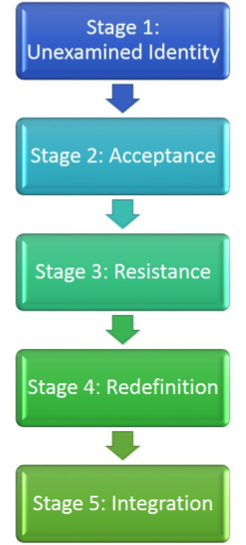
    The following model was developed by Rita Hardiman in 1994 and contains some similarities with Phinney’s minority identity development model.

    • Stage 1: Unexamined Identity. This stage is the same for both minority and majority individuals. While children may notice that some of their playmates have different colored skin, they do not fear or feel superior to them.
    • Stage 2: Acceptance. The move to stage two signals a passive or active acceptance of the dominant ideology—either way the individual does not recognize that he or she has been socialized into accepting it. When a White person goes the route of passive acceptance they have no conscious awareness of being White although they may hold some subtly racist assumptions such as “[p]eople of color are culturally different, whereas Whites are individuals with no group identity, culture, or shared experience of racial privilege.” Or, White art forms are “classical” whereas works of art by people of color are considered “ethnic art,” “folk art,” or “crafts” (Martin and Nakayama 132). People in this stage may minimize contact with minorities or act in a “let me help you” fashion toward them. If a White person in this stage follows the active acceptance path then they are conscious of their White identity and may act in ways that highlight it. Refusing to eat food from other cultures or watch foreign films are examples of the active acceptance path of this stage.
    • Stage 3: Resistance. Just as the move from stage two to stage three in the minority development model required a great deal of critical thought, so does this juncture. Here the members of the majority group cease blaming the members of minority groups for their conditions and see socioeconomic realities as a result of an unjust and biased sociopolitical system. There is an overall move from seeing one’s station in life as a purely individual event or responsibility to a more systemic issue. Here, people may feel guilty about being White and ashamed of some historical actions taken by some White people, they may try to associate with only people of color, or they may attempt to exorcise aspects of White privilege from their daily lives.
    • Stage 4: Redefinition. In this stage, people attempt to redefine what it means to be White without the racist baggage. They are able to move beyond White guilt and recognize that White people and people of all cultures contain both racist and nonracist elements and that there are many historical and cultural events of which White people can be proud.
    • Stage 5: Integration. In the last phase individuals are able to accept their Whiteness or other majority aspects of their identity and integrate it into other parts of their lives. There is a simultaneous self-acceptance and acceptance of others.

    Bi- or Multiracial Identity Development

    Originally, people thought that bi-racial individuals followed the development model of minority individuals, but given that we now know that race and the meanings about race are socially constructed, it makes sense to realize that a person of mixed racial ancestry is likely to be viewed differently (from both the dominant culture and the individual’s own culture) than a minority individual. Thus, they are likely to experience a social reality unique to their experience. The following five-stage model is derived from the work of W.S. Carlos Poston.

    • Stage 1: Personal Identity. Poston’s first stage is much like the unexamined identity stage in the previous two models. Again, children are not aware of race as a value-based social category and derive their personal identity from individual personality features instead of cultural ones.
    • Stage 2: Group Categorization. In the move from stage one to two, the person goes from no racial or cultural awareness to having to choose between one or the other. In a family where the father is Black and the mother is Japanese, the child may be asked by members of both families to decide if he or she is Black or Japanese. Choosing both is not an option in this stage.
    • Stage 3: Enmeshment/Denial. Following the choice made in stage two, individuals attempt to immerse themselves in one culture while denying ties to the other. This process may result in guilt or feelings of distance from the parent and family whose culture was rejected in stage two. If these feelings are resolved then the child moves to the next stage. If not, they remain here.
    • Stage 4: Appreciation. When feelings of guilt and anger are resolved the person can work to appreciate all of the cultures that shape their identity. While there is an attempt to learn about the diversity of their heritage, they will still identify primarily with the culture chosen in stage two.
    • Stage 5: Integration. In the fifth and final stage the once fragmented parts of the person’s identity are brought together to create a unique whole. There is integration of cultures throughout all facets of the person’s life—dress, food, holidays, spirituality, language, and communication.

    Empathy

    In the International Encyclopedia of Intercultural Communication (June 27th 2017), Benjamin Broom states that, “In intercultural situations, empathy is more complex and more difficult, but it is a key competency for effective intercultural communication.” The author goes on to describe how empathy is an opportunity to try to imagine the life of another person. That being said, trying to understand the struggles of another is a first step to positive intercultural communication. Statement shirts or clothing such as, “I Can’t Breathe” are attempting to convey a sense of empathy with the plight of African-American males in US society. Seeing another person wearing this shirt might be confusing if one does not ask about it in hope of understanding. Being sensitive to the potential underlying meaning of these kinds of cultural reference can lead to empathy.


    This page titled 8.4: Belonging is shared under a mixed 1.0 license and was authored, remixed, and/or curated by Scott T. Paynton & Laura K. Hahn with Humboldt State University Students.
