

4.5: The Social Self
- Page ID
- 306027
\( \newcommand{\vecs}[1]{\overset { \scriptstyle \rightharpoonup} {\mathbf{#1}} } \)
\( \newcommand{\vecd}[1]{\overset{-\!-\!\rightharpoonup}{\vphantom{a}\smash {#1}}} \)
\( \newcommand{\dsum}{\displaystyle\sum\limits} \)
\( \newcommand{\dint}{\displaystyle\int\limits} \)
\( \newcommand{\dlim}{\displaystyle\lim\limits} \)
\( \newcommand{\id}{\mathrm{id}}\) \( \newcommand{\Span}{\mathrm{span}}\)
( \newcommand{\kernel}{\mathrm{null}\,}\) \( \newcommand{\range}{\mathrm{range}\,}\)
\( \newcommand{\RealPart}{\mathrm{Re}}\) \( \newcommand{\ImaginaryPart}{\mathrm{Im}}\)
\( \newcommand{\Argument}{\mathrm{Arg}}\) \( \newcommand{\norm}[1]{\| #1 \|}\)
\( \newcommand{\inner}[2]{\langle #1, #2 \rangle}\)
\( \newcommand{\Span}{\mathrm{span}}\)
\( \newcommand{\id}{\mathrm{id}}\)
\( \newcommand{\Span}{\mathrm{span}}\)
\( \newcommand{\kernel}{\mathrm{null}\,}\)
\( \newcommand{\range}{\mathrm{range}\,}\)
\( \newcommand{\RealPart}{\mathrm{Re}}\)
\( \newcommand{\ImaginaryPart}{\mathrm{Im}}\)
\( \newcommand{\Argument}{\mathrm{Arg}}\)
\( \newcommand{\norm}[1]{\| #1 \|}\)
\( \newcommand{\inner}[2]{\langle #1, #2 \rangle}\)
\( \newcommand{\Span}{\mathrm{span}}\) \( \newcommand{\AA}{\unicode[.8,0]{x212B}}\)
\( \newcommand{\vectorA}[1]{\vec{#1}} % arrow\)
\( \newcommand{\vectorAt}[1]{\vec{\text{#1}}} % arrow\)
\( \newcommand{\vectorB}[1]{\overset { \scriptstyle \rightharpoonup} {\mathbf{#1}} } \)
\( \newcommand{\vectorC}[1]{\textbf{#1}} \)
\( \newcommand{\vectorD}[1]{\overrightarrow{#1}} \)
\( \newcommand{\vectorDt}[1]{\overrightarrow{\text{#1}}} \)
\( \newcommand{\vectE}[1]{\overset{-\!-\!\rightharpoonup}{\vphantom{a}\smash{\mathbf {#1}}}} \)
\( \newcommand{\vecs}[1]{\overset { \scriptstyle \rightharpoonup} {\mathbf{#1}} } \)
\(\newcommand{\longvect}{\overrightarrow}\)
\( \newcommand{\vecd}[1]{\overset{-\!-\!\rightharpoonup}{\vphantom{a}\smash {#1}}} \)
\(\newcommand{\avec}{\mathbf a}\) \(\newcommand{\bvec}{\mathbf b}\) \(\newcommand{\cvec}{\mathbf c}\) \(\newcommand{\dvec}{\mathbf d}\) \(\newcommand{\dtil}{\widetilde{\mathbf d}}\) \(\newcommand{\evec}{\mathbf e}\) \(\newcommand{\fvec}{\mathbf f}\) \(\newcommand{\nvec}{\mathbf n}\) \(\newcommand{\pvec}{\mathbf p}\) \(\newcommand{\qvec}{\mathbf q}\) \(\newcommand{\svec}{\mathbf s}\) \(\newcommand{\tvec}{\mathbf t}\) \(\newcommand{\uvec}{\mathbf u}\) \(\newcommand{\vvec}{\mathbf v}\) \(\newcommand{\wvec}{\mathbf w}\) \(\newcommand{\xvec}{\mathbf x}\) \(\newcommand{\yvec}{\mathbf y}\) \(\newcommand{\zvec}{\mathbf z}\) \(\newcommand{\rvec}{\mathbf r}\) \(\newcommand{\mvec}{\mathbf m}\) \(\newcommand{\zerovec}{\mathbf 0}\) \(\newcommand{\onevec}{\mathbf 1}\) \(\newcommand{\real}{\mathbb R}\) \(\newcommand{\twovec}[2]{\left[\begin{array}{r}#1 \\ #2 \end{array}\right]}\) \(\newcommand{\ctwovec}[2]{\left[\begin{array}{c}#1 \\ #2 \end{array}\right]}\) \(\newcommand{\threevec}[3]{\left[\begin{array}{r}#1 \\ #2 \\ #3 \end{array}\right]}\) \(\newcommand{\cthreevec}[3]{\left[\begin{array}{c}#1 \\ #2 \\ #3 \end{array}\right]}\) \(\newcommand{\fourvec}[4]{\left[\begin{array}{r}#1 \\ #2 \\ #3 \\ #4 \end{array}\right]}\) \(\newcommand{\cfourvec}[4]{\left[\begin{array}{c}#1 \\ #2 \\ #3 \\ #4 \end{array}\right]}\) \(\newcommand{\fivevec}[5]{\left[\begin{array}{r}#1 \\ #2 \\ #3 \\ #4 \\ #5 \\ \end{array}\right]}\) \(\newcommand{\cfivevec}[5]{\left[\begin{array}{c}#1 \\ #2 \\ #3 \\ #4 \\ #5 \\ \end{array}\right]}\) \(\newcommand{\mattwo}[4]{\left[\begin{array}{rr}#1 \amp #2 \\ #3 \amp #4 \\ \end{array}\right]}\) \(\newcommand{\laspan}[1]{\text{Span}\{#1\}}\) \(\newcommand{\bcal}{\cal B}\) \(\newcommand{\ccal}{\cal C}\) \(\newcommand{\scal}{\cal S}\) \(\newcommand{\wcal}{\cal W}\) \(\newcommand{\ecal}{\cal E}\) \(\newcommand{\coords}[2]{\left\{#1\right\}_{#2}}\) \(\newcommand{\gray}[1]{\color{gray}{#1}}\) \(\newcommand{\lgray}[1]{\color{lightgray}{#1}}\) \(\newcommand{\rank}{\operatorname{rank}}\) \(\newcommand{\row}{\text{Row}}\) \(\newcommand{\col}{\text{Col}}\) \(\renewcommand{\row}{\text{Row}}\) \(\newcommand{\nul}{\text{Nul}}\) \(\newcommand{\var}{\text{Var}}\) \(\newcommand{\corr}{\text{corr}}\) \(\newcommand{\len}[1]{\left|#1\right|}\) \(\newcommand{\bbar}{\overline{\bvec}}\) \(\newcommand{\bhat}{\widehat{\bvec}}\) \(\newcommand{\bperp}{\bvec^\perp}\) \(\newcommand{\xhat}{\widehat{\xvec}}\) \(\newcommand{\vhat}{\widehat{\vvec}}\) \(\newcommand{\uhat}{\widehat{\uvec}}\) \(\newcommand{\what}{\widehat{\wvec}}\) \(\newcommand{\Sighat}{\widehat{\Sigma}}\) \(\newcommand{\lt}{<}\) \(\newcommand{\gt}{>}\) \(\newcommand{\amp}{&}\) \(\definecolor{fillinmathshade}{gray}{0.9}\)2.5: The Social Self

"The Ukrainian people awarded the European Parliament’s 2022 Sakharov Prize - 52440054683" by European Parliament is licensed under CC BY 2.0.
To this point, we have argued that human beings have complex and well-developed self-concepts and that they generally attempt to come to view themselves as positively as they can. In this section, we will consider in more detail the social aspects of the self by considering the many ways that the social situation determines our self-concept. Our selves are not created in isolation; we are not born with perceptions of ourselves as shy, interested in jazz, or charitable to others. Rather, these beliefs are determined by our observations of and interactions with others. Are you rich or poor? Beautiful or ugly? Smart or not? Good or poor at video games? And how do you know? These questions can be answered only by comparing ourselves with those around us. The self has meaning only within the social context, and it is not wrong to say that the social situation defines our self-concept and our self-esteem. We rely on others to provide a “social reality”—to help us determine what to think, feel, and do (Hardin & Higgins, 1996).
Social Comparison Helps Create the Self-Concept
Research Focus
Affiliation and Social Comparison

"Girls Camp 196" by znuk is licensed under CC BY 2.0.
Upward and Downward Comparisons Influence Our Self-Esteem
Social Groups Provide Social Identity
A Measure of Social Identity
Table 4.1 Varieties of Social Identities
| Relationships | Vocation/avocation | Political affiliation | Stigma | Ethnicity/religion |
|---|---|---|---|---|
| Widow | Intellectual | Feminist | Welfare recipient | Jewish |
| Divorced person | Bookworm | Political independent | Unemployed person | Christian |
| Woman | Military veteran | Democrat | Homeless person | Catholic |
| Man | Student | Republican | Retired person | Southerner |
| Lover | Collector | Old person | New Yorker | |
| Friend | Musician | Fat person | American | |
| Girlfriend | Gardener | Deaf person | Hispanic | |
| Boyfriend | Teacher | Person with AIDS | Asian-American | |
| Homemaker | Supervisor | Lesbian | African-American | |
| Head of household | Secretary | Gay | ||
| Teenager | Scientist | Smoker | ||
| Child | Psychologist | Alcoholic | ||
| Wife | Salesperson | |||
| Husband | Business person | |||
| Son | Athlete | |||
| Daughter | ||||
| Sister | ||||
| Brother | ||||
| Grandmother | ||||
| Grandfather | ||||
| Uncle | ||||
| Aunt | ||||
| Mother Father | ||||
| This table represents some of the many social identities reported by a sample of college students. Data are from Deaux et al. (1995). | ||||
Social identity refers to the positive emotions we experience as a member of an important social group.
Wikimedia Commons – CC BY-SA 3.0.
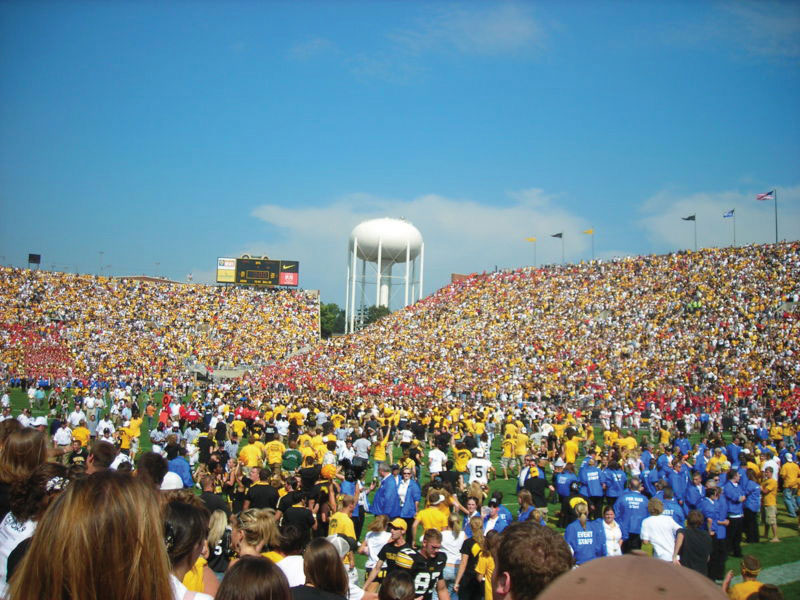
Robert Cialdini and his colleagues (Cialdini et al., 1976) studied the idea that we can sometimes enhance our self-esteem by “basking in the reflected glory” of our ingroups or of other people that we know. They called this basking process BIRGing. To test this idea, they observed the clothes and clothing accessories that students at different U.S. universities wore to classes on Mondays. They found that when the university’s football team had won its game on Saturday, students were likely to emphasize their university memberships by wearing clothing, such as sweatshirts and hats, with the symbols of their university on them. However, they were significantly less likely to wear university clothing on the Mondays that followed a football loss. Furthermore, in a study in which students from a university were asked to describe a victory by their university team, they frequently used the term “we,” whereas when asked to describe a game in which their school lost, they used the term “we” significantly less frequently. Emphasizing that “we’re a good school” and “we beat them” evidently provided a social identity for these students, allowing them to feel good about themselves.
Different Cultures Create Different Selves
Figure 4.7 Cultural Differences in Desire for Uniqueness
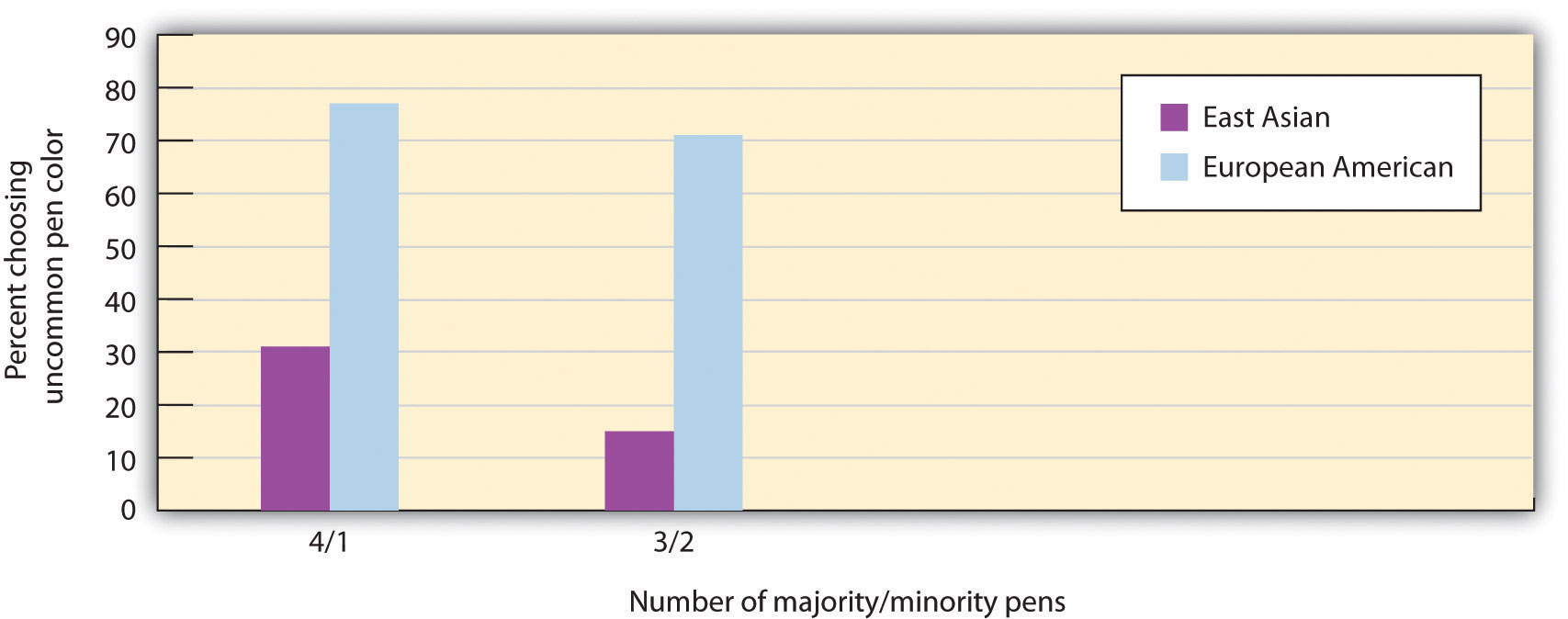
In this study, participants from European American and East Asian cultures were asked to choose a pen as a token of appreciation for completing a questionnaire. It was arranged such that there were either four pens of one color and one of another color or three pens of one color and two of another. European Americans were significantly more likely to choose the more uncommon pen color in both cases. Data are from Kim and Markus (1999, Experiment 3).
Attributions:
The above content was remix from:
4.3: The Social Self- The Role of the Social Situation is shared under a CC BY-NC-SA 3.0 license and was authored, remixed, and/or curated by Anonymous via source content that was edited to the style and standards of the LibreTexts platform; a detailed edit history is available upon request.