

4.3: Types of Nonverbal Communication
- Page ID
- 107993

\( \newcommand{\vecs}[1]{\overset { \scriptstyle \rightharpoonup} {\mathbf{#1}} } \)
\( \newcommand{\vecd}[1]{\overset{-\!-\!\rightharpoonup}{\vphantom{a}\smash {#1}}} \)
\( \newcommand{\dsum}{\displaystyle\sum\limits} \)
\( \newcommand{\dint}{\displaystyle\int\limits} \)
\( \newcommand{\dlim}{\displaystyle\lim\limits} \)
\( \newcommand{\id}{\mathrm{id}}\) \( \newcommand{\Span}{\mathrm{span}}\)
( \newcommand{\kernel}{\mathrm{null}\,}\) \( \newcommand{\range}{\mathrm{range}\,}\)
\( \newcommand{\RealPart}{\mathrm{Re}}\) \( \newcommand{\ImaginaryPart}{\mathrm{Im}}\)
\( \newcommand{\Argument}{\mathrm{Arg}}\) \( \newcommand{\norm}[1]{\| #1 \|}\)
\( \newcommand{\inner}[2]{\langle #1, #2 \rangle}\)
\( \newcommand{\Span}{\mathrm{span}}\)
\( \newcommand{\id}{\mathrm{id}}\)
\( \newcommand{\Span}{\mathrm{span}}\)
\( \newcommand{\kernel}{\mathrm{null}\,}\)
\( \newcommand{\range}{\mathrm{range}\,}\)
\( \newcommand{\RealPart}{\mathrm{Re}}\)
\( \newcommand{\ImaginaryPart}{\mathrm{Im}}\)
\( \newcommand{\Argument}{\mathrm{Arg}}\)
\( \newcommand{\norm}[1]{\| #1 \|}\)
\( \newcommand{\inner}[2]{\langle #1, #2 \rangle}\)
\( \newcommand{\Span}{\mathrm{span}}\) \( \newcommand{\AA}{\unicode[.8,0]{x212B}}\)
\( \newcommand{\vectorA}[1]{\vec{#1}} % arrow\)
\( \newcommand{\vectorAt}[1]{\vec{\text{#1}}} % arrow\)
\( \newcommand{\vectorB}[1]{\overset { \scriptstyle \rightharpoonup} {\mathbf{#1}} } \)
\( \newcommand{\vectorC}[1]{\textbf{#1}} \)
\( \newcommand{\vectorD}[1]{\overrightarrow{#1}} \)
\( \newcommand{\vectorDt}[1]{\overrightarrow{\text{#1}}} \)
\( \newcommand{\vectE}[1]{\overset{-\!-\!\rightharpoonup}{\vphantom{a}\smash{\mathbf {#1}}}} \)
\( \newcommand{\vecs}[1]{\overset { \scriptstyle \rightharpoonup} {\mathbf{#1}} } \)
\(\newcommand{\longvect}{\overrightarrow}\)
\( \newcommand{\vecd}[1]{\overset{-\!-\!\rightharpoonup}{\vphantom{a}\smash {#1}}} \)
\(\newcommand{\avec}{\mathbf a}\) \(\newcommand{\bvec}{\mathbf b}\) \(\newcommand{\cvec}{\mathbf c}\) \(\newcommand{\dvec}{\mathbf d}\) \(\newcommand{\dtil}{\widetilde{\mathbf d}}\) \(\newcommand{\evec}{\mathbf e}\) \(\newcommand{\fvec}{\mathbf f}\) \(\newcommand{\nvec}{\mathbf n}\) \(\newcommand{\pvec}{\mathbf p}\) \(\newcommand{\qvec}{\mathbf q}\) \(\newcommand{\svec}{\mathbf s}\) \(\newcommand{\tvec}{\mathbf t}\) \(\newcommand{\uvec}{\mathbf u}\) \(\newcommand{\vvec}{\mathbf v}\) \(\newcommand{\wvec}{\mathbf w}\) \(\newcommand{\xvec}{\mathbf x}\) \(\newcommand{\yvec}{\mathbf y}\) \(\newcommand{\zvec}{\mathbf z}\) \(\newcommand{\rvec}{\mathbf r}\) \(\newcommand{\mvec}{\mathbf m}\) \(\newcommand{\zerovec}{\mathbf 0}\) \(\newcommand{\onevec}{\mathbf 1}\) \(\newcommand{\real}{\mathbb R}\) \(\newcommand{\twovec}[2]{\left[\begin{array}{r}#1 \\ #2 \end{array}\right]}\) \(\newcommand{\ctwovec}[2]{\left[\begin{array}{c}#1 \\ #2 \end{array}\right]}\) \(\newcommand{\threevec}[3]{\left[\begin{array}{r}#1 \\ #2 \\ #3 \end{array}\right]}\) \(\newcommand{\cthreevec}[3]{\left[\begin{array}{c}#1 \\ #2 \\ #3 \end{array}\right]}\) \(\newcommand{\fourvec}[4]{\left[\begin{array}{r}#1 \\ #2 \\ #3 \\ #4 \end{array}\right]}\) \(\newcommand{\cfourvec}[4]{\left[\begin{array}{c}#1 \\ #2 \\ #3 \\ #4 \end{array}\right]}\) \(\newcommand{\fivevec}[5]{\left[\begin{array}{r}#1 \\ #2 \\ #3 \\ #4 \\ #5 \\ \end{array}\right]}\) \(\newcommand{\cfivevec}[5]{\left[\begin{array}{c}#1 \\ #2 \\ #3 \\ #4 \\ #5 \\ \end{array}\right]}\) \(\newcommand{\mattwo}[4]{\left[\begin{array}{rr}#1 \amp #2 \\ #3 \amp #4 \\ \end{array}\right]}\) \(\newcommand{\laspan}[1]{\text{Span}\{#1\}}\) \(\newcommand{\bcal}{\cal B}\) \(\newcommand{\ccal}{\cal C}\) \(\newcommand{\scal}{\cal S}\) \(\newcommand{\wcal}{\cal W}\) \(\newcommand{\ecal}{\cal E}\) \(\newcommand{\coords}[2]{\left\{#1\right\}_{#2}}\) \(\newcommand{\gray}[1]{\color{gray}{#1}}\) \(\newcommand{\lgray}[1]{\color{lightgray}{#1}}\) \(\newcommand{\rank}{\operatorname{rank}}\) \(\newcommand{\row}{\text{Row}}\) \(\newcommand{\col}{\text{Col}}\) \(\renewcommand{\row}{\text{Row}}\) \(\newcommand{\nul}{\text{Nul}}\) \(\newcommand{\var}{\text{Var}}\) \(\newcommand{\corr}{\text{corr}}\) \(\newcommand{\len}[1]{\left|#1\right|}\) \(\newcommand{\bbar}{\overline{\bvec}}\) \(\newcommand{\bhat}{\widehat{\bvec}}\) \(\newcommand{\bperp}{\bvec^\perp}\) \(\newcommand{\xhat}{\widehat{\xvec}}\) \(\newcommand{\vhat}{\widehat{\vvec}}\) \(\newcommand{\uhat}{\widehat{\uvec}}\) \(\newcommand{\what}{\widehat{\wvec}}\) \(\newcommand{\Sighat}{\widehat{\Sigma}}\) \(\newcommand{\lt}{<}\) \(\newcommand{\gt}{>}\) \(\newcommand{\amp}{&}\) \(\definecolor{fillinmathshade}{gray}{0.9}\)Learning Objectives
- Understand and explain six primary types of nonverbal communication.
- Learn how to record a speech or deliver an effective virtual presentation.
As we discussed previously, when it comes to nonverbal messages, there are often multiple things going on at once. Let's gain a better understanding by looking at the types of nonverbal communication.
Kinesics
Haptics
Personal Appearance

Proxemics
Hall's system provides useful insight into the constructive use of space for various interactions. It should be noted, however, that appropriate distance is determined by many variables, including the situation, the nature of the relationship, the topic of conversation, and the physical constraints which are present. Dr. Tricia Jones points out that vertical distance is also included in proxemics. Just as the horizontal distance between people communicates something, so does the vertical distance. In this case, however, vertical distance is often understood to convey the degree of dominance or sub-ordinance in a relationship. Looking up at or down on another person can be taken literally in many cases, with the higher person asserting greater status. People who work with small children should realize that children will interact more comfortably with a communicator when they are in the same vertical plane. On the other hand, in a situation of conflict, a person might stand to use vertical distance to their advantage. (Creducation.com)

Chronemics
Paralanguage
- Volume: the softness or loudness of a voice
- Rate: how quickly or slowly we speak
- Pitch: highness or lowness of a voice
- Inflection: variations in pitch that add meaning to our sentences. An upward inflection is when there is a change in pitch going from a lower to a higher note. In most cases, an upward inflection is used for a question or to indicate insincerity or surprise. A downward inflection is a change in pitch from a higher to a lower note. A downward inflection is used when making a statement.
- Vocalizations: sounds that have meaning, such as “uh-huh,” “shhh,” and “mmm.”
- Silence/pause: a break where there is no sound. Sometimes silence is unintentional and other times intentional. A well-placed pause or use of silence is an art that can add impact and emphasis to a message.
- Nonfluencies: words or sounds that interrupt the flow of your sentences. Examples of common nonfluencies are uh, uhm, like, and you know.
Paralanguage adds important information to our message. Paralanguage can show our excitement and enthusiasm or can indicate our unease about what we are saying. It can keep our listeners alert or put them to sleep. The best paralanguage complements our words and makes our voice pleasing and interesting to our listeners. Through effective paralanguage, we can emphasize important words in our sentences and can clue our listeners into whether we are asking a question or making a statement. There are also times when we can intentionally use paralanguage to contradict our words. Sarcasm and incongruence are two examples of this. When you use sarcasm, your paralanguage is intended to contradict the verbal message. However, sometimes using sarcasm can backfire when listeners do not pick up our paralinguistic cues and focus primarily on the verbal message.
Body language affects how others see us, but it may also change how we see ourselves. Social psychologist Amy Cuddy argues that "power posing" -- standing in a posture of confidence, even when we don't feel confident -- can boost feelings of confidence, and might have an impact on our chances for success. Cuddy's talk was presented at an official TED conference, and was featured by TED editors on the home page.
What is your opinion of Cuddy's views? Try "power posing" a few times and see what you think.
Recording Effective Smartphone Videos
When it comes to recording or giving virtual presentations, "It's not just what you say, it's how you say it." Here are some suggestions for recording effective videos or giving effective virtual presentations using your smartphone or other recording technology.
1. Record with your camera placed horizontally, not vertically.
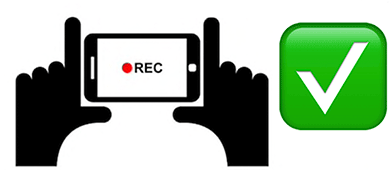
2. Raise the camera so it is at or close to eye level. Use a stack of books to add some height, if necessary. If you don't have a tri-pod, check out these instructions for making your own. https://fixthephoto.com/diy-iphone-tripod.html
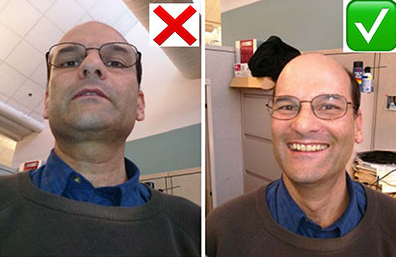
3. Make sure your face is well lit. The light source should be in front of you, behind the camera, or above your head, not behind it.
4. Chose a quiet, distraction-free environment. The background should be neat and tidy. Turn the television off. Close the door to bar barking dogs, inquisitive cats, or crying children.
5. Look directly into the camera. This gives the appearance of eye contact. Do not look at the keyboard, the ceiling, or the screen. DO NOT READ to the audience.
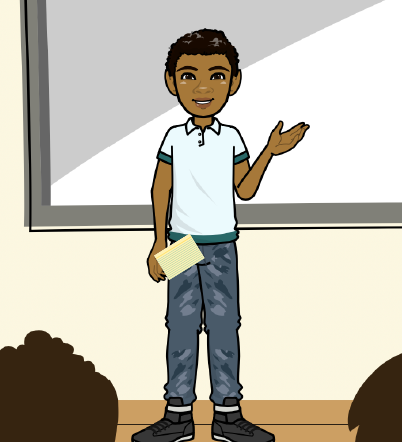
6. If you are recording a speech or formal presentation, you will be expected to stand up and place the camera far enough away from you so that your body language will be visible to the instructor.
7. Make certain your microphone works well.
8. Use effective paralanguage to capture your audience's interest and convey enthusiasm. Pronounce words correctly and say them distinctly. Use vocal variety, modifying your rate, inflections, and volume to keep the attention of the audience. Avoid speaking in a monotone.
9. Keep both feet planted firmly on the floor with your weight distributed equally between both feet.
10. Use occasional natural hand gestures. Hand gestures make you appear more conversational and animated. Smile. Dress professionally. Do not wear a hat or head covering unless it is required by your religion.
11. Record your rehearsal and watch the recording. This is one of the best ways to see areas for improvement.
Images 1 and 2 are provided by the Office of Communications, Amherst College.
References