You’ve learned the importance of citing sources. Now that you know why written and oral citations are important to the ethical process of public speaking, let’s focus on how to cite supporting speech material. Studies show that oftentimes students do not cite a source because they’re unsure of how or when to cite a reference (Shi, 2010). Shi’s study describes some typical responses for why students did not cite sources, such as “I couldn’t remember where I learned the information,” or “I had already cited that author and didn’t want the audience to think all of my information was from some outside source.” Though these rationales are understandable, they are not ethical.
Develop accurate citations
Ethical speakers share source information with the audience. On written materials, such as handouts or speech outlines, citations are handled much like they would be in any essay. In addition to written citations, oral citations provide source information to audience members who may not see your written speech. In all citations, enough information should be given so that the audience can easily find the source.
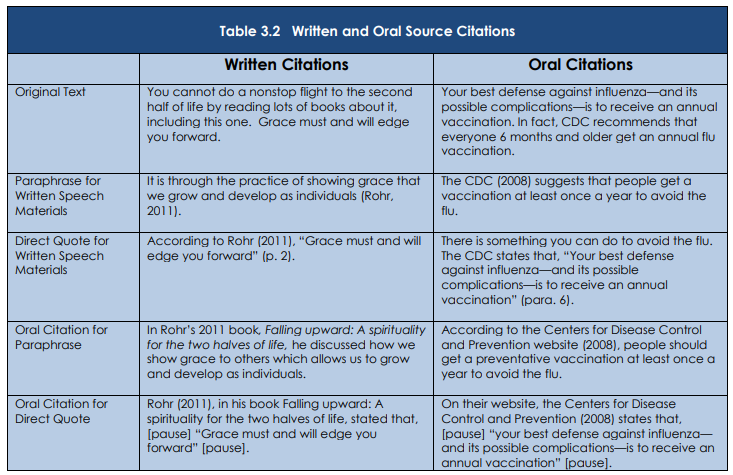
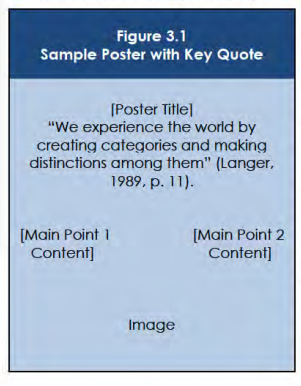
You may choose to briefly describe the author before citing him or her to lend credibility to your supporting information. Writing style guidebooks, such as APA or MLA (Modern Language Association), teach that a source's credentials are not necessary in the text of your paper. We can interpret that the same is true for providing oral citations in a speech----the author's occupation, the source website, or the journal name are not required bu may be helpful verbal cues to explain the legitimacy of your chosen source. You should provide enough information so that an audience member can locate the source. For instance, if explaining the research of a medical doctor, it might be useful to describe the doctor as a leading pediatrician--after which you would state the doctor's last name, year of publication, and the quote or paraphrase. To orally paraphrase a Langer quote (see example poster in Figure 3.1), you might say to your audience:
I really agree with Langer (1989), who wrote in her book Mindfulness, that our world is constructed from the categories we build in our mind. I find that I interpret the world based in my initial understanding of things and have to mindfully force myself to question the categories and biases I've formally created in my head.
Note, the Langer paraphrase provides the author's last name, year of publication, and the title of the book should an audience member want to find the orally cited source.
Ethical speakers provide written, oral, and visual citations. Visual aids, discussed in Chapter 13, include posters, objects, models, PowerPoints, and handouts. Visual aids are used to enhance your speech message. Visual aids, just like speech content, must be displayed ethically for the audience. In other words, if you use a poster to display a famous quote, then you should cite the author on your poster (see Figure 3.1). Similarly, you should cite sources on your PowerPoint throughout the presentation. It is not sufficient to include a "Sources" or "References" slide at the end of your PowerPoint presentation because that does not accurately link each author to his or her work. Instead, ethical presenters provide an author reference on the slide in which the cited content is shown (see Figure 3.2).
Speakers should also carefully select and correctly cite images displayed in their visual aid. Images should be relevant to the keywords used on your PowerPoint slide. In other words, captions are not necessary because the image can stand alone; images you display should obviously correlate with your speech content (a caption is typically used because the picture needs explanation). In other words, the presence of a caption typically means your image does not directly correspond with the verbal speech material. Images should support, not distract, from the verbal or visual message. Hence, there is no need for blinking, rotating, or otherwise distracting visual aids (Danoff-Burg 2002). Images should be simple and relevant. All pictures should be cited, unless the presenter uses a personal clipart, or purchased stock image. To cite an image, simply include the credit (or web link) to that picture; note, however, the font of the link should be reduced so that it is visible to the audience without distracting from the content in your visual aid. Seeing an image link should not be distracting to audience members.

It’s also important to understand how copyright law might affect what and how you include information in your speech and on your visual aid. The fair use provision allows for copyrighted information to be shared if it is used for educational benefits, news reporting, research, and in other situations. Nolo (2010) explains, “In its most general sense, a fair use is any copying of copyrighted material done for a limited and ‘transformative’ purpose, such as to comment upon, criticize, or parody a copyrighted work. Such uses can be done without permission from the copyright owner” (para. 1). In order to determine if the use of content falls under the fair use provision, there are four factors to consider:
1. How will this be used?
2. What is to be used?
3. How much will be used?
4. What effect does this have? (Harper, 2007)
You can find more about these four factors at the U.S. Copyright website – www.copyright.gov.
Ethical citing includes crediting authors in the text of your written speech materials, acknowledging authors aloud during your speech, and citing images and sources on your visual aid. However, ethics in public speaking encompass more than crediting source material. It’s also necessary to strive for responsible speech goals.
Ethics and equity and the principles of justice do not change with the calendar. ~ David Herbert Lawrence