

1.9: Summary
- Page ID
- 345635
\( \newcommand{\vecs}[1]{\overset { \scriptstyle \rightharpoonup} {\mathbf{#1}} } \)
\( \newcommand{\vecd}[1]{\overset{-\!-\!\rightharpoonup}{\vphantom{a}\smash {#1}}} \)
\( \newcommand{\dsum}{\displaystyle\sum\limits} \)
\( \newcommand{\dint}{\displaystyle\int\limits} \)
\( \newcommand{\dlim}{\displaystyle\lim\limits} \)
\( \newcommand{\id}{\mathrm{id}}\) \( \newcommand{\Span}{\mathrm{span}}\)
( \newcommand{\kernel}{\mathrm{null}\,}\) \( \newcommand{\range}{\mathrm{range}\,}\)
\( \newcommand{\RealPart}{\mathrm{Re}}\) \( \newcommand{\ImaginaryPart}{\mathrm{Im}}\)
\( \newcommand{\Argument}{\mathrm{Arg}}\) \( \newcommand{\norm}[1]{\| #1 \|}\)
\( \newcommand{\inner}[2]{\langle #1, #2 \rangle}\)
\( \newcommand{\Span}{\mathrm{span}}\)
\( \newcommand{\id}{\mathrm{id}}\)
\( \newcommand{\Span}{\mathrm{span}}\)
\( \newcommand{\kernel}{\mathrm{null}\,}\)
\( \newcommand{\range}{\mathrm{range}\,}\)
\( \newcommand{\RealPart}{\mathrm{Re}}\)
\( \newcommand{\ImaginaryPart}{\mathrm{Im}}\)
\( \newcommand{\Argument}{\mathrm{Arg}}\)
\( \newcommand{\norm}[1]{\| #1 \|}\)
\( \newcommand{\inner}[2]{\langle #1, #2 \rangle}\)
\( \newcommand{\Span}{\mathrm{span}}\) \( \newcommand{\AA}{\unicode[.8,0]{x212B}}\)
\( \newcommand{\vectorA}[1]{\vec{#1}} % arrow\)
\( \newcommand{\vectorAt}[1]{\vec{\text{#1}}} % arrow\)
\( \newcommand{\vectorB}[1]{\overset { \scriptstyle \rightharpoonup} {\mathbf{#1}} } \)
\( \newcommand{\vectorC}[1]{\textbf{#1}} \)
\( \newcommand{\vectorD}[1]{\overrightarrow{#1}} \)
\( \newcommand{\vectorDt}[1]{\overrightarrow{\text{#1}}} \)
\( \newcommand{\vectE}[1]{\overset{-\!-\!\rightharpoonup}{\vphantom{a}\smash{\mathbf {#1}}}} \)
\( \newcommand{\vecs}[1]{\overset { \scriptstyle \rightharpoonup} {\mathbf{#1}} } \)
\(\newcommand{\longvect}{\overrightarrow}\)
\( \newcommand{\vecd}[1]{\overset{-\!-\!\rightharpoonup}{\vphantom{a}\smash {#1}}} \)
\(\newcommand{\avec}{\mathbf a}\) \(\newcommand{\bvec}{\mathbf b}\) \(\newcommand{\cvec}{\mathbf c}\) \(\newcommand{\dvec}{\mathbf d}\) \(\newcommand{\dtil}{\widetilde{\mathbf d}}\) \(\newcommand{\evec}{\mathbf e}\) \(\newcommand{\fvec}{\mathbf f}\) \(\newcommand{\nvec}{\mathbf n}\) \(\newcommand{\pvec}{\mathbf p}\) \(\newcommand{\qvec}{\mathbf q}\) \(\newcommand{\svec}{\mathbf s}\) \(\newcommand{\tvec}{\mathbf t}\) \(\newcommand{\uvec}{\mathbf u}\) \(\newcommand{\vvec}{\mathbf v}\) \(\newcommand{\wvec}{\mathbf w}\) \(\newcommand{\xvec}{\mathbf x}\) \(\newcommand{\yvec}{\mathbf y}\) \(\newcommand{\zvec}{\mathbf z}\) \(\newcommand{\rvec}{\mathbf r}\) \(\newcommand{\mvec}{\mathbf m}\) \(\newcommand{\zerovec}{\mathbf 0}\) \(\newcommand{\onevec}{\mathbf 1}\) \(\newcommand{\real}{\mathbb R}\) \(\newcommand{\twovec}[2]{\left[\begin{array}{r}#1 \\ #2 \end{array}\right]}\) \(\newcommand{\ctwovec}[2]{\left[\begin{array}{c}#1 \\ #2 \end{array}\right]}\) \(\newcommand{\threevec}[3]{\left[\begin{array}{r}#1 \\ #2 \\ #3 \end{array}\right]}\) \(\newcommand{\cthreevec}[3]{\left[\begin{array}{c}#1 \\ #2 \\ #3 \end{array}\right]}\) \(\newcommand{\fourvec}[4]{\left[\begin{array}{r}#1 \\ #2 \\ #3 \\ #4 \end{array}\right]}\) \(\newcommand{\cfourvec}[4]{\left[\begin{array}{c}#1 \\ #2 \\ #3 \\ #4 \end{array}\right]}\) \(\newcommand{\fivevec}[5]{\left[\begin{array}{r}#1 \\ #2 \\ #3 \\ #4 \\ #5 \\ \end{array}\right]}\) \(\newcommand{\cfivevec}[5]{\left[\begin{array}{c}#1 \\ #2 \\ #3 \\ #4 \\ #5 \\ \end{array}\right]}\) \(\newcommand{\mattwo}[4]{\left[\begin{array}{rr}#1 \amp #2 \\ #3 \amp #4 \\ \end{array}\right]}\) \(\newcommand{\laspan}[1]{\text{Span}\{#1\}}\) \(\newcommand{\bcal}{\cal B}\) \(\newcommand{\ccal}{\cal C}\) \(\newcommand{\scal}{\cal S}\) \(\newcommand{\wcal}{\cal W}\) \(\newcommand{\ecal}{\cal E}\) \(\newcommand{\coords}[2]{\left\{#1\right\}_{#2}}\) \(\newcommand{\gray}[1]{\color{gray}{#1}}\) \(\newcommand{\lgray}[1]{\color{lightgray}{#1}}\) \(\newcommand{\rank}{\operatorname{rank}}\) \(\newcommand{\row}{\text{Row}}\) \(\newcommand{\col}{\text{Col}}\) \(\renewcommand{\row}{\text{Row}}\) \(\newcommand{\nul}{\text{Nul}}\) \(\newcommand{\var}{\text{Var}}\) \(\newcommand{\corr}{\text{corr}}\) \(\newcommand{\len}[1]{\left|#1\right|}\) \(\newcommand{\bbar}{\overline{\bvec}}\) \(\newcommand{\bhat}{\widehat{\bvec}}\) \(\newcommand{\bperp}{\bvec^\perp}\) \(\newcommand{\xhat}{\widehat{\xvec}}\) \(\newcommand{\vhat}{\widehat{\vvec}}\) \(\newcommand{\uhat}{\widehat{\uvec}}\) \(\newcommand{\what}{\widehat{\wvec}}\) \(\newcommand{\Sighat}{\widehat{\Sigma}}\) \(\newcommand{\lt}{<}\) \(\newcommand{\gt}{>}\) \(\newcommand{\amp}{&}\) \(\definecolor{fillinmathshade}{gray}{0.9}\)Finishing the circle
Figure 1.1 offers a powerful way to synthesize the core ideas of a global studies textbook by visualizing globalization as an interconnected, layered system shaped by multiple actors, flows, and consequences. At its center, the globe functions not simply as a map, but as a representation of interdependence—suggesting that no region operates in isolation. The puzzle-like design reinforces that global systems are constructed, contingent, and constantly being reshaped by political, economic, cultural, and environmental forces.
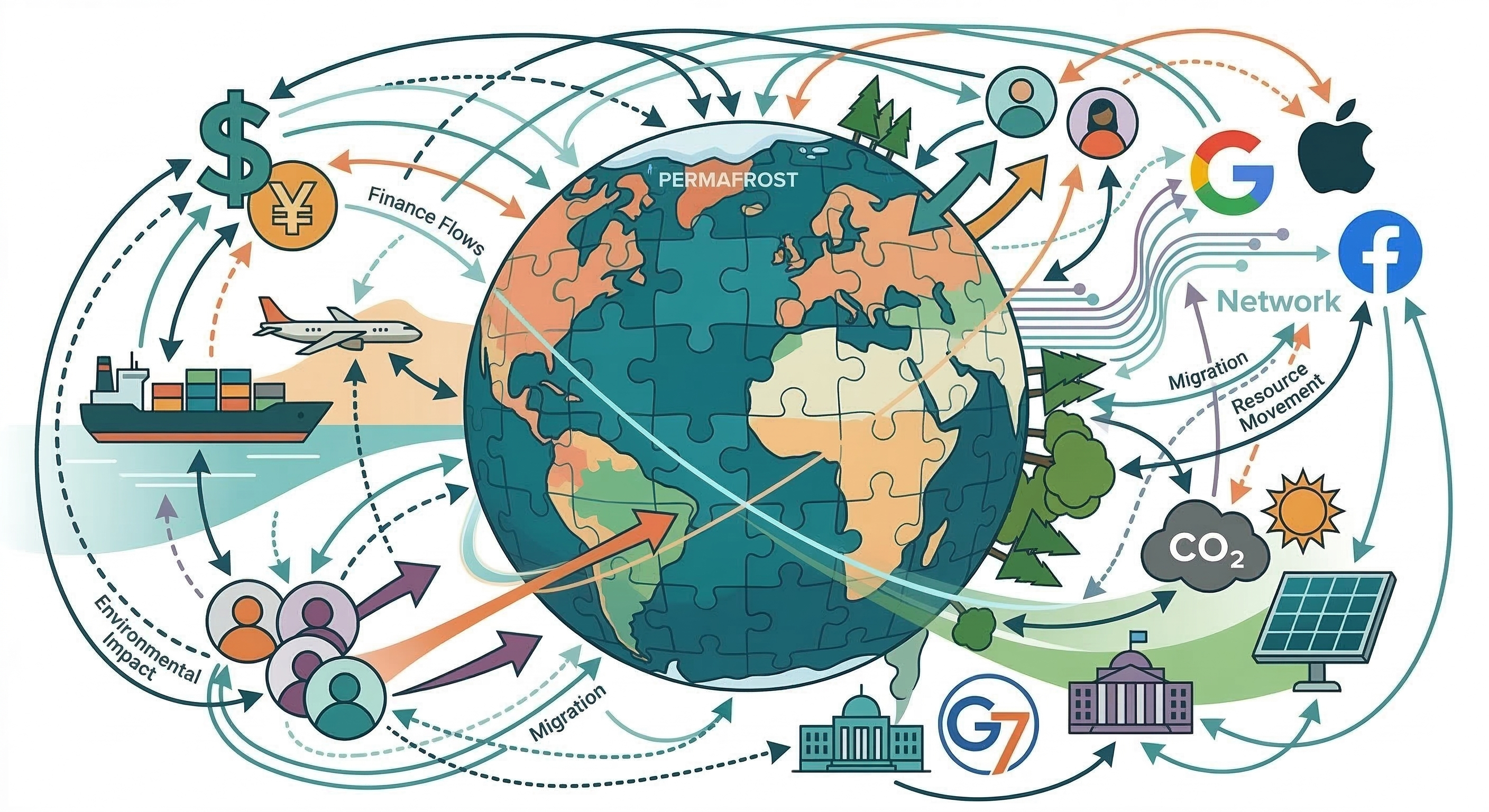
Surrounding the globe, the arrows illustrate the multidirectional flows that define globalization. Finance flows, represented through currency symbols, highlight the speed and scale of capital movement across borders, shaping development, inequality, and economic dependency. Trade networks, depicted through cargo ships and airplanes, emphasize global supply chains in which production and consumption are geographically dispersed. These flows underscore a key concept in global studies: that everyday goods are the result of complex transnational processes involving labor, regulation, and resource extraction across multiple regions.
The inclusion of corporate and digital platform icons points to the growing influence of transnational corporations and information technologies. These actors operate beyond traditional state boundaries, shaping global communication, culture, and even governance. Social media networks illustrate how ideas, identities, and information circulate rapidly, creating new forms of cultural exchange while also raising questions about power, data control, and digital inequality. This reflects a central theme in global studies: globalization is not only economic, but also cultural and technological.
Migration pathways shown in the image highlight the movement of people as both a cause and consequence of globalization. Individuals and communities move in response to economic opportunity, political instability, and environmental pressures. These flows reveal the human dimension of global systems, emphasizing issues of labor, identity, borders, and belonging. They also point to persistent inequalities, as mobility is unevenly distributed and shaped by policies, resources, and geopolitical conditions.
Environmental elements—such as CO₂ emissions, solar panels, and permafrost—underscore that ecological systems are deeply intertwined with globalization. Climate change operates across borders, linking industrial activity, energy consumption, and environmental degradation in one region to consequences in another. The presence of renewable energy symbols alongside emissions highlights the tension between sustainability and development, a key debate in global studies. This reinforces the idea that environmental challenges are collective problems requiring coordinated global responses.
Institutions and governance structures, suggested by symbols like government buildings and international groupings, represent the role of states and global organizations in managing these interconnected systems. However, their placement alongside corporations, networks, and environmental forces suggests that power in globalization is diffuse rather than centralized. Authority is shared and contested among multiple actors, complicating efforts to regulate global systems effectively.
Taken together, the image encapsulates several foundational concepts in global studies. First, globalization is multidimensional, involving economic, cultural, political, technological, and environmental processes that intersect and influence one another. Second, it is characterized by flows—of capital, goods, people, information, and ecological effects—that move in complex, non-linear ways. Third, it involves a diverse set of actors, including states, corporations, communities, and ecosystems, all of which shape outcomes in different ways. Finally, globalization produces both integration and inequality, creating opportunities for connection and innovation while also reinforcing disparities in power, access, and resources.
By linking these systems visually, the image helps students understand that global issues are not abstract or distant. Instead, they are embedded in everyday life, from the products we use to the information we consume and the environmental conditions we experience. A global studies perspective, therefore, requires interdisciplinary thinking—drawing from economics, politics, sociology, environmental science, and cultural studies—to fully grasp the complexity of the world we inhabit.