The Empirical Revolution (1950–1970): Theory In A Test Tube
Speech departments in the 1950s promoted the ancient rhetorical wisdom that persuasive discourse was a matter of an ethical speaker using logical arguments—‘‘the good man speaking well.”11 But younger faculty with training in the social sciences were no longer willing to accept this ‘‘truth” by faith. Armed with a scientific skepticism and new methods to assess attitudes, they put rhetorical principles to the test…
Aristotle, for example, wrote that ethos was a combination of a speaker’s intelligence, character, and goodwill toward the audience. Empirically oriented speech researchers subsequently discovered that audience rankings of “communicator credibility” did indeed include factors of competence (intelligence) and trustworthiness (character).12 But they found no evidence that audiences regarded goodwill or positive intentions as traits separate from character.
Scholars interested in this kind of study adopted the media-effects term communication research to distinguish their work from the historical-critical textual analysis of rhetoricians. In 1950 a group of communication researchers founded what is now the International Communication Association (ICA) as a science-based professional organization to rival the Speech Association of America, which was grounded in the humanities. Traditional speech teachers of this era often accused communication researchers of succumbing to ‘‘the law of the hammer.” This was a not-so-subtle dig at those who would pound away with newly acquired statistical tools no matter what the job required.
But irony did little to slow the radical transformation within the communication discipline….The empiricists continued to borrow their core ideas from other disciplines—especially social psychology. Indeed, five of the thirty-three communication theories in this book come from that specialized branch of psychology. Their common methodology and unity of world view gave social scientists in the communication field a greater impact than their numbers alone would indicate. In 1969, the SAA changed its name to the Speech Communication Association (SCA). The term communication in the title was tacit evidence that the scientific approach now dominated the discipline. At the start of the 1960s few departments that taught speech had the word communication as part of their title. By the mid 1970s there were few that didn’t.
www.afirstlook.com/archive/talkabout.cfm?source=archther
There are three characteristics that help us understand empirical laws theories: causation, prediction, and generalization (Infante, Rancer & Womack). Causation states that there is a “cause and effect” relationship for all actions. In the physical world, if someone drops a pen it will fall. In human communication, if someone says “hello” to someone, that person responds. Prediction suggests that once someone determines a particular law is at work, they will use it to predict outcomes of communication situations. Have you ever rehearsed how you will ask someone out on a date and tried to predict the outcome?
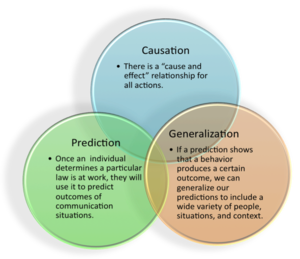
Causation, Generalization, Prediction
What evidence did you use to make your prediction? In this example, you are using the “if X, then Y” equation to predict the outcome of the interaction. Generalization suggests that if a prediction shows that a behavior produces a certain outcome, we can generalize our predictions to include a wide variety of people, situations, and contexts. We make generalization such as, “If I’m friendly to others, they will be friendly to me” based on our past experiences with this type of behavior. However, this does not account for scenarios in which the person might not hear you, might be having a bad day and do not wish to respond, or assume you are talking to another person so they choose not to acknowledge you.
In the physical sciences, laws are absolute. This is comforting because it allows us to make informed decisions based on what we know about the laws that govern the world around us. In our example of gravity, we know that dropping an object will produce the same result every time. We could spend the rest of our lives testing this theory, but we don’t have to. We know what the result will be without having to continuously drop an object. Now, imagine what it would be like to always know what the outcome would be of every communication situation! Would that be comforting to you, or make your life boring?
Unlike the physical world, laws that govern human communication are not absolute and are most often bound by culture and context. Empirical laws theories are generally approached from the perspective of probability rather than absoluteness (Miller & Berger). Probability states that under certain conditions it is highly likely that we can predict communication outcomes. For example, when you greet someone with “hello” it is probable, not absolute, they will respond back with a greeting of their own. If they do not, you might run through a variety of reasons why the other person did not respond in accordance with the “laws” that govern greetings in our culture. Even though empirical laws theories do not produce absolutes about communication, we still use them in our everyday interactions with one another. Businesses, advertisers, schools, and other organizations use this approach to predict consumer, educational, and behavioral habits of particular demographic groups. While their approaches never produce a 100% cause-effect relationship, the information they gather helps them determine what actions to take to be successful in their communicative behaviors.