

2: The Basics of Oral Argumentation
- Page ID
- 319025
\( \newcommand{\vecs}[1]{\overset { \scriptstyle \rightharpoonup} {\mathbf{#1}} } \)
\( \newcommand{\vecd}[1]{\overset{-\!-\!\rightharpoonup}{\vphantom{a}\smash {#1}}} \)
\( \newcommand{\dsum}{\displaystyle\sum\limits} \)
\( \newcommand{\dint}{\displaystyle\int\limits} \)
\( \newcommand{\dlim}{\displaystyle\lim\limits} \)
\( \newcommand{\id}{\mathrm{id}}\) \( \newcommand{\Span}{\mathrm{span}}\)
( \newcommand{\kernel}{\mathrm{null}\,}\) \( \newcommand{\range}{\mathrm{range}\,}\)
\( \newcommand{\RealPart}{\mathrm{Re}}\) \( \newcommand{\ImaginaryPart}{\mathrm{Im}}\)
\( \newcommand{\Argument}{\mathrm{Arg}}\) \( \newcommand{\norm}[1]{\| #1 \|}\)
\( \newcommand{\inner}[2]{\langle #1, #2 \rangle}\)
\( \newcommand{\Span}{\mathrm{span}}\)
\( \newcommand{\id}{\mathrm{id}}\)
\( \newcommand{\Span}{\mathrm{span}}\)
\( \newcommand{\kernel}{\mathrm{null}\,}\)
\( \newcommand{\range}{\mathrm{range}\,}\)
\( \newcommand{\RealPart}{\mathrm{Re}}\)
\( \newcommand{\ImaginaryPart}{\mathrm{Im}}\)
\( \newcommand{\Argument}{\mathrm{Arg}}\)
\( \newcommand{\norm}[1]{\| #1 \|}\)
\( \newcommand{\inner}[2]{\langle #1, #2 \rangle}\)
\( \newcommand{\Span}{\mathrm{span}}\) \( \newcommand{\AA}{\unicode[.8,0]{x212B}}\)
\( \newcommand{\vectorA}[1]{\vec{#1}} % arrow\)
\( \newcommand{\vectorAt}[1]{\vec{\text{#1}}} % arrow\)
\( \newcommand{\vectorB}[1]{\overset { \scriptstyle \rightharpoonup} {\mathbf{#1}} } \)
\( \newcommand{\vectorC}[1]{\textbf{#1}} \)
\( \newcommand{\vectorD}[1]{\overrightarrow{#1}} \)
\( \newcommand{\vectorDt}[1]{\overrightarrow{\text{#1}}} \)
\( \newcommand{\vectE}[1]{\overset{-\!-\!\rightharpoonup}{\vphantom{a}\smash{\mathbf {#1}}}} \)
\( \newcommand{\vecs}[1]{\overset { \scriptstyle \rightharpoonup} {\mathbf{#1}} } \)
\(\newcommand{\longvect}{\overrightarrow}\)
\( \newcommand{\vecd}[1]{\overset{-\!-\!\rightharpoonup}{\vphantom{a}\smash {#1}}} \)
\(\newcommand{\avec}{\mathbf a}\) \(\newcommand{\bvec}{\mathbf b}\) \(\newcommand{\cvec}{\mathbf c}\) \(\newcommand{\dvec}{\mathbf d}\) \(\newcommand{\dtil}{\widetilde{\mathbf d}}\) \(\newcommand{\evec}{\mathbf e}\) \(\newcommand{\fvec}{\mathbf f}\) \(\newcommand{\nvec}{\mathbf n}\) \(\newcommand{\pvec}{\mathbf p}\) \(\newcommand{\qvec}{\mathbf q}\) \(\newcommand{\svec}{\mathbf s}\) \(\newcommand{\tvec}{\mathbf t}\) \(\newcommand{\uvec}{\mathbf u}\) \(\newcommand{\vvec}{\mathbf v}\) \(\newcommand{\wvec}{\mathbf w}\) \(\newcommand{\xvec}{\mathbf x}\) \(\newcommand{\yvec}{\mathbf y}\) \(\newcommand{\zvec}{\mathbf z}\) \(\newcommand{\rvec}{\mathbf r}\) \(\newcommand{\mvec}{\mathbf m}\) \(\newcommand{\zerovec}{\mathbf 0}\) \(\newcommand{\onevec}{\mathbf 1}\) \(\newcommand{\real}{\mathbb R}\) \(\newcommand{\twovec}[2]{\left[\begin{array}{r}#1 \\ #2 \end{array}\right]}\) \(\newcommand{\ctwovec}[2]{\left[\begin{array}{c}#1 \\ #2 \end{array}\right]}\) \(\newcommand{\threevec}[3]{\left[\begin{array}{r}#1 \\ #2 \\ #3 \end{array}\right]}\) \(\newcommand{\cthreevec}[3]{\left[\begin{array}{c}#1 \\ #2 \\ #3 \end{array}\right]}\) \(\newcommand{\fourvec}[4]{\left[\begin{array}{r}#1 \\ #2 \\ #3 \\ #4 \end{array}\right]}\) \(\newcommand{\cfourvec}[4]{\left[\begin{array}{c}#1 \\ #2 \\ #3 \\ #4 \end{array}\right]}\) \(\newcommand{\fivevec}[5]{\left[\begin{array}{r}#1 \\ #2 \\ #3 \\ #4 \\ #5 \\ \end{array}\right]}\) \(\newcommand{\cfivevec}[5]{\left[\begin{array}{c}#1 \\ #2 \\ #3 \\ #4 \\ #5 \\ \end{array}\right]}\) \(\newcommand{\mattwo}[4]{\left[\begin{array}{rr}#1 \amp #2 \\ #3 \amp #4 \\ \end{array}\right]}\) \(\newcommand{\laspan}[1]{\text{Span}\{#1\}}\) \(\newcommand{\bcal}{\cal B}\) \(\newcommand{\ccal}{\cal C}\) \(\newcommand{\scal}{\cal S}\) \(\newcommand{\wcal}{\cal W}\) \(\newcommand{\ecal}{\cal E}\) \(\newcommand{\coords}[2]{\left\{#1\right\}_{#2}}\) \(\newcommand{\gray}[1]{\color{gray}{#1}}\) \(\newcommand{\lgray}[1]{\color{lightgray}{#1}}\) \(\newcommand{\rank}{\operatorname{rank}}\) \(\newcommand{\row}{\text{Row}}\) \(\newcommand{\col}{\text{Col}}\) \(\renewcommand{\row}{\text{Row}}\) \(\newcommand{\nul}{\text{Nul}}\) \(\newcommand{\var}{\text{Var}}\) \(\newcommand{\corr}{\text{corr}}\) \(\newcommand{\len}[1]{\left|#1\right|}\) \(\newcommand{\bbar}{\overline{\bvec}}\) \(\newcommand{\bhat}{\widehat{\bvec}}\) \(\newcommand{\bperp}{\bvec^\perp}\) \(\newcommand{\xhat}{\widehat{\xvec}}\) \(\newcommand{\vhat}{\widehat{\vvec}}\) \(\newcommand{\uhat}{\widehat{\uvec}}\) \(\newcommand{\what}{\widehat{\wvec}}\) \(\newcommand{\Sighat}{\widehat{\Sigma}}\) \(\newcommand{\lt}{<}\) \(\newcommand{\gt}{>}\) \(\newcommand{\amp}{&}\) \(\definecolor{fillinmathshade}{gray}{0.9}\)
This Photo by Unknown Author is licensed under CC BY-SA
After reading this chapter, the student will be able to:
- Identify the three main parts of an argument: assertion, reasoning, and evidence.
- Explain how reasoning connects evidence to a claim.
- Recognize common types of reasoning used in arguments.
- Evaluate whether evidence is credible, relevant, and effective.
- Practice constructing complete arguments.
The Elements of an Argument
Understanding the elements of arguments is foundational for effective debate and persuasive communication. Each argument is composed of several essential parts that work together to create a convincing case. Mastering these elements allows debaters to present their viewpoints clearly, anticipate challenges, and defend their positions with logical reasoning. According to Meany and Shuster (2003), a complete argument can be divided into three major parts: assertion, reasoning, and evidence; remember the acronym A.R.E.
A Claim or Assertion
An assertion—also called a proposition, contention or claim in debate—is a statement presented as true. In other words, an assertion is what the speaker wants listeners to accept or believe. It identifies the position being examined, questioned, or defended in an argument. The assertion is the foundation of any argument because it establishes what the speaker wants the audience to accept. However, an assertion by itself is not an argument. To become a full argument, it must be supported with reasoning (the explanation or why the claim makes sense) and evidence (the proof: examples, research findings, historical or scientific facts). An argument requires all three parts.
A well‑crafted assertion or debate proposition:
- States a definite position
- Can be supported with logical explanation and credible evidence
- Can be challenged by opposing arguments
- Sets the direction for the entire argument
Below is an example of a claim in a debate about school uniforms:
Requiring school uniforms improves student focus and reduces bullying.
This statement takes a clear stance, can be supported with research and examples, and invites counterarguments—making it an effective proposition for debate.
Here are additional examples of assertions that are debatable:
- Online learning is more effective than traditional classroom learning.
- Cats make better pets than dogs.
- Electric cars are the future of transportation.
- College tuition should be free.
- Social media does more harm than good.
- Video games improve problem‑solving skills.
These statements are claims, not arguments. They express positions, but they still require reasoning and evidence to become complete, persuasive arguments. Each of these claims invites further explanation and proof. By stating a clear assertion, debaters help the audience understand the issue at stake and what they are being asked to consider or evaluate. By articulating a direct claim, debaters help the audience understand the issue at stake and what they are being asked to consider.
In debate, not all claims function the same way. While every assertion expresses a position, the type of position varies depending on what the speaker is trying to prove. Understanding the three major types of claims—fact, value, and policy—helps debaters identify what kind of argument they are making and what kind of support they will need. Each type of claim invites a different kind of reasoning, evidence, and refutation.
Propositions of Fact
A proposition of fact asserts that something is, was, or will be true. These claims focus on verifiable information—things that can be proven or disproven through observation, data, or credible testimony. Observations refer to direct, firsthand accounts or measurable phenomena, such as scientific experiments or historical records. Data includes quantitative information like statistics, survey results, or trends that can be objectively analyzed. Credible testimony comes from recognized experts or authorities in a relevant field whose statements are supported by established knowledge or research. Together, these sources provide the factual basis needed to support or refute a proposition of fact, making the argument more convincing and reliable.
Examples of propositions of fact:
- Climate change is accelerating due to human activity.
- Homework does not significantly improve academic performance in elementary school.
- Electric cars produce fewer lifetime emissions than gas‑powered vehicles.
These claims require empirical evidence such as statistics, studies, or expert analysis. Opponents typically challenge the accuracy, interpretation, or relevance of that evidence.
Propositions of Value
A proposition of value makes a judgment about something—whether it is good or bad, right or wrong, better or worse, more or less desirable. These claims rely on criteria or standards that the speaker must define and defend. Criteria are the benchmarks or principles used to judge the subject of the value proposition—they establish what counts as better, best, or harmful, depending on the topic. For example, if debating whether cats make better pets than dogs, a speaker might set criteria such as companionship, ease of care, cleanliness, or emotional support. When you compare cats to dogs based on these criteria, you are better able to make a complete argument. Each criterion must be explained clearly and justified as relevant to the claim. The speaker then uses evidence and examples to show how the subject meets or falls short of these standards. Defining strong, appropriate criteria is essential because it shapes the discussion and determines how the audience evaluates the argument’s validity.
Examples of propositions of value:
- Reading is a more beneficial hobby than watching television.
- The Simpsons is the best television show.
- Social media does more harm than good.
Propositions of Policy
A proposition of policy argues that a specific action should or should not be taken. These claims call for change—whether by individuals, institutions, or governments. They often include the word “should,” signaling a recommendation or proposal.
Examples of propositions of policy:
- College tuition should be free.
- The United States should eliminate its nuclear arsenal.
- Cities should invest more in public transportation.
Policy claims require debaters to show that a problem exists, the proposed action will solve or reduce the problem, and the benefits outweigh the drawbacks. Evidence may include expert recommendations, case studies, cost analyses, or examples of successful policies elsewhere. Recognizing whether a proposition is factual, value‑based, or policy‑oriented helps debaters choose the right type of reasoning, select appropriate evidence, anticipate the strongest counterarguments, and clarify what they are asking the audience to believe or do. A well‑crafted argument begins with a clear understanding of the type of claim being made. Once the claim is identified, the speaker can build strong reasoning and evidence to support it.
Reasoning
The second component of an argument is reasoning or a logical explanation of why the proposition is true or false. Reasoning is the process of drawing a conclusion from facts, expert opinions, examples, or other credible forms of support. It serves as the link between your evidence and your assertion, showing the audience why the evidence you’ve provided actually supports the claim you are making. In other words, reasoning is the justification behind your assertion. When your reasoning is clear, the audience can easily follow the connection between your claim and your evidence, which makes your argument more convincing and trustworthy. Skilled debaters use strong reasoning not only to support their own claims but also to anticipate and respond to potential counterarguments, strengthening their overall position.
Speakers can choose from several types of reasoning to reinforce their arguments. Understanding these different forms helps you select the most effective strategy for your topic and audience. Common types include reasoning by authority, definition, generalization, analogy, cause and effect, and sign reasoning. Each type offers a distinct way to connect your evidence to your claim, making your argument more coherent and compelling. Ultimately, reasoning is the bridge that links a well‑formed claim to the evidence that supports it. Let’s explore each type in more detail.
Reasoning by authority establishes the validity of a claim based on the reliability of an external source or expert. In this approach, the speaker refers to an individual or organization other than themselves to support their assertion. The selected expert or source is generally recognized as having expertise in a specific field. For instance, one could say, "According to the World Health Organization, regular handwashing helps prevent the spread of infectious diseases." This type of reasoning depends on the perceived credibility of the cited authority.
Reasoning by definition relies on key attributes of a concept to support claims and set standards for interpretation or judgment. For instance, consider the debate over whether schools should switch to remote learning during a severe influenza outbreak. Some school administrators, prioritizing student and staff health, argue that transitioning to online classes is the safest option because it allows education to continue while minimizing the risk of virus transmission within the school community. Reasoning by definition relies on the meaning of a term or concept to justify a claim. In this type of argument, the speaker asserts that something is true because it fits the definition of a particular category or idea. Similarly, "A pandemic is defined as a worldwide outbreak of a disease. Since COVID-19 has spread globally, it meets the definition of a pandemic." This approach depends on both the accuracy and relevance of the definition used and often requires clarification to avoid misunderstandings or misinterpretations.
Reasoning by generalization bases the truth of a claim on one or more specific instances or examples, arguing that what is true of some must be true of most or all. For example, imagine someone visits a new restaurant and finds the service slow and the food cold. They might conclude, “The service at this restaurant is always terrible,” based solely on their single experience. In this case, the individual is generalizing from one visit to all possible visits, which may not accurately reflect the restaurant's overall quality. A speaker also employs this type of reasoning when reporting poll and survey results.
Reasoning by analogy claims that if two things are alike, what holds true for one probably holds for the other, assuming similarities matter more than differences. Here's an example of reasoning by analogy: "Just as regular exercise strengthens the body, regular reading strengthens the mind." This analogy works because it compares two activities—exercise and reading—based on their effects: physical vs. mental strength. The speaker assumes that the benefits of repetition, discipline, and engagement in one domain (fitness) apply similarly to another (intellectual development). The analogy is persuasive because most people accept the value of physical exercise, so linking it to reading encourages a similar appreciation.
Reasoning by cause establishes the validity of a claim by linking one event as the cause that brings about another event as the effect. In this form of argument, the claim points to the impact or consequence while the supporting evidence points to the cause. For instance, a speaker might claim that the rise in teen anxiety is due to increased social media use. The argument assumes that social media contributes to stress, unhealthy comparisons, and reduced sleep which in turn leads to greater anxiety among teenagers. Here's another example of reasoning by cause: "The increase in childhood obesity is largely due to the rise in sedentary lifestyles and consumption of processed foods." The speaker is asserting that childhood obesity is increasing because more sedentary behavior and processed food consumption are causing a higher frequency of obesity in children. The assumption is that a lack of physical activity and poor nutrition directly contribute to weight gain and health issues. This type of causal reasoning is common in public health discussions where behaviors and environmental factors are linked to outcomes.
Reasoning by sign works when one thing shows or points to another. In this kind of argument, the sign or clue is given as evidence (the grounds), and what the sign means is the claim. While we usually don’t say the sign causes what it points to, this kind of reasoning is similar to thinking from an effect back to its cause—the opposite of cause-and-effect reasoning. Here’s another example of reasoning by sign: “Dark clouds gathering in the sky suggest that a storm is coming."
Why it works:
- Sign (Premise): Dark clouds.
- Indicating (Claim): A storm is likely.
- The argument doesn’t claim the clouds cause the storm, but that they indicate it based on a known pattern.
This type of reasoning is common in everyday observations, medical diagnoses (e.g., symptoms indicating illness), and even forensic investigations.
Each type of reasoning serves a different purpose and is suited to particular contexts. Understanding when and how to use these approaches allows debaters to construct stronger, more nuanced arguments. For example, combining reasoning by authority with well-chosen evidence can enhance credibility while drawing analogies may help clarify complex ideas for the audience. By recognizing the strengths and limitations of each reasoning type, speakers can adapt their strategies to suit the topic, audience, and goals of the debate.
In summary, effective reasoning requires clarity and precision in presenting arguments. Debaters should ensure that their logic is clear and free from ambiguous language or unsupported assumptions. It is important to note that sound reasoning also involves evaluating the strengths and weaknesses of different approaches. Effective debaters carefully select the type of reasoning that best fits their claim and audience, ensuring their justifications are both logical and contextually appropriate. By applying these methods, speakers can make their arguments more persuasive and resilient to criticism.
Assertion: A claim or simple statement of what the speaker wants the audience to accept or believe; it must be supported by logical explanation and factual evidence to be persuasive. This is the proposition for debate.
A proposition of fact: asserts that something is, was, or will be true.
A proposition of value: makes a judgment about something, whether it is good or bad, right or wrong, better or worse, more or less desirable.
A proposition of policy: argues that a specific action should or should not be taken and typically involves a recommended change to a policy.
Reasoning: The logical process of drawing a conclusion or justifying a particular position; reasons why the statement is true.
Evidence: Includes facts, examples, statistics, expert testimony or perspectives, research study findings, historical examples, direct observation from personal experience, or any information that supports the validity of a claim.
Evidence
The final element of an argument is evidence. Evidence consists of facts, examples, statistics, expert testimony or perspectives, research study findings, historical examples, direct observation from personal experience, or any information that supports the validity of a claim. For evidence to be strong, it must be relevant to the claim, come from trustworthy sources, and be sufficient to back the argument. Evidence supports the foundation of sound reasoning, providing factual or authoritative backing for claims made in a debate. Not only does strong evidence make arguments more persuasive, but it also builds trust between the speaker and the audience. Skilled debaters carefully select evidence that is relevant, current, and clearly aligned with their reasoning, ensuring their arguments withstand close examination. Ultimately, the strength of an argument often hinges on the quality and clarity of the evidence presented.
Now that you’ve learned about all three elements that make an argument complete, let’s look at clear examples of complete arguments including a solid assertion, sound reasoning, and strong evidence. These examples are structured like the main idea and supporting points in a preparation outline.
I. Assertion: Climate change is accelerating due to human activity.
A. Reasoning: Human industrialization, deforestation, and the widespread use of fossil fuels have significantly increased the concentration of greenhouse gases in the atmosphere. These gases trap heat, leading to a rise in global temperatures and disruptions in climate patterns. Scientific consensus strongly supports the link between human actions and the intensification of climate change.
B. Evidence: The Intergovernmental Panel on Climate Change (IPCC) reports that global temperatures have risen by approximately 1.1°C since the late 19th century with over 90% of the warming attributed to greenhouse gas emissions from the burning of fossil fuels.
This evidence is relevant (directly supporting the claim), reliable (from a respected scientific body), and sufficient (based on decades of peer-reviewed research). Here is another example below.
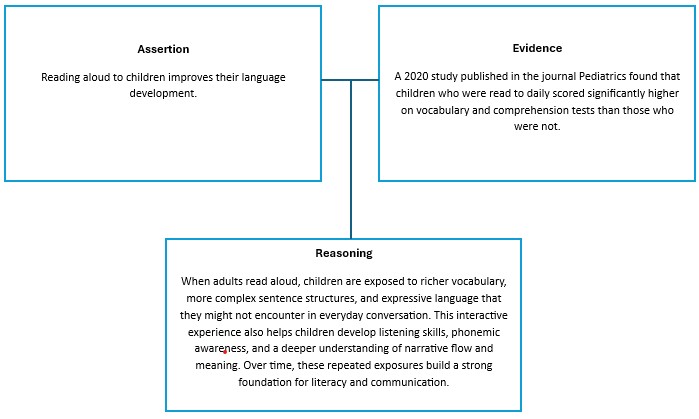
II. Assertion: College graduates earn more over their lifetime than non-graduates.
A. Reasoning: Higher education often leads to access to better-paying jobs, increased job stability, and more opportunities for career advancement. Employers tend to value the specialized knowledge, critical thinking skills, and credentials that come with a college degree which can translate into higher salaries and long-term financial benefits.
B. Evidence: According to the U.S. Bureau of Labor Statistics, individuals with a bachelor’s degree earn, on average, $1 million more over their lifetime than those with only a high school diploma.
This is statistical evidence from a credible government source, making it both persuasive and hard to refute. These examples illustrate the use of credible, relevant, and sufficient evidence to support claims. When presenting evidence in an argument, it is essential to evaluate its source, specificity, and direct connection to the claim being made. Strong evidence not only bolsters your position but also prepares you to address counterarguments effectively.
Directions: Complete the table below by creating a clear proposition or assertion about each given topic. For each assertion, explain the reasoning behind why it could be considered true or false. Finally, support your assertion with factual, expert, or scientific evidence. The first row is completed as an example for your reference. This exercise focuses on developing propositions of fact.
|
Topic |
Assertion | Reasoning (Why the claim is true) | Evidence (Proof supporting the reasoning) |
| School Uniforms | Requiring school uniforms improves student focus and reduces bullying. | Uniforms minimize distractions and reduce visible socioeconomic differences that often lead to teasing. | Studies from the National Association of Elementary School Principals report decreases in discipline issues after uniform policies are adopted. |
| Electric Cars | |||
| College Tuition | |||
| Climate Change |