Archaic Homo sapiens share our species name but are distinguished by the term “archaic” as a way of recognizing both the long period of time between their appearance and ours, as well as the way in which human traits have continued to evolve over time—making archaic Homo sapiens look slightly different from us today, despite technically being considered the same species. Living throughout the Old World during the Middle Pleistocene, archaic Homo sapiens are considered, in many ways, transitional between Homo erectus and modern Homo sapiens (see Figure 11.3). All archaic Homo sapiens share the defining trait of an increased brain size—specifically a brain of at least 1,100 cc and averaging 1,200 cc—but are also characterized by significant regional and temporal (time) variations. Because of these variations, scientists disagree on whether these fossils represent a single, variable species or multiple, closely related species (sometimes called Homo antecessor, Homo heidelbergensis, Homo georgicus, Homo neanderthalensis, and Homo rhodesiensis). For simplicity we are going to lump them all together under the heading of archaic Homo sapiens and discuss them as a unit, with the exception of a particularly unique and well-known population living in Europe and West Asia known as the Neanderthals, which we will examine separately.
Table 11.3.1: A comparison of Homo erectus, archaic Homo sapiens, and anatomically modern Homo sapiens. This table compares key traits of the crania and postcrania that distinguish these three hominins.
Trait
Homo erectus
Archaic Homo sapiens
Anatomically Modern Homo sapiens
Average Brain Size
900 cc
1,200 cc (1,500 cc when including Neanderthals)
1,400 cc
Skull Shape
Long and low
Angular
Intermediate
Short and high
Globular
Forehead
Absent
Emerging
Present
Nasal Region
Projecting nasal bones (bridge of the nose), no midfacial prognathism
Wider nasal aperture and midfacial prognathism
Narrower nasal aperture, no midfacial prognathism
Chin
Absent
Absent
Present
Other Facial Features
Large brow ridge and large projecting face
Intermediate
Small brow ridge and retracted face
Other Skull Features
Nuchal torus, sagittal keel, thick cranial bone
Projecting occipital bone, often called occipital bun in Neanderthals; intermediate thickness of cranial bone
Small bump on rear of skull, if anything; thin cranial bone
Dentition
Large teeth, especially front teeth
Slightly smaller teeth; front teeth still large;
retromolar gap in Neanderthals
Smaller teeth
Postcranial Features
Robust bones of skeleton
Robust bones of skeleton
More gracile bones of skeleton
When comparing Homo erectus, archaic Homo sapiens, and anatomically modern Homo sapiens across several anatomical features, one can see quite clearly that archaic Homo sapiens are intermediate in their physical form. This follows the trends first seen in Homo erectus for some features and in other features having early, less developed forms of traits more clearly seen in modern Homo sapiens. For example, archaic Homo sapiens trended toward less angular and higher skulls than Homo erectus but had skulls notably not as short and globular in shape and with a less developed forehead than anatomically modern Homo sapiens. archaic Homo sapiens had smaller brow ridges and a less-projecting face than Homo erectus and slightly smaller teeth, although incisors and canines were often about as large as that of Homo erectus. Archaic Homo sapiens also had a wider nasal aperture, or opening for the nose, as well as a forward-projecting midfacial region, known as midfacial prognathism. The occipital bone often projected and the cranial bone was of intermediate thickness, somewhat reduced from Homo erectus but not nearly as thin as that of anatomically modern Homo sapiens. The postcrania remained fairly robust, as well. To identify a set of features that is unique to the group archaic Homo sapiens is a challenging task, due to both individual variation—these developments were not all present to the same degree in all individuals—and the transitional nature of their features. Neanderthals will be the exception, as they have several clearly unique traits that make them notably different from modern Homo sapiens as well as their closely related archaic cousins.
Figure \(\PageIndex{1}\): “Broken Hill Man” archaic Homo sapiens cranium found at Kabwe in Zambia. One of several individuals found at this site, this cranium reflects common traits associated with archaic Homo sapiens in Africa including a large brain, taller cranium, and many Homo erectus-like features such as massive brow ridges, a large face, and thick cranial bones.
The one thing that is clear about archaic Homo sapiens is that regional variation, first seen in the different Homo erectus specimens across Asia and Africa, is clearly present and even more pronounced. While the general features of archaic Homo sapiens, identified earlier, are present in the fossils of this time period, there are significant regional differences. The majority of this regional variation lies in the degree to which fossils have features more closely aligned with Homo erectus or with anatomically modern Homo sapiens.
Figure \(\PageIndex{2}\): Atapuerca 5 archaic Homo sapiens found in northern Spain. One of many fossils found at this site, this fossil is representative of traits seen in archaic Homo sapiens in Europe including thick a cranial bone, enlarged cranial capacity, intermediate cranial height, and a more rounded cranium, as well as increased midfacial prognathism.
To illustrate this point, we will examine three exemplary specimens, one from each of the three continents on which archaic Homo sapiens lived. In Africa, “Broken Hill Man,” one of several individuals found in the Kabwe lead mine in Zambia, had a large brain (1,300 cc) and taller cranium as well as many Homo erectus-like skull features, including massive brow ridges, a large face, and thick cranial bones (Figure 11.4). Conditions for preservation in Asia during the Middle Pleistocene were not as conducive to the fossilization of complete crania; however, many archaic Homo sapiens skullcaps have been found. One partial crania from Dali, China, is representative of archaic Homo sapiens in Asia, including large and robust features with heavy brow ridges, akin to what is seen in Homo erectus, and a large cranial capacity intermediate between Homo erectus and anatomically modern Homo sapiens. Across Europe, many near-complete archaic Homo sapiens crania have been discovered, including one, part of an almost-complete skeleton, found in northern Spain at Atapuerca. Atapuerca 5 (Figure 11.5) has thick cranial bone, an enlarged cranial capacity, intermediate cranial height, and a more rounded cranium than seen previously. Additionally, Atapuerca 5 demonstrates features that foreshadow Neanderthals, including increased midfacial prognathism. After examining some of the fossils, the transitional nature of archaic Homo sapiens is clear—their features place them squarely between Homo erectus and modern Homo sapiens.
Due to the transitional nature of archaic Homo sapiens, identifying the time period they are associated with is problematic and complex. Generally, it is agreed upon that archaic Homo sapiens lived between 600,000 and 200,000 years ago. But regionally this varies with considerable overlap between Homo erectus on the early end of the spectrum and modern Homo sapiens and Neanderthals on the latter end. The earliest-known archaic Homo sapiens fossils tentatively date to about 600,000 years ago in Africa, whereas archaic Homo sapiens fossils in Asia appear around 300,000 years ago and in Europe around 350,000 years ago (and potentially as early as 600,000 years ago). The end point of archaic Homo sapiens is also problematic since it largely depends upon when the next subspecies of Homo sapiens appears and the classification of highly intermediate specimens. For example, in Africa, the end of archaic Homo sapiens is met with the appearance of modern Homo sapiens, while in Europe it is the appearance of Neanderthals that is traditionally seen as the end of archaic Homo sapiens.
Archaic Homo sapiens mark an important chapter in the human lineage, bridging more ancestral forms, such as Homo erectus, with modern Homo sapiens. During this period of climatic transition and fluctuation, archaic Homo sapiens mirror the challenges of their environments. Showing increasing regional variation due to the need for local adaptation, there is no single archetype for this group but, rather, multiple variations; their transitional nature is one of their key defining characteristics.


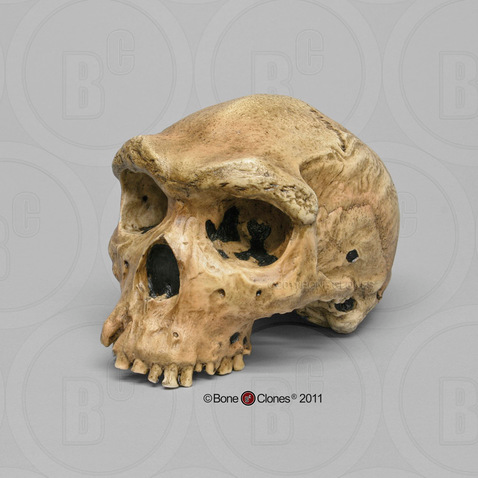 Figure \(\PageIndex{1}\): “Broken Hill Man” archaic Homo sapiens cranium found at Kabwe in Zambia. One of several individuals found at this site, this cranium reflects common traits associated with archaic Homo sapiens in Africa including a large brain, taller cranium, and many Homo erectus-like features such as massive brow ridges, a large face, and thick cranial bones.
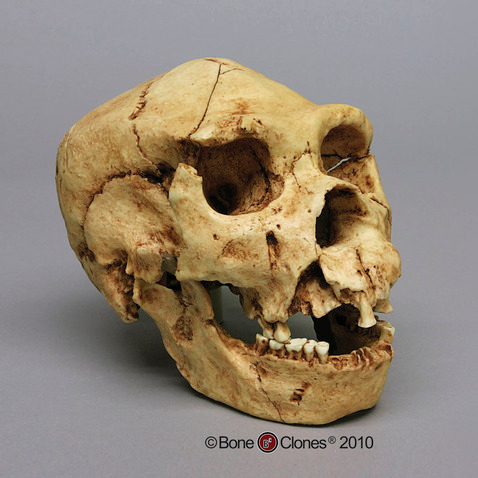 Figure \(\PageIndex{2}\): Atapuerca 5 archaic Homo sapiens found in northern Spain. One of many fossils found at this site, this fossil is representative of traits seen in archaic Homo sapiens in Europe including thick a cranial bone, enlarged cranial capacity, intermediate cranial height, and a more rounded cranium, as well as increased midfacial prognathism.