

11.2: How much Stimulus?
- Page ID
- 287990

\( \newcommand{\vecs}[1]{\overset { \scriptstyle \rightharpoonup} {\mathbf{#1}} } \)
\( \newcommand{\vecd}[1]{\overset{-\!-\!\rightharpoonup}{\vphantom{a}\smash {#1}}} \)
\( \newcommand{\dsum}{\displaystyle\sum\limits} \)
\( \newcommand{\dint}{\displaystyle\int\limits} \)
\( \newcommand{\dlim}{\displaystyle\lim\limits} \)
\( \newcommand{\id}{\mathrm{id}}\) \( \newcommand{\Span}{\mathrm{span}}\)
( \newcommand{\kernel}{\mathrm{null}\,}\) \( \newcommand{\range}{\mathrm{range}\,}\)
\( \newcommand{\RealPart}{\mathrm{Re}}\) \( \newcommand{\ImaginaryPart}{\mathrm{Im}}\)
\( \newcommand{\Argument}{\mathrm{Arg}}\) \( \newcommand{\norm}[1]{\| #1 \|}\)
\( \newcommand{\inner}[2]{\langle #1, #2 \rangle}\)
\( \newcommand{\Span}{\mathrm{span}}\)
\( \newcommand{\id}{\mathrm{id}}\)
\( \newcommand{\Span}{\mathrm{span}}\)
\( \newcommand{\kernel}{\mathrm{null}\,}\)
\( \newcommand{\range}{\mathrm{range}\,}\)
\( \newcommand{\RealPart}{\mathrm{Re}}\)
\( \newcommand{\ImaginaryPart}{\mathrm{Im}}\)
\( \newcommand{\Argument}{\mathrm{Arg}}\)
\( \newcommand{\norm}[1]{\| #1 \|}\)
\( \newcommand{\inner}[2]{\langle #1, #2 \rangle}\)
\( \newcommand{\Span}{\mathrm{span}}\) \( \newcommand{\AA}{\unicode[.8,0]{x212B}}\)
\( \newcommand{\vectorA}[1]{\vec{#1}} % arrow\)
\( \newcommand{\vectorAt}[1]{\vec{\text{#1}}} % arrow\)
\( \newcommand{\vectorB}[1]{\overset { \scriptstyle \rightharpoonup} {\mathbf{#1}} } \)
\( \newcommand{\vectorC}[1]{\textbf{#1}} \)
\( \newcommand{\vectorD}[1]{\overrightarrow{#1}} \)
\( \newcommand{\vectorDt}[1]{\overrightarrow{\text{#1}}} \)
\( \newcommand{\vectE}[1]{\overset{-\!-\!\rightharpoonup}{\vphantom{a}\smash{\mathbf {#1}}}} \)
\( \newcommand{\vecs}[1]{\overset { \scriptstyle \rightharpoonup} {\mathbf{#1}} } \)
\(\newcommand{\longvect}{\overrightarrow}\)
\( \newcommand{\vecd}[1]{\overset{-\!-\!\rightharpoonup}{\vphantom{a}\smash {#1}}} \)
\(\newcommand{\ket}[1]{\left| #1 \right>}\)
\(\newcommand{\bra}[1]{\left< #1 \right|}\)
\(\newcommand{\braket}[2]{\left< #1 \vphantom{#2} \right| \left. #2 \vphantom{#1} \right>}\)
\(\newcommand{\braopket}[3]{\left< #1 \vphantom{#2}\vphantom{#3} \right| #2 \vphantom{#1}\vphantom{#3} \left| #3 \vphantom{#1}\vphantom{#2} \right>}\)
\(\newcommand{\qmvec}[1]{\mathbf{\vec{#1}}}\)
\(\newcommand{\op}[1]{\hat{\mathbf{#1}}}\)
\(\newcommand{\expect}[1]{\langle #1 \rangle}\)
\(\newcommand{\dfn}[1]{\emph{\textbf{#1}}}\)
The government (both at the state and federal levels) has two tools that can be used to stimulate demand (shifting the aggregate demand curve to the right):
- Tax cuts
- Government spending
Both policy options have their pros and cons that will be discussed later in this lesson. But for right now we are going to examine the issue of how much government stimulus is needed to get the economy back to the full-employment level of output.
When the economy moves into the recession portion of the business cycle this means that the equilibrium level of output is below the full-employment level of output. See figure 2.

Figure 2
How large does the government’s stimulus need to be to push the economy (i.e., the AD curve) to the full-employment rate of output?
The size of the stimulus needs to be big enough to move the economy to full employment. If the GDP gap (sometimes referred to as the GDP gap or recession gap) is $800 billion then the stimulus needs to generate that much in new output. Graphically, this means that the stimulus needs to shift the AD curve far enough to the right to create a new equilibrium above the full employment level of output. See figure 3.
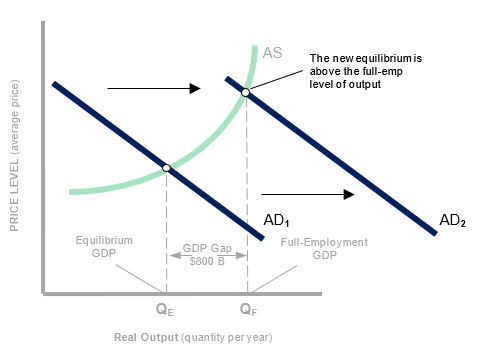
Figure 3
The total shift of the AD curve depends on three things:
- Size of the stimulus package (either spending and/or tax cuts)
- Size of the fiscal multiplier
- Price effect (i.e., slope of the AS curve)
Size of the Stimulus Package and Price Effects
The initial government stimulus shifts the AD curve to the right by the amount of the stimulus. For example, if the government spends $100 billion on a public works project (e.g., hydroelectric dam) then the AD curve will shift to the right by $100 billion. See figure 4.

Figure 4
Size of the Fiscal Multiplier
Income is generated when the government spends money on new production (e.g., the company that supplies the bulldozer for the government funded project earns income). This income will be either spent or saved (probably both). The income spent will have the same effect on the economy as the government stimulus. The secondary spending on new output will generate income for others and this will continue until “ripple effect” from new spending fades away. See figure 5.

Figure 5
The total shift of the AD curve has to be big enough to close the GDP gap and compensate for rising prices.
If the complete shift in AD equals the GDP gap, then the economy would not move to the full-employment rate of rate of output. See figure 6.

Figure 6
The reason the economy does not move to full employment when the AD curve shifts by the amount of the GDP gap is because as demand increases price levels rise. As prices increase it takes away some momentum from the shifting AD curve (after all, the law of demand states that demand falls when prices rise). See figure 7.

Figure 7
Because rising prices reduces the impact demand has on output the shift in AD must be greater than the GDP gap. See figure 8.
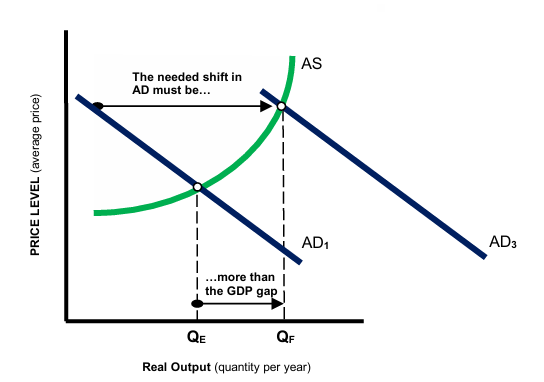
Figure 8
How can the government shift the aggregate demand curve from AD1 to AD3? First, the government does not have to do all of the shifting on its own. After the initial shift from a government stimulus package the AD will continue to shift (like a ball’s momentum from a push) due to the multiplier effect.
If the MPC is .8, then multiplier is 5 (multiplier = 1/(1-MPC)). This means that if the government spends $100 billion on new output the AD curve will shift by $500 billion.