Define, and distinguish between, key terms including government, state, country, and nation.
Describe the historical development of the state.
Differentiate between types of power and types of legitimacy within modern states.
Introduction
What is a government? Is government necessary? Why do governments exist?
There are approximately eight billion people on the planet and nearly 200 identified countries worldwide, each of which has a government running the country. A government is the organization, or the group of people, with the power to set rules, to manage, and to regulate a political unit. Yet the question of why most people live under a government, or in a country that has rules and societal norms, can be difficult to grasp. Why do people consent to being ruled over? The existence of nearly 200 countries for eight billion people suggests that, while daily life for the average person may be filled with myriad to-do lists and activities, political powers also influence daily life in small and big ways.
To this end, this section considers the historical formation of political power within countries and introduces several pieces of foundational terminology in the field of comparative politics.
Social Order and the Social Contract
Let’s begin with some critical questions: Why does government exist? Is government necessary?
A society without government or central leadership is one that lives in anarchy. Anarchy is a situation in which there is a lack of societal structure and no established hierarchy of power or central governing authority. While many scholars have considered the phenomenon and applicability of anarchy, it has not been a norm within the communities of humans living over the past 15,000 years. Even prior to the establishment of formal governments and formalized institutions, human beings organized themselves for survival purposes. Over the course of human history, humans began to understand that survival seemed more feasible when they cooperated with one another. While they did not have established, written laws, early humans did have informal rules and norms for how they handled themselves in society. Informal leaders also sometimes guided small groups, mostly composed of family members, in their pursuit of survival.
Take a moment to consider your own family when you were a child. Were there rules within your household? Who was in charge? Who told you what to do and when to do it? Whether your household had many or few rules, consider now how those rules contributed to the manner in which your family worked and lived. Did rules help your family? Did you think the family leaders were legitimate? Did you follow their rules voluntarily?
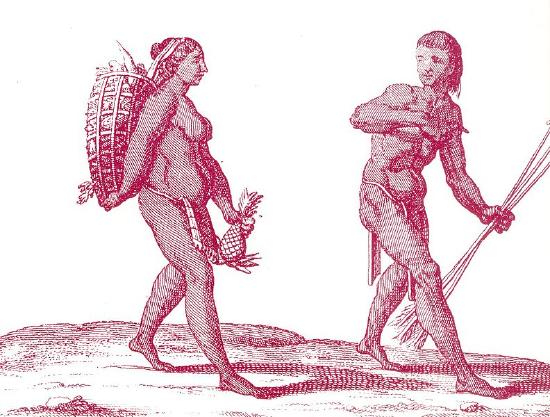
Over time, the small family groupings banded together into tribes with the common goal of surviving. These tribes then formed their own rules and norms for how their group should act. Over time, the sophistication of these tribes' survival techniques increased, moving from a hunter-gatherer approach--in which humans hunted for their food and gathered fruits, berries, and other available plant life--toward farming.
Approximately 12,000 years ago, developments during the Agricultural Revolution allowed humans to stay in one place for longer. Humans learned to grow crops by tilling the land and introducing early irrigation methods. With the ability to stay in one place for longer, rather than moving around constantly to hunt and gather, human groups began to aggregate in common locations. This aggregation also led to human population growth. A larger number of people living closer together led to the need for formal societal organization. To ensure successful coexistence, and ultimately survival, humans needed order. Rather than by pursuing an anarchical system, humans calculated that a strong set of rules would improve the status quo (individually and collectively), and therefore embraced mutual cooperation in a rules-based society.
This ultimately led to the development of ideas by philosophers like Thomas Hobbes, John Locke, and Jean-Jacques Rousseau to create what we now term "social contract theory." In short, a social contract is a formal or informal agreement between the rulers and those ruled in a society. Those who are ruled submit to the laws of the rulers in exchange for certain benefits.
Social contract theory developed gradually. Hobbes (1588-1679) acknowledged that all people act within their own self-interest, and in acting in their own self-interest, make calculations to ensure their survival. This selfish nature of human beings creates an unstable and dangerous state of nature. According to Hobbes, a government is therefore necessary, and beneficial, to control the masses. Locke (1632-1704), in his Two Treatises of Government, took a more positive view of human nature. He argued that all people are born with "certain, unalienable" rights, which governments should protect through their political institutions and structures. Rousseau (1712-1778), in The Social Contract, argued that society does not lend itself to equal and equitable treatment, and a government is therefore only legitimate if it comes from the consent of the people. He argued that there must be a "unified will" that takes into consideration the interests of the people for the common good.
We observe an early form of the social contract in Ancient Greece, where elite men participated in government and representatives worked on behalf of the people. While a direct democracy is a political system in which all citizens are involved in political decision-making, an indirect, or representative, democracy is one in which the people elect representatives to serve on their behalf to make the laws and rules of society. Though Ancient Greece excluded many members of the population from decision-making processes and therefore did not have a true democracy, people did submit to the ruling class, through a type of representative leadership, in order to gain protection from the political system---a social contract.
As a second historical example, we can consider the development of feudalism. Feudalism was a system of social order that arose out of the Middle Ages, particularly in Europe, wherein peasants (sometimes called Serfs) were forced to provide members of the upper class with their crops, goods, services, and loyalty. The upper class, usually Nobles, would provide some level of protection to the Serfs in exchange for their products and services. Though not the ideal social contract, the Serfs were able to exchange their goods and services for some level of protection of their lives and property.
Today, we observe social contracts in almost every type of political system, democratic and non-democratic, and these social contracts can be voluntary or involuntary. A voluntary social contract is one in which the people agree to submit to the ruling class. The benefits of doing so may be as simple as military protection. In the United States, for example, citizens are expected to obey the laws of the land, as expressed (in part) through the U.S. Constitution. This is in exchange for protection of their "life, liberty, and the pursuit of happiness," as famously written in the Declaration of Independence. Though a social contract may be voluntary, it does not always mean that those who are ruled enjoy privileges like freedom of speech. Rather, the people may simply need protection from outside threats, and they may voluntarily agree to submit to the ruling class without any guarantees of other protections like civil liberties. Alternatively, an involuntary social contract is when the ruling class dominates in a given territory and demands obedience from the people. In this case, those being ruled are coerced into a social contract.
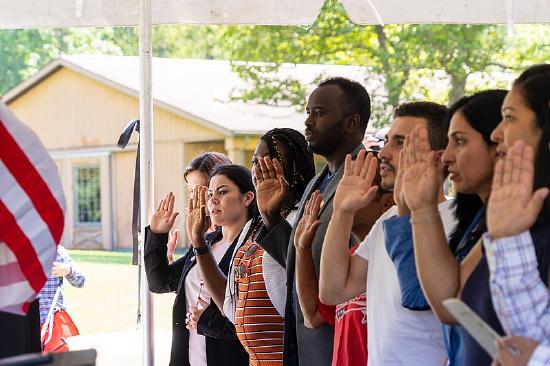
There are also implicit social contracts. For example, most U.S. citizens are born into their social contract because the 14th Amendment to the U.S. Constitution guarantees birthright citizenship. By being born into citizenship, Americans may never need to actualize, or act upon, their citizenship. They benefit from a system that protects their rights and liberties, even when they choose not to obey the law. In contrast, there are other U.S. citizens who are not born into this social contract, and instead go through a formal process, called naturalization, for citizenship. Naturalization is the process by which non-citizens formally become citizens of the country they reside in. Naturalization is a long process that requires multiple steps, including but not limited to background checks, oral examinations, paperwork, and pledging allegiance to the host country in a formal ceremony. The process of naturalization is an example of a voluntary and formal social contract.
To summarize, our understanding of and need for government comes from this historical reckoning of the social contract and the drive for social order. We will now define several related, but distinct, terms that are foundational to the study of comparative politics.
Defining Terms
One of the most frequently used words in the study of comparative politics is the word "state." For many students, "state" implies a subnational government, such as states within the United States like California, Louisiana, Montana, and Rhode Island. In comparative politics, however, a state is a national-level group, organization, or body that administers its own legal and governmental policies within a designated region or territory. As a reminder from a term introduced in Chapter 1, a state must have sovereignty, which is fundamental governmental power and authority in decision-making within a given territory.
States, then, are the major political actors in global politics. The United Nations, in fact, includes 193 member-states. Outside of the comparative politics discipline, many people tend to use the terms state, country, nation, and government interchangeably. Within comparative politics, each of these terms is distinct, and each term has different implications when observing political landscapes around the world.
If a state is a national-level organization that administers its own legal and governmental policies within a designated region or territory, what are nations and countries? While a state relates specifically to how a designated territory operates politically through institutions (e.g., legislatures, courts, the military), a nation is broadly defined as a population of people joined by common culture, history, language, and/or ancestry within a designated region or territory. It is therefore possible for a nation to exist without sovereignty. A country is similar, and the term that most people tend to use colloquially, but this term can encompass aspects of both the nation and the state. A country is a nation, which may have one or more states within it. Finally, as a reminder from the introduction to this section, a government is the group of people in charge of running a state. The government therefore changes over time (e.g., in a democracy, the government may change after an election).
As an example to better differentiate these terms, we will briefly consider the case of Spain. Spain, meaning all of the political institutions that manage the Spanish territory, is a state. Within Spain, there are several nations with unique languages, cultures, and traditions, such as the Basques, the Catalans, and the Galicians. When we speak of Spain as a country, we include both the political institutions making up the state and the diverse nations within the Spanish territory. Finally, the leadership in power at a given time--in Spain, a prime minister and their cabinet--is the Spanish government. When a new election takes place, the government may change, but the state remains the same.
As noted above, one of the crucially important characteristics of a state is its ability to independently organize its policies and goals. Sovereigntyis not only fundamental governmental power to coerce, but it also involves the ability to manage the state's affairs independently from outside interference (external sovereignty) and the ability to deflect internal resistance (internal sovereignty). If a state does not have the ability to manage its own affairs and issues, it will not be able to maintain power.
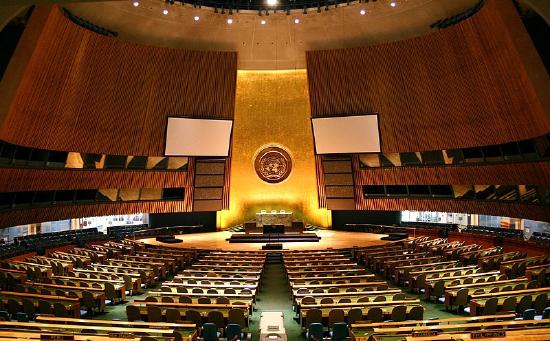
Power, broadly defined, is the ability to get others to do what you want them to do. Soft power means being able to get others to do what you want them to do using the methods of persuasion and attraction, such as through diplomacy or cultural influence. Hard power, in contrast, is the ability to get others to do what you want using physical, military might and/or aggressive economic measures. While hard power aims to coerce, soft power aims to persuade, and both types of power hold critical places in the world of politics.
Figure \(\PageIndex{6}\): On the left, a photo of the United Nations General Assembly Hall. Negotiating for ideal political terms is an example of soft power. On the right, a photo of a Test launch of an LGM-25C Titan II Intercontinental Ballistic Missile at Vandenberg Air Force Base in the United States, 1975. Launching a missile would be an example of trying to exercise hard power. (Sources: From left to right,United Nations General Assembly Hall by Patrick Gruban is licensed underCC BY-SA 2.0;An LGM-25C Titan II missile is launched at Vandenberg Air Force Base by the U.S. Air Force is licensed underPublic Domain - US)
Whether a state has power, and whether it can operate effectively, depends on its authority and legitimacy. Authority is the state's power to get things done. Legitimacy is the state’s ability to establish itself as a valid power over its citizens. If we put these two terms together, a state is legitimate in its operations if it has the authority to make decisions and carry out its policy goals.
A state's leaders (i.e., its government) can garner legitimacy through multiple means. Traditional legitimacy occurs when states have the authority to lead based on historical precedent. For example, the legitimacy of a king may stem from the passing down of the throne through one family over time. Charismatic legitimacy occurs when citizens follow the rules of a state based on the charisma and personality of the current leader. Rational-legal legitimacy occurs when states derive their authority through firmly established laws, rules, regulations, and procedures. This type of legitimacy often derives from a state's constitution, which is a written document describing the basic principles and laws of the state.
Each of these forms of legitimacy, especially when taken together, can enhance a state’s ability to function. If, for instance, there is a written and adopted constitution, and that document has been transparently drafted and considered by representatives of a state, individuals will know what the rules are within their state (rational-legal legitimacy). In time, as laws and norms are followed and accepted, this process establishes a historical precedent that individuals are more likely to accept (traditional legitimacy). Finally, if there happens to be an especially appealing or inspirational leader, that person may be able to garner further support from the people to deepen a state’s legitimacy (charismatic legitimacy).
Keeping in mind the differences in the terms government, state, country, and nation, the next section will provide two further distinctions. First, we will consider how to differentiate "weak" versus "strong" states. Second, we will start to consider one additional foundational term, political regime, which we will expand on in Chapter 4 and Chapter 5.