

12: The Criminal Justice System in Texas
- Page ID
- 129189

\( \newcommand{\vecs}[1]{\overset { \scriptstyle \rightharpoonup} {\mathbf{#1}} } \)
\( \newcommand{\vecd}[1]{\overset{-\!-\!\rightharpoonup}{\vphantom{a}\smash {#1}}} \)
\( \newcommand{\dsum}{\displaystyle\sum\limits} \)
\( \newcommand{\dint}{\displaystyle\int\limits} \)
\( \newcommand{\dlim}{\displaystyle\lim\limits} \)
\( \newcommand{\id}{\mathrm{id}}\) \( \newcommand{\Span}{\mathrm{span}}\)
( \newcommand{\kernel}{\mathrm{null}\,}\) \( \newcommand{\range}{\mathrm{range}\,}\)
\( \newcommand{\RealPart}{\mathrm{Re}}\) \( \newcommand{\ImaginaryPart}{\mathrm{Im}}\)
\( \newcommand{\Argument}{\mathrm{Arg}}\) \( \newcommand{\norm}[1]{\| #1 \|}\)
\( \newcommand{\inner}[2]{\langle #1, #2 \rangle}\)
\( \newcommand{\Span}{\mathrm{span}}\)
\( \newcommand{\id}{\mathrm{id}}\)
\( \newcommand{\Span}{\mathrm{span}}\)
\( \newcommand{\kernel}{\mathrm{null}\,}\)
\( \newcommand{\range}{\mathrm{range}\,}\)
\( \newcommand{\RealPart}{\mathrm{Re}}\)
\( \newcommand{\ImaginaryPart}{\mathrm{Im}}\)
\( \newcommand{\Argument}{\mathrm{Arg}}\)
\( \newcommand{\norm}[1]{\| #1 \|}\)
\( \newcommand{\inner}[2]{\langle #1, #2 \rangle}\)
\( \newcommand{\Span}{\mathrm{span}}\) \( \newcommand{\AA}{\unicode[.8,0]{x212B}}\)
\( \newcommand{\vectorA}[1]{\vec{#1}} % arrow\)
\( \newcommand{\vectorAt}[1]{\vec{\text{#1}}} % arrow\)
\( \newcommand{\vectorB}[1]{\overset { \scriptstyle \rightharpoonup} {\mathbf{#1}} } \)
\( \newcommand{\vectorC}[1]{\textbf{#1}} \)
\( \newcommand{\vectorD}[1]{\overrightarrow{#1}} \)
\( \newcommand{\vectorDt}[1]{\overrightarrow{\text{#1}}} \)
\( \newcommand{\vectE}[1]{\overset{-\!-\!\rightharpoonup}{\vphantom{a}\smash{\mathbf {#1}}}} \)
\( \newcommand{\vecs}[1]{\overset { \scriptstyle \rightharpoonup} {\mathbf{#1}} } \)
\(\newcommand{\longvect}{\overrightarrow}\)
\( \newcommand{\vecd}[1]{\overset{-\!-\!\rightharpoonup}{\vphantom{a}\smash {#1}}} \)
\(\newcommand{\avec}{\mathbf a}\) \(\newcommand{\bvec}{\mathbf b}\) \(\newcommand{\cvec}{\mathbf c}\) \(\newcommand{\dvec}{\mathbf d}\) \(\newcommand{\dtil}{\widetilde{\mathbf d}}\) \(\newcommand{\evec}{\mathbf e}\) \(\newcommand{\fvec}{\mathbf f}\) \(\newcommand{\nvec}{\mathbf n}\) \(\newcommand{\pvec}{\mathbf p}\) \(\newcommand{\qvec}{\mathbf q}\) \(\newcommand{\svec}{\mathbf s}\) \(\newcommand{\tvec}{\mathbf t}\) \(\newcommand{\uvec}{\mathbf u}\) \(\newcommand{\vvec}{\mathbf v}\) \(\newcommand{\wvec}{\mathbf w}\) \(\newcommand{\xvec}{\mathbf x}\) \(\newcommand{\yvec}{\mathbf y}\) \(\newcommand{\zvec}{\mathbf z}\) \(\newcommand{\rvec}{\mathbf r}\) \(\newcommand{\mvec}{\mathbf m}\) \(\newcommand{\zerovec}{\mathbf 0}\) \(\newcommand{\onevec}{\mathbf 1}\) \(\newcommand{\real}{\mathbb R}\) \(\newcommand{\twovec}[2]{\left[\begin{array}{r}#1 \\ #2 \end{array}\right]}\) \(\newcommand{\ctwovec}[2]{\left[\begin{array}{c}#1 \\ #2 \end{array}\right]}\) \(\newcommand{\threevec}[3]{\left[\begin{array}{r}#1 \\ #2 \\ #3 \end{array}\right]}\) \(\newcommand{\cthreevec}[3]{\left[\begin{array}{c}#1 \\ #2 \\ #3 \end{array}\right]}\) \(\newcommand{\fourvec}[4]{\left[\begin{array}{r}#1 \\ #2 \\ #3 \\ #4 \end{array}\right]}\) \(\newcommand{\cfourvec}[4]{\left[\begin{array}{c}#1 \\ #2 \\ #3 \\ #4 \end{array}\right]}\) \(\newcommand{\fivevec}[5]{\left[\begin{array}{r}#1 \\ #2 \\ #3 \\ #4 \\ #5 \\ \end{array}\right]}\) \(\newcommand{\cfivevec}[5]{\left[\begin{array}{c}#1 \\ #2 \\ #3 \\ #4 \\ #5 \\ \end{array}\right]}\) \(\newcommand{\mattwo}[4]{\left[\begin{array}{rr}#1 \amp #2 \\ #3 \amp #4 \\ \end{array}\right]}\) \(\newcommand{\laspan}[1]{\text{Span}\{#1\}}\) \(\newcommand{\bcal}{\cal B}\) \(\newcommand{\ccal}{\cal C}\) \(\newcommand{\scal}{\cal S}\) \(\newcommand{\wcal}{\cal W}\) \(\newcommand{\ecal}{\cal E}\) \(\newcommand{\coords}[2]{\left\{#1\right\}_{#2}}\) \(\newcommand{\gray}[1]{\color{gray}{#1}}\) \(\newcommand{\lgray}[1]{\color{lightgray}{#1}}\) \(\newcommand{\rank}{\operatorname{rank}}\) \(\newcommand{\row}{\text{Row}}\) \(\newcommand{\col}{\text{Col}}\) \(\renewcommand{\row}{\text{Row}}\) \(\newcommand{\nul}{\text{Nul}}\) \(\newcommand{\var}{\text{Var}}\) \(\newcommand{\corr}{\text{corr}}\) \(\newcommand{\len}[1]{\left|#1\right|}\) \(\newcommand{\bbar}{\overline{\bvec}}\) \(\newcommand{\bhat}{\widehat{\bvec}}\) \(\newcommand{\bperp}{\bvec^\perp}\) \(\newcommand{\xhat}{\widehat{\xvec}}\) \(\newcommand{\vhat}{\widehat{\vvec}}\) \(\newcommand{\uhat}{\widehat{\uvec}}\) \(\newcommand{\what}{\widehat{\wvec}}\) \(\newcommand{\Sighat}{\widehat{\Sigma}}\) \(\newcommand{\lt}{<}\) \(\newcommand{\gt}{>}\) \(\newcommand{\amp}{&}\) \(\definecolor{fillinmathshade}{gray}{0.9}\)After reading this chapter, you should be able to:
- Explain the hierarchy of the criminal justice system.
- Outline the nature of criminal law and the different classifications of criminal offenses.
- Trace the judicial procedures associated with criminal cases.
- Describe the structure of the Texas prison and jail systems and how they have evolved.
- Assess the prospects for substantive criminal justice reform.
Approximately seventy-one percent of murders in Texas remain open, pending the discovery of new evidence—Texas has over 15,000 “cold cases.”1 Among those cases are unsolved mysteries which are “fascinating [sometimes gruesome] and bizarre real cases that continue to stump detectives and amateur sleuths2 (Figure 12.1). One cold case, dubbed the “Lover’s Lane Murders,” took place in an undeveloped wooded area of West Houston in 1990. Cheryl Henry and her boyfriend, Andy Atkinson, had parked in a deserted spot known by young couples in the area. Law enforcement officers found the couple's car at the scene and their bodies in the woods close by. The unknown assailant raped Cheryl and then slashed her throat. Her half-buried body was recovered under a pile of wood. Authorities believe Andy was killed afterward, and his body was found bound to a tree, with severe damage to his neck. New DNA evidence was discovered linking the murder to a rape case in 2017.3 But the investigation continues.
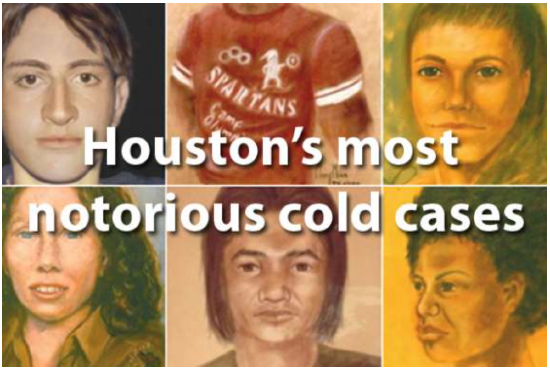
Some of the most infamous unsolved cases have very unusual names including: “Texarkana Moonlight Murders” (1946) when Texas Rangers were drafted but ultimately unable to find the so-called “Phantom Killer" of five who attacked couples late at night, and the macabre “Icebox Murders” (1965) where police discovered the heads of eighty-one year old Fred Rogers and his seventy-nine year old wife, Edwina, in the vegetable bins of their refrigerator. In the “Texas Killing Fields” case the bodies of more than thirty young women and children were found in the 1970s buried along a stretch of I-45 South between Houston and Galveston. The number of bodies indicates that multiple killers have used the remote area to dispose of their victims’ bodies though locals initially believed these were the victims of one serial killer. The brother of a twenty-five year old woman whose bloody body was found in her bathroom in Houston’s Orchard Apartments (“Orchard Apartment Murders”) over forty years ago but whose killer was never identified said, "Each year, it gets rougher knowing someone is out there, getting away with it. . . . You just can't let something like that go."4
Recognizing the “cold case crisis,” the Texas legislature created a Texas Ranger Unsolved Crimes Investigation Program in 2001.5 In 2018, Texas Ranger James Holland brought the convicted killer, Samuel Little, back to Texas. At seventy-eight, he admitted responsibility for ninety-three unsolved murder cases.6 For the survivors of these homicide victims, there is no full closure until these crimes are solved. Solving these—and many other similar forgotten cases—remain at the forefront of this specialized investigator group of Texas Rangers. Police reformer James Adcock, president of Mid-South Cold Case Initiative, says given the backlog it’s not enough. He argues police departments could improve results by shifting funding to detectives, training, and forensic testing, and embracing innovations like “publishing data online on unsolved cases to seek tips, hiring civilians to handle administrative duties, and creating or expanding cold case task forces to include retired officers, professors, or other hand-selected volunteers.”7
Perhaps you will one day become a part of the process that brings justice to those who commit crimes and relief to their victims and their families. Why not consider a career in law enforcement investigation, in law as a prosecutor, or even as a judge who presides over such cases. If you pursue another, unrelated, career path, there is still a good chance that you may participate in the legal system at least once during your life, either as a witness or a juror in a criminal case. If so, perhaps you will be part of history when any of these or other similar cases are resolved after many years of remaining dormant.
- 12.1: Sources and Hierarchy of Law
- This page discusses the Texas Penal Code and Code of Criminal Procedure, which govern criminal law in Texas, detailing criminal offenses, classifications, and the rights of the accused. Established in 1856 and reorganized in 1973, these codes are subject to the Supremacy Clause, which emphasizes that federal laws take precedence over state and local laws.
- 12.2: Criminal Law, Justice, and Offenses
- This page explains criminal law's focus on punishing harmful actions to society, emphasizing state prosecution. It describes Texas's criminal justice system, which prioritizes quick punishment for offenders and distinguishes between misdemeanors and felonies. The page also highlights Texas's determinate sentencing guidelines that promote consistent penalties based on crime classification.
- 12.3: Texas Criminal Justice Process
- This page discusses the Texas court system's balance between public welfare and the rights of the accused, detailing the criminal justice process from investigation to appeal, including policing based on constitutional guidelines. It also references bail reform efforts in Harris County aimed at addressing poverty-related incarceration, the abolition of cash bail for minor offenses, and implications for other counties, alongside constitutional provisions regarding bail and parole.
- 12.4: Crime and Criminal Defense
- This page discusses the Sixth Amendment's guarantee of effective legal representation for criminal defendants, emphasizing options like self-representation, pro bono services, and the roles of court-appointed attorneys and public defenders. It highlights the challenges faced by public defenders, including high caseloads and underfunding, and references key cases such as Gideon v. Wainwright.
- 12.5: Civil Liberties- Protecting the Rights of the Criminally Accused
- This page discusses the Bill of Rights' vital protections for individuals, particularly in criminal proceedings, through amendments that ensure fair treatment, such as the Fourth, Fifth, Sixth, and Eighth Amendments. It highlights Texas's shifting public sentiment against the death penalty due to wrongful convictions and racial disparities, as well as the decline in its use since life without parole became available.
- 12.6: The Texas Correctional System
- This page outlines the evolution of Texas's penitentiary system, beginning with the first state penitentiary in 1849, and its current status under the Texas Department of Criminal Justice. It highlights issues such as overcrowding, high execution rates, and a shift toward life sentences.
- 12.7: Recent Reforms of the Texas Criminal Justice System
- This page discusses Texas's dual focus on rights for crime victims and the accused, with tough sentencing and prison conditions reflecting conservative views. While there are emerging bipartisan efforts for criminal justice reform aimed at community supervision, criticism persists over high incarceration rates. Despite some progress and claims of successes in reforms, the page emphasizes the ongoing need for collaborative solutions to enhance justice and public safety.
- 12.8: Prospects for Future Criminal Justice Reform
- This page discusses Texas legislators' growing focus on criminal justice reforms aimed at addressing systemic issues such as rehabilitation for inmates, financial impacts on communities, and support for individuals with disabilities. Key proposals include the George Floyd Act to increase police accountability and critiques from the Sunset Advisory Commission regarding law enforcement regulations.
- 12.9: Conclusion
- This page explores the Texas criminal justice system's emphasis on punishment over rehabilitation, driven by a political culture favoring harsh penalties, especially for violent crimes. It discusses the collaboration among government agencies in managing prosecutions and parole while noting the pressure to consider public sentiment.
- 12.10: Critical Thinking Questions
- This page discusses the high prison populations in Texas, driven by socioeconomic issues like low income and education. It recommends improvements in education and access to college for low-income students. Furthermore, it highlights the treatment of 17-year-olds as adults in the justice system, which critics claim increases recidivism. Advocates for reform suggest reassigning these young offenders to juvenile justice, but financial limitations may obstruct these proposed changes.
- Thomas Hargrove, “Cold Case Homicide Statistics – Breakdown of Homicide Clearance Rates,” Project: Cold Case (2019).
- Web Infoguy, “Unsolved Mysteries: Famous Murders that Remain Unsolved,” Unspeakable Times Ranker, upd. Oct.19, 2020, https://www.ranker.com/list/famous- unsolved-murder-cases/web-infoguy.
- Shern-Min Chow, “Missing Pieces: Police Using New Technology to Help Solve ‘Lovers Lane Murders,’” KHOU 11, Nov. 17, 2017, https://www.khou.com/article/news/in.../285-492796954.
- Sadie Gurman,”Murder Victim Mary Michael Calcutta's Family 'Just Can't Let Go,' Even after 30 Years,” Pittsburgh Post-Gazette, Aug. 19, 2009, https://www.post-gazette.com/neighbo...s/200908170197.
- Lise Olsen, “Undetected,” Texas Observer, Feb. 8, 2021, https://www.texasobserver.org/undetected/.
- Olsen, “Undetected,” https://www.texasobserver.org/undetected/.
- Olsen, “Undetected,” https://www.texasobserver.org/undetected/.