At the end of this chapter you will be able to do the following.
Define and identify marrieds, nonmarrieds, and cohabitors
Identify pros and cons of each group
Explain the legal aspects of marriage
Compare benefits for marrieds and nonmarrieds
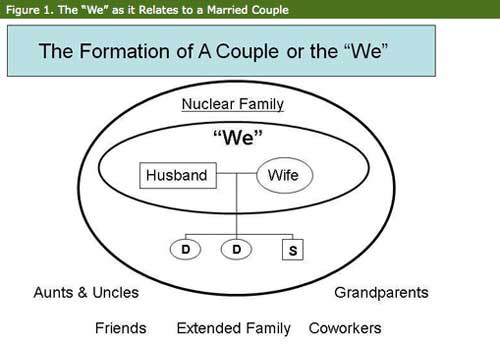
A couple is simply a pair of people who identify themselves in terms of belonging together, trusting one another, and having a unique relationship, separate from all others. A "We" is close to the same thing, yet it focuses on the relationship as an entity in itself. A "We," as shown in Figure \(\PageIndex{1}\), is a married couple but can also include cohabiters or other intimate non-married couple arrangements. This is a relationship that is not intimately connected to any other relationships at the same profound level as they are connected to one another.
Figure \(\PageIndex{1}\). The "We" as it Relates to a Married Couple
Here is a metaphor, a "We" is much like a vehicle (relationship) that two people purchased together. Both have to put in maintenance. Both have to care for it and treat it in such a way that it runs for a long time. Sometimes, spouses or partners attack the other in such a way that the other is harmed or damaged in their trust. A "We" is the social and emotional boundary a couple establishes when they decide to become a couple. This boundary includes only the two partners. It purposefully excludes the children, extended family, co-workers, and friends. Most couples who establish a strong marital bond have successfully distinguished themselves as a "We" and partially disengaged from the existing relationships of child, grandchild, best friends, etc. That is not to say that you cut your parents, relatives, and other friends off. You just have to establish a new exclusive intimacy that only includes you and your spouse. \({ }^1\)
This also means making certain things into spouse-only issues which are the decisions, advice, and discussion that are held exclusively between partners and intentionally NOT between other family and friends. This might include types of birth control, how to run a budget, sexual techniques and practices, who might be at fault in an argument, etc. If a couple marries in their late 20 's, then they have a lifelong history of intimate help-seeking and advice-giving relationships with others. These may continue as long as the help-seeking behavior doesn't violate the intimate agreements of confidentiality for each spouse or partner. It is crucial to form the "We" so that married couples avoid the damaging intrusions of family and friends into their new marriage.
Marriage is a legal union between a man and a woman as recognized by most of the United States. Internationally, and in certain U.S. political regions, a man and another man or a woman and another woman can be legally recognized as a married couple. What are typical marriage structures? The U.S. and world-wide culturally preferred marriage type today is monogamy. Monogamy is the marriage form permitting only one spouse at a time. Almost all who have married in the U.S. have done so monogamously since the original colonies in the 1600s. Monogamy implies a 1:1 relationship and is typically desired both by married couples and by opposite and same-sex cohabiters.
Cohabitation is the heterosexual, bisexual, and homosexual moving in together of two partners without going through the formalities of legal marriage. Although similar in form and function, cohabitating couples live differently in many significant day-to-day aspects when compared to married couples. Also, many cohabiting couples eventually choose to marry, but their risk of divorce is higher than among couples that never cohabited. Cohabitation will be discussed more below, but it has been increasingly popular over the last 30 years.
Polygamy is a marriage form permitting more than one spouse at the same time. Polygyny is marriage form permitting more than one wife at the same time and is the most common form of polygamy in the world's history. Polygyny is still common and legal in many African, Middle-Eastern, Muslim, and Indian nations. It was a deep part of China's history and prior to World War II it was common for a Chinese man to have multiple wives and many children.
Polyandry is a marriage form permitting more than one husband at the same time. This is historically and currently rare, and, if or when it was practiced, it often includes the marriage of one wife to a set of brothers with all husbands having sexual access to the wife. Polyandry was found among some Pacific Island cultures and among the pre-Taliban Afghanis.
What if a person marries, divorces, marries, divorces, etc.? Serial Monogamy or Serial Polygamy is the process of establishing intimate marriage or cohabiting relationships that eventually dissolve and are followed by another intimate marriage or cohabiting relationship, that eventually dissolve, etc. in a series. Thus polygamists have simultaneous multiple spouses while serial monogamists or serial polygamists have multiple spouses in a sequence of relationships. Millions of U.S. adults will experience serial marriages and divorces. Many marry then divorce, yet still want to be married again. Many others who suffered through their parents' unhealthy marriages and divorces also want to marry, knowing firsthand how risky that might be.
Footnotes
1. see Judith Wallerstein and Sandra Blakeslee (1995) The Good Marriage ISBN 0-446-67248-3; Warner Pub