So often arguments focus on who was right, which facts were involved, and ultimately who is to blame. These types of arguments are annoying both to have and to overhear. These are called non-directional arguments, because the underlying issue is not being dealt with in the argument itself. Non-directional arguments happen for many reasons, but rarely help resolve an issue. Arguing is a quandary for many people because they believe that arguing is a weakness, sign of trouble, or even a sin. Marriage and family researchers have established for years that it is not the argument that is the problem; it is how the argument transpires that matters.
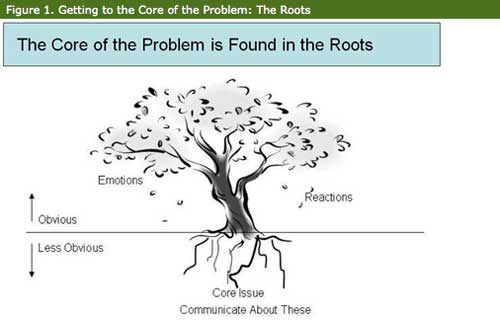
Directional arguments have a goal or a purpose and usually approach the issue that led to the argument in the first place. It isn't always obvious how to argue in such a way that it accomplishes something useful. Markman et al. (2001) have established a training program for how to help couples fight for their marriages (Markman, Stanley, \& Blumberg, 2010). Likewise, John Gottman (2002) published a relationship book that focuses on strategies for healthy arguments (among other strategies) (Gottman \& DeClaire, 2002). The core of a healthy argument is to get to the root of the problem in such a way that both parties can be content with the outcomes. Easier said than done? Learning to argue is not rocket science. Have you ever heard the phrase "beat around the bush?" In Figure 1 the bush is the argument. The real source of the argument comes from the roots or core issue. So often when we argue about who was right and who is to blame, or when we become emotional and react to what the other says, we waste time beating around the bush rather than getting to the real issue.
The root cause is often less obvious because we don't always know exactly what is bugging us. We simply get frustrated or concerned and start talking. If emotions and pride set in, the argument becomes non-directional and burdensome.
Figure \(\PageIndex{1}\). Getting to the Core of the Problem: The Roots
The diagram in Figure \(\PageIndex{2}\) shows the same principle found in Figure \(\PageIndex{1}\). In Figure \(\PageIndex{2}\) the core of the problem lies on the left side of the “root of most disagreements” and these core issues are common for most people. Our values are what we define as important, desirable, and of merit. Our beliefs are what we define as real and accept as truths in our lives. Needs are those things that are necessary to our existence and wants are those things we would like to have. Our values, beliefs, needs, and wants are typically where most core issues originate.
Let's walk through the model with a case study. A young couple married and were saving to eventually make a down payment on a home. She worked in the loan department of a bank and he worked in construction. One Friday afternoon she came home from work. She had a difficult day at work and was especially tired and stressed. She opened the door to their apartment, carrying a box of paperwork in her arms. Not knowing her husband had taken off his muddy work boots, she tripped and almost fell. She sat her box down and looked down only to find that her best work shoes had mud on them and were now scratched.
She slipped them off thinking she would have to come back later and clean them up. On the way to the bedroom she tipped over a half-eaten bowl of cereal that dampened her sock and messed up the carpet. She made it to the bedroom and dropped the box on the floor. She took off her socks and put them on the bathroom sink. She then noticed her husband's muddy pants draped over the toilet. She suddenly realized that within less than one minute, she now had to clean, her muddy shoes, her sticky socks, the wet carpet, and the toilet. Just then her husband returned from the mailbox and said “Honey, I’m home.”
Figure \(\PageIndex{2}\). How to Have a Healthy Argument: the Win-Win Model
Her husband had arrived 30 minutes earlier excited about a pay raise he'd received that day. He had showered, started eating a bowl of cereal, and darted out to get the mail. When he walked in the door she slammed the bedroom door and locked it.
A hurtful argument
"Honey are you in there?" he asked knocking on the door.
"Leave me alone!" she yelled through the door while crying.
"Honey what's the matter; are you okay?"
"I'm fine!"
"Did I do something wrong?"
"No, I did when I married a pig!"
"A pig?"
"Yes, you live like a pig!"
"Well, well whose mother is always meddling in our marriage?"
“What?” She gasped. “Then whose uncle is in prison for life!” “That’s it.” He stomped out of the apartment and drove off.
This is a non-directional, beating around the bush, and hurtful argument. You can see what happened to them using the diagram in Figure \(\PageIndex{2}\). Somewhere between the muddy boots and the toilet, she felt a perceived injustice. She felt like her husband did not respect her need to keep a clean apartment. Her emotional response was anger. It happens to us all, but in this case it wasn't controlled very well and she took the low-road in this diagram which is the combat response.
When she slammed the door and called him a pig, she was attacking him, emotionally, psychologically, and or intellectually. By doing this she inadvertently gave him a perceived injustice. He also has values and most likely felt that his need to be respected by his wife was not met. He perceived an injustice of maltreatment, felt hurt, then also took the low road and retaliated with an attack on her mother. Had this argument continued, the vicious cycle of beating around the bush or perpetually providing each partner with a perceived injustice, emotional response, and combat opportunity may have continued. Notice that the core issues were never dealt with in their communication. Never in this exchange did either of them get to their needs, wants, values, or beliefs.
She came from a home where her mother was an immaculate homemaker, stay-at-home mother, and artist. She and her mother prided themselves on the cleanliness and order of their homes. She married a young man whose mother cleaned up after him. He could count on one hand the number of times he cleaned his room while growing up. They chose each other! On top of that she was stressed and tired and he was jubilant from the good week at work and pay raise. Neither is to blame. Arguments happen to everyone and unhealthy ones will be the pattern unless they do something about it. They both had to modify their behaviors so that they could get to the core issues and support one another. To do that, they'd have to take the high road.