The high road in this model offers problem resolution strategies which have been around the counseling and communications literature for many years. They've been researched and discussed in numerous self-help and consulting books over the last two decades. They work well and offer techniques which facilitate a healthy argument and outcome. The first strategy is to negotiate a win-win solution. The goal is that everyone can find a way to work out an argument or disagreement so that the other person feels like he or she came out with his or her needs addressed and met as well. Think about it, if you always win then your partner always loses. That would make her or him a loser and who wants to be married to a loser? Figure \(\PageIndex{1}\) shows the diagram of how a couple forms an entity called the "We."
Figure \(\PageIndex{1}\). How the Couple Forms a "We"
A couple is simply a pair of people who identify themselves in terms of belonging together, trusting one another, and having a unique relationship, separate from all others. A "We" is close to the same thing, yet it focuses on the relationship as an entity in itself. A "We" as shown in this diagram is a married couple but can include cohabiters, or other intimate nonmarried couple arrangements. This is a relationship that is not intimately connected to any other relationships as profoundly as they are connected to one another. A "We" is much like a vehicle that two people purchase together. Both have to put in maintenance. Both have to care for it and treat it in such a way that it runs for a long time. Sometimes, spouses or partners attack the other in such a way that the other is harmed or damaged in their trust. A "We" is the social and emotional boundary a couple establishes when they decide to become a couple. This boundary includes only the husband and wife. It purposefully excludes the children, extended family, co-workers, and friends.
When one spouse is made to feel like the loser, then it's like getting upset and scratching the car's paint or stabbing a tire with a screwdriver. How long can a car last if one inflicts damage in this way? The key is to remember that together you have formed a social bond that can only be as strong as its weakest part. Many non-directional arguments weaken one or both partners and can lead to an eventual abandonment of the relationship since this undermines the emotional connection and bond.
Knowing a strategy to create a win-win situation makes it much more likely to happen. Think about what you might need if you were the couple in the story above. What might she desire? Perhaps she’d like for him not to make messes for her. What might he desire? Perhaps he’d like for her to refrain from calling him farm animal names. So, later, after both have cooled down they may decide to talk about what happened and forgive one another. Then, they might try to answer this key question, each taking a turn to listen to the other, “What was really at the core of your concern?”
"Well, I've talked to you for nearly two years about how hard it is for me to feel love for you when I pick up after you and clean up your messes," She might say.
"Well, I've heard you and your family members call people names when they are not present, and I need for you to refrain from calling me names like that," He might say.
"Well, I've talked to you for nearly two years about how hard it is for me to feel love for you when I pick up after you and clean up your messes," She might say.
"Well, I've heard you and your family members call people names when they are not present, and I need for you to refrain from calling me names like that," He might say.
Figure \(\PageIndex{2}\). How to Have a Healthy Argument: the Win-Win Model
The second option under Figure \(\PageIndex{2}\)., Problem Resolution Strategies is to Agree as a Gift. This is to be done only on very unique circumstances. Agreeing as a gift means that you are willing to give in on something of importance at your root level. Let's use the example of a couple who were building their own home. They were exhausted and burned out. One day during a normal morning start to the day. He mentioned that in the day's schedule he wanted to go down to the brick yard and pick out the brick. He'd assumed that brick would be the best way to go. She brought up the point that she had already mentioned using stone instead of brick to him months before and had already picked out three types she really liked. They ended up in a heated argument. The next day he expressed his sorrow for assuming that she would just go with him on the brick idea. He then offered her this olive leaf, "I'll support whatever stone you think is best for the outside of our new home." She was surprised and asked him why he'd give in like that. "You spend more time at home with the children. You grew up in a home faced with stone, and to me, I just was trying to be efficient about getting this home built and it really didn't matter for me as much as it does for you."
They both then talked about how tired and worn out they had become and how dangerous building a home can be to a marital relationship. In this case, he offered to agree as a gift. It wasn't a negotiation for future authority to decide on a home trait. It was an unattached gift. It's important not to give in all the time; a one-sided relationship is not satisfying for either person in the long run. Martyrs always give in and find themselves unhappy with the direction of the relationship. The "We" is strong because of many negotiations which ensure that both parties can have their core issues addressed while meeting the needs of the other. If you sense the issue is more important to your partner than it is to you, give in.
Problem Resolution Strategy three is to simply learn to live with differences in a relationship. Most couples do have irreconcilable differences in their marriage or relationship. Most couples realize that each is an individual and each has uniqueness that they bring to the "We" which makes it what it is in terms of richness and viability. Some people think that their partner should change because their happiness may depend upon it. Many studies suggest that individuals are as happy as they choose to be, regardless of the changing that does or does not transpire in their relationship. Happiness is a conscious choice and exists when the individual persists in feeling happy even in difficult circumstances (Frankl, 2006).
Finally, Problem Resolution Strategy four is to simply change yourself. If you came from a home where a clean home reflected upon your self-worth, where a clean home meant a happy home, and where a clean home meant that you and your mother were close, and then you married a guy who never did housework, why should he have to change? He might over the years learn to share the housework responsibilities, but in the reality of things it might be easier to redefine the meaning of a clean home to yourself than to ask another individual to be something else in an attempt to accommodate your current tastes.
The model in Figure \(\PageIndex{2}\). is a useful way of understanding where arguments come from and how they might be best managed in such a way that the "We" is ultimately nurtured because the root issues are addressed by one another. One last suggestion in having a healthy argument, remember that not all issues are created equally.
Some arguments originate from a disease level in one of the partner's personality-the Leukemia of arguments. They stem from an underlying medical condition that requires professional intervention. Many personality disorders might lead a couple to professional counseling and can undermine the "We" if not treated professionally. Just like Leukemia, if professional help is not sought, the relationship will suffer and might die.
Then there are the day-to-day arguments that are very common during the first three years. How to squeeze the tooth paste tube, how to cook an omelet, and how to drive to a destination are common issues of these arguments, especially among newlyweds. These arguments can be useful in the sense that they give the couple practice in having healthy arguments. Peaceful resolution of these minor arguments are a training ground for resolving major arguments.
Practice is important because major arguments threaten the very life of the relationship if unchecked. These occur when the very core values, beliefs, needs, and wants of a spouse are at stake. For example, the belief that marital sexuality should be exclusive to the couple is a deeply held belief that most couples respect. But when an extramarital affair does occur, the "We" has been damaged and it takes a tremendous amount of concerted effort to repair trust.
When arguing, first focus on the issues at hand and how to create a win-win outcome. Second, don't let others into the boundaries of your "We." An argument should be between the partners, not the aunts, uncles, parents, children, or friends. Third, let professionals give you some training on how to argue in healthier ways. There is no need to reinvent the wheel when thousands of studies have been published on relationships. Self-help books and seminars can be very useful. And fourth, treat your relationship the same way you'd treat a nice car. Care for it, perform preventative maintenance, and avoid the tendency to ignore it, neglect it, or damage it.
Family Scientists have borrowed from the physics literature a concept called entropy which is roughly defined as the principle that matter tends to decay and reduce toward its simplest parts. For example, a new car if parked in a field and ignored would eventually decay and rot. A planted garden if left unmaintained would be overrun with weeds, pests, and yield low if any crop. Marital Entropy is the principle that if a marriage does not receive preventive maintenance and upgrades it will move towards decay and break down.
Couples who realize that marriage is not constant bliss and that it often requires much work experience more stability and strength than those who do not nurture their marriage. Those who treat their marriage like a nice car and become committed to preventing breakdowns rather than waiting to repair them reap the benefits. These couples read and study experts like Gottman, Cherlin, Markman, Popenoe, and others who have focused their research on how to care for the marriage, acknowledging the propensity relationships have to decay if unattended.
There are some basic principles that apply to communication with others. It is very important to know what you feel, and say what you mean to say. It sounds simple but people are not always connected to their inner issues. Our issues lie deep within us. Often we just see the tip of them like we might only see the tip of an ice berg. Some of us are strangers to them while others are very aware of what the issues are. When an argument arises, you might ask yourself these self-awareness questions. How did it happen, what lead up to it, and what was at stake for you? This helps many to get to the underlying issue.
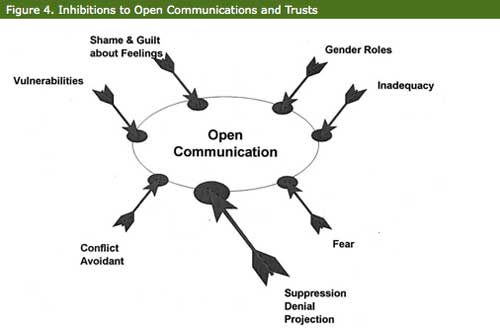
Not only is it difficult for some of us to know what our issues are, but many of us have had relationships end painfully or with hurt feelings. These past hurts may inhibit open communication in current relationships. Figure \(\PageIndex{3}\). shows some of the painful arrows that threaten communication and trust. Some of us grow up feeling shamed and worthless. This sometimes makes us feel extremely sensitive to how others evaluate us and can make it very difficult for us to want to open up and show others what we believe are our flaws.
Self-disclosure--being open about oneself--is correlated with relationship satisfaction (MacNeil \& Byers, 2005). Relationship satisfaction and well-being are increased when couples communicate about sex, positive events, and emotions (Gable, Gonzaga, \& Strachman, 2006).
Figure \(\PageIndex{3}\). Inhibitions to Open Communications and Trusts