

6.2: Persuasion Theories
- Page ID
- 271613

\( \newcommand{\vecs}[1]{\overset { \scriptstyle \rightharpoonup} {\mathbf{#1}} } \)
\( \newcommand{\vecd}[1]{\overset{-\!-\!\rightharpoonup}{\vphantom{a}\smash {#1}}} \)
\( \newcommand{\dsum}{\displaystyle\sum\limits} \)
\( \newcommand{\dint}{\displaystyle\int\limits} \)
\( \newcommand{\dlim}{\displaystyle\lim\limits} \)
\( \newcommand{\id}{\mathrm{id}}\) \( \newcommand{\Span}{\mathrm{span}}\)
( \newcommand{\kernel}{\mathrm{null}\,}\) \( \newcommand{\range}{\mathrm{range}\,}\)
\( \newcommand{\RealPart}{\mathrm{Re}}\) \( \newcommand{\ImaginaryPart}{\mathrm{Im}}\)
\( \newcommand{\Argument}{\mathrm{Arg}}\) \( \newcommand{\norm}[1]{\| #1 \|}\)
\( \newcommand{\inner}[2]{\langle #1, #2 \rangle}\)
\( \newcommand{\Span}{\mathrm{span}}\)
\( \newcommand{\id}{\mathrm{id}}\)
\( \newcommand{\Span}{\mathrm{span}}\)
\( \newcommand{\kernel}{\mathrm{null}\,}\)
\( \newcommand{\range}{\mathrm{range}\,}\)
\( \newcommand{\RealPart}{\mathrm{Re}}\)
\( \newcommand{\ImaginaryPart}{\mathrm{Im}}\)
\( \newcommand{\Argument}{\mathrm{Arg}}\)
\( \newcommand{\norm}[1]{\| #1 \|}\)
\( \newcommand{\inner}[2]{\langle #1, #2 \rangle}\)
\( \newcommand{\Span}{\mathrm{span}}\) \( \newcommand{\AA}{\unicode[.8,0]{x212B}}\)
\( \newcommand{\vectorA}[1]{\vec{#1}} % arrow\)
\( \newcommand{\vectorAt}[1]{\vec{\text{#1}}} % arrow\)
\( \newcommand{\vectorB}[1]{\overset { \scriptstyle \rightharpoonup} {\mathbf{#1}} } \)
\( \newcommand{\vectorC}[1]{\textbf{#1}} \)
\( \newcommand{\vectorD}[1]{\overrightarrow{#1}} \)
\( \newcommand{\vectorDt}[1]{\overrightarrow{\text{#1}}} \)
\( \newcommand{\vectE}[1]{\overset{-\!-\!\rightharpoonup}{\vphantom{a}\smash{\mathbf {#1}}}} \)
\( \newcommand{\vecs}[1]{\overset { \scriptstyle \rightharpoonup} {\mathbf{#1}} } \)
\(\newcommand{\longvect}{\overrightarrow}\)
\( \newcommand{\vecd}[1]{\overset{-\!-\!\rightharpoonup}{\vphantom{a}\smash {#1}}} \)
\(\newcommand{\avec}{\mathbf a}\) \(\newcommand{\bvec}{\mathbf b}\) \(\newcommand{\cvec}{\mathbf c}\) \(\newcommand{\dvec}{\mathbf d}\) \(\newcommand{\dtil}{\widetilde{\mathbf d}}\) \(\newcommand{\evec}{\mathbf e}\) \(\newcommand{\fvec}{\mathbf f}\) \(\newcommand{\nvec}{\mathbf n}\) \(\newcommand{\pvec}{\mathbf p}\) \(\newcommand{\qvec}{\mathbf q}\) \(\newcommand{\svec}{\mathbf s}\) \(\newcommand{\tvec}{\mathbf t}\) \(\newcommand{\uvec}{\mathbf u}\) \(\newcommand{\vvec}{\mathbf v}\) \(\newcommand{\wvec}{\mathbf w}\) \(\newcommand{\xvec}{\mathbf x}\) \(\newcommand{\yvec}{\mathbf y}\) \(\newcommand{\zvec}{\mathbf z}\) \(\newcommand{\rvec}{\mathbf r}\) \(\newcommand{\mvec}{\mathbf m}\) \(\newcommand{\zerovec}{\mathbf 0}\) \(\newcommand{\onevec}{\mathbf 1}\) \(\newcommand{\real}{\mathbb R}\) \(\newcommand{\twovec}[2]{\left[\begin{array}{r}#1 \\ #2 \end{array}\right]}\) \(\newcommand{\ctwovec}[2]{\left[\begin{array}{c}#1 \\ #2 \end{array}\right]}\) \(\newcommand{\threevec}[3]{\left[\begin{array}{r}#1 \\ #2 \\ #3 \end{array}\right]}\) \(\newcommand{\cthreevec}[3]{\left[\begin{array}{c}#1 \\ #2 \\ #3 \end{array}\right]}\) \(\newcommand{\fourvec}[4]{\left[\begin{array}{r}#1 \\ #2 \\ #3 \\ #4 \end{array}\right]}\) \(\newcommand{\cfourvec}[4]{\left[\begin{array}{c}#1 \\ #2 \\ #3 \\ #4 \end{array}\right]}\) \(\newcommand{\fivevec}[5]{\left[\begin{array}{r}#1 \\ #2 \\ #3 \\ #4 \\ #5 \\ \end{array}\right]}\) \(\newcommand{\cfivevec}[5]{\left[\begin{array}{c}#1 \\ #2 \\ #3 \\ #4 \\ #5 \\ \end{array}\right]}\) \(\newcommand{\mattwo}[4]{\left[\begin{array}{rr}#1 \amp #2 \\ #3 \amp #4 \\ \end{array}\right]}\) \(\newcommand{\laspan}[1]{\text{Span}\{#1\}}\) \(\newcommand{\bcal}{\cal B}\) \(\newcommand{\ccal}{\cal C}\) \(\newcommand{\scal}{\cal S}\) \(\newcommand{\wcal}{\cal W}\) \(\newcommand{\ecal}{\cal E}\) \(\newcommand{\coords}[2]{\left\{#1\right\}_{#2}}\) \(\newcommand{\gray}[1]{\color{gray}{#1}}\) \(\newcommand{\lgray}[1]{\color{lightgray}{#1}}\) \(\newcommand{\rank}{\operatorname{rank}}\) \(\newcommand{\row}{\text{Row}}\) \(\newcommand{\col}{\text{Col}}\) \(\renewcommand{\row}{\text{Row}}\) \(\newcommand{\nul}{\text{Nul}}\) \(\newcommand{\var}{\text{Var}}\) \(\newcommand{\corr}{\text{corr}}\) \(\newcommand{\len}[1]{\left|#1\right|}\) \(\newcommand{\bbar}{\overline{\bvec}}\) \(\newcommand{\bhat}{\widehat{\bvec}}\) \(\newcommand{\bperp}{\bvec^\perp}\) \(\newcommand{\xhat}{\widehat{\xvec}}\) \(\newcommand{\vhat}{\widehat{\vvec}}\) \(\newcommand{\uhat}{\widehat{\uvec}}\) \(\newcommand{\what}{\widehat{\wvec}}\) \(\newcommand{\Sighat}{\widehat{\Sigma}}\) \(\newcommand{\lt}{<}\) \(\newcommand{\gt}{>}\) \(\newcommand{\amp}{&}\) \(\definecolor{fillinmathshade}{gray}{0.9}\)- Explain the concept of cognitive dissonance, including its psychological impact and the common strategies individuals use to reduce it.
- Differentiate between the central and peripheral routes to persuasion as described by the Elaboration Likelihood Model (ELM), identifying factors that determine which route is more likely to be taken by an audience.
- Describe the core mechanisms of influence for at least three specific persuasion theories from this chapter (e.g., Foot-in-the-door, Inoculation Theory, Psychological Reactance Theory, or the Narrative Paradigm).
Persuasion Theories
As we continue our exploration of persuasive communication, we move beyond the basic building blocks of arguments and the direct force of emotional appeals to examine the intricate psychological mechanisms that shape how individuals process and respond to messages. This chapter delves into several foundational theories that explain the "why" and "how" of attitude and behavior change, often in ways that aren't immediately obvious.
We'll begin by understanding Cognitive Dissonance, the powerful discomfort we feel when our beliefs and actions are inconsistent, and how this discomfort drives us to seek harmony. From there, we'll explore models that outline the conditions under which persuasion occurs, from the characteristics of the source and message to the audience's level of engagement (like the Elaboration Likelihood Model). We'll also uncover theories that explain how our desire for consistency (Foot-in-the-door), our natural resistance to threats to our freedom (Psychological Reactance), our ability to build defenses against counter-persuasion (Inoculation Theory), and our fundamental reliance on storytelling (Narrative Paradigm) profoundly impact our susceptibility to influence. By understanding these diverse theoretical frameworks, you'll gain powerful insights into both analyzing and strategically crafting compelling persuasive messages.
Cognitive Dissonance
Social psychologists have documented that feeling good about ourselves and maintaining positive self-esteem is a powerful motivator of human behavior (Tavris & Aronson, 2008). In the United States, members of the predominant culture typically think very highly of themselves and view themselves as good people who are above average on many desirable traits (Ehrlinger, Gilovich, & Ross, 2005). Often, our behavior, attitudes, and beliefs are affected when we experience a threat to our self-esteem or positive self-image. Psychologist Leon Festinger (1957) defined cognitive dissonance as psychological discomfort arising from holding two or more inconsistent attitudes, behaviors, or cognitions (thoughts, beliefs, or opinions). Festinger’s theory of cognitive dissonance states that when we experience a conflict in our behaviors, attitudes, or beliefs that runs counter to our positive self-perceptions, we experience psychological discomfort (dissonance). For example, if you believe smoking is bad for your health but you continue to smoke, you experience conflict between your belief and behavior (See figure \(\PageIndex{1}\) below).
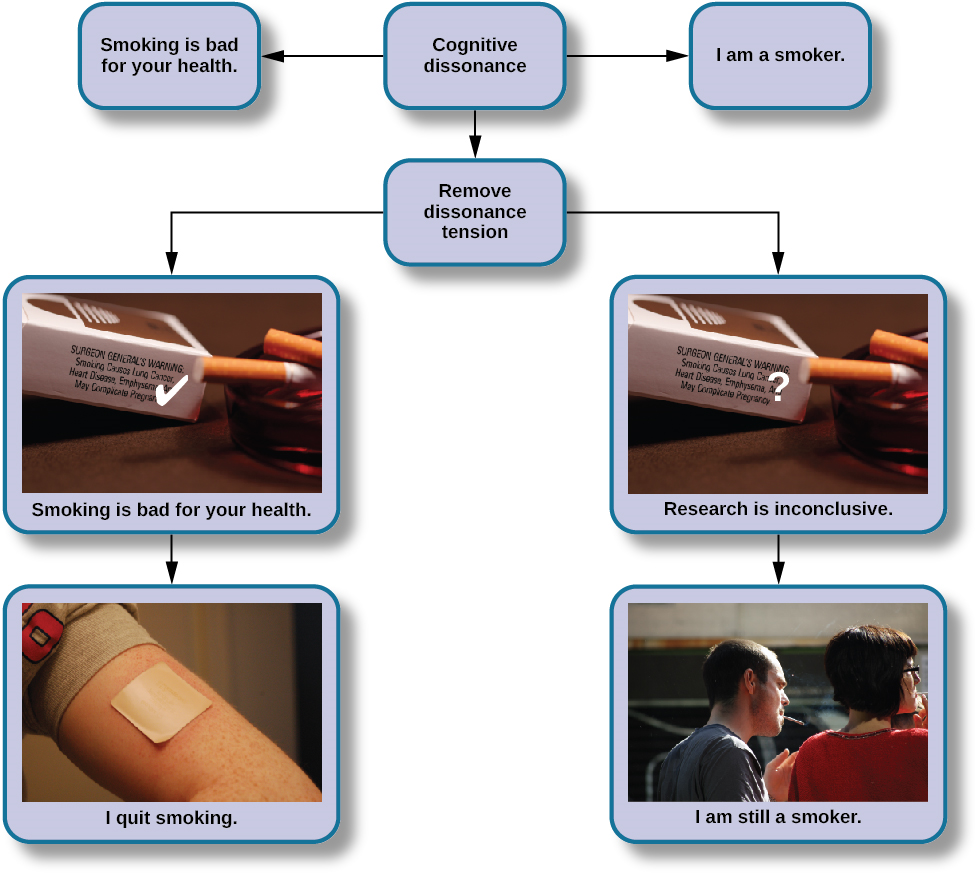
Later research documented that only conflicting cognitions that threaten individuals’ positive self-image cause dissonance (Greenwald & Ronis, 1978). Additional research found that dissonance is not only psychologically uncomfortable but also can cause physiological arousal (Croyle & Cooper, 1983) and activate regions of the brain important in emotions and cognitive functioning (van Veen, Krug, Schooler, & Carter, 2009). When we experience cognitive dissonance, we are motivated to decrease it because it is psychologically, physically, and mentally uncomfortable. We can reduce cognitive dissonance by bringing our cognitions, attitudes, and behaviors in line—that is, making them harmonious. This can be done in different ways, such as:
- changing our discrepant behavior (e.g., stop smoking),
- changing our cognitions through rationalization or denial (e.g., telling ourselves that health risks can be reduced by smoking filtered cigarettes),
- adding a new cognition (e.g., “Smoking suppresses my appetite so I don’t become overweight, which is good for my health.”).
A classic example of cognitive dissonance is John, a \(20\)-year-old who enlists in the military. During boot camp he is awakened at 5:00 a.m., is chronically sleep deprived, yelled at, covered in sand flea bites, physically bruised and battered, and mentally exhausted (See figure \(\PageIndex{2}\)). It gets worse. Recruits that make it to week \(11\) of boot camp have to do \(54\) hours of continuous training.

Not surprisingly, John is miserable. No one likes to be miserable. In this type of situation, people can change their beliefs, their attitudes, or their behaviors. The last option, a change of behaviors, is not available to John. He has signed on to the military for four years, and he cannot legally leave.
If John keeps thinking about how miserable he is, it is going to be a very long four years. He will be in a constant state of cognitive dissonance. As an alternative to this misery, John can change his beliefs or attitudes. He can tell himself, “I am becoming stronger, healthier, and sharper. I am learning discipline and how to defend myself and my country. What I am doing is really important.” If this is his belief, he will realize that he is becoming stronger through his challenges. He then will feel better and not experience cognitive dissonance, which is an uncomfortable state.
The Effect of Initiation
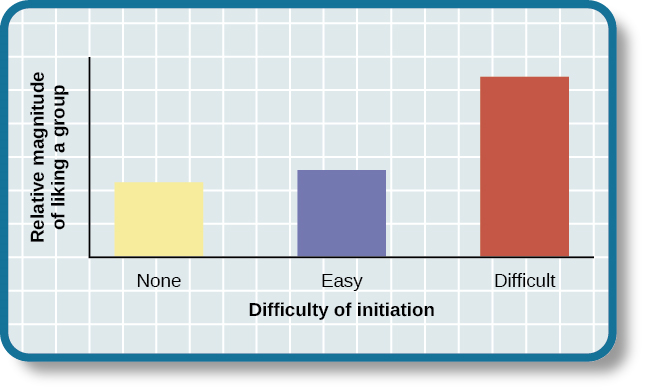
The military example demonstrates the observation that a difficult initiation into a group influences us to like the group more, due to the justification of effort. We do not want to have wasted time and effort to join a group that we eventually leave. A classic experiment by Aronson and Mills (1959) demonstrated this justification of effort effect. College students volunteered to join a campus group that would meet regularly to discuss the psychology of sex. Participants were randomly assigned to one of three conditions: no initiation, an easy initiation, and a difficult initiation into the group. After participating in the first discussion, which was deliberately made very boring, participants rated how much they liked the group. Participants who underwent a difficult initiation process to join the group rated the group more favorably than did participants with an easy initiation or no initiation (See figure \(\PageIndex{3}\)).
Similar effects can be seen in a more recent study of how student effort affects course evaluations. Heckert, Latier, Ringwald-Burton, and Drazen (2006) surveyed \(463\) undergraduates enrolled in courses at a midwestern university about the amount of effort that their courses required of them. In addition, the students were also asked to evaluate various aspects of the course. Given what you’ve just read, it will come as no surprise that those courses that were associated with the highest level of effort were evaluated as being more valuable than those that did not. Furthermore, students indicated that they learned more in courses that required more effort, regardless of the grades that they received in those courses (Heckert et al., 2006).
Besides the classic military example and group initiation, can you think of other examples of cognitive dissonance? Here is one: Marco and Maria live in Fairfield County, Connecticut, which is one of the wealthiest areas in the United States and has a very high cost of living. Marco telecommutes from home and Maria does not work outside of the home. They rent a very small house for more than \(\$3000\) a month. Maria shops at consignment stores for clothes and economizes where she can. They complain that they never have any money and that they cannot buy anything new. When asked why they do not move to a less expensive location, since Marco telecommutes, they respond that Fairfield County is beautiful, they love the beaches, and they feel comfortable there. How does the theory of cognitive dissonance apply to Marco and Maria’s choices?
Yale Attitude Change Approach
The topic of persuasion has been one of the most extensively researched areas in social psychology. During the Second World War, Carl Hovland extensively researched persuasion for the U.S. Army. After the war, Hovland continued his exploration of persuasion at Yale University. Out of this work came a model called the Yale attitude change approach, which describes the conditions under which people tend to change their attitudes. Hovland demonstrated that certain features of the source of a persuasive message, the content of the message, and the characteristics of the audience will influence the persuasiveness of a message (Hovland, Janis, & Kelley, 1953).
Features of the source of the persuasive message include the credibility of the speaker (Hovland & Weiss, 1951) and the physical attractiveness of the speaker (Eagly & Chaiken, 1975; Petty, Wegener, & Fabrigar, 1997). Thus, speakers who are credible, or have expertise on the topic, and who are deemed as trustworthy are more persuasive than less credible speakers. Similarly, more attractive speakers are more persuasive than less attractive speakers. The use of famous actors and athletes to advertise products on television and in print relies on this principle. The immediate and long term impact of the persuasion also depends, however, on the credibility of the messenger (Kumkale & Albarracín, 2004).
Features of the message itself that affect persuasion include subtlety (the quality of being important, but not obvious) (Petty & Cacioppo, 1986; Walster & Festinger, 1962); sidedness (that is, having more than one side) (Crowley & Hoyer, 1994; Igou & Bless, 2003; Lumsdaine & Janis, 1953); timing (Haugtvedt & Wegener, 1994; Miller & Campbell, 1959), and whether both sides are presented. Messages that are more subtle are more persuasive than direct messages. Arguments that occur first, such as in a debate, are more influential if messages are given back-to-back. However, if there is a delay after the first message, and before the audience needs to make a decision, the last message presented will tend to be more persuasive (Miller & Campbell, 1959).
Features of the audience that affect persuasion are attention (Albarracín & Wyer, 2001; Festinger & Maccoby, 1964), intelligence, self-esteem (Rhodes & Wood, 1992), and age (Krosnick & Alwin, 1989). In order to be persuaded, audience members must be paying attention. People with lower intelligence are more easily persuaded than people with higher intelligence; whereas people with moderate self-esteem are more easily persuaded than people with higher or lower self-esteem (Rhodes & Wood, 1992). Finally, younger adults aged 18–25 are more persuadable than older adults.
Elaboration Likelihood Model
An especially popular model that describes the dynamics of persuasion is the elaboration likelihood model of persuasion (Petty & Cacioppo, 1986). The elaboration likelihood model considers the variables of the attitude change approach—that is, features of the source of the persuasive message, contents of the message, and characteristics of the audience are used to determine when attitude change will occur. According to the elaboration likelihood model of persuasion, there are two main routes that play a role in delivering a persuasive message: central and peripheral (See figure \(\PageIndex{5}\)).
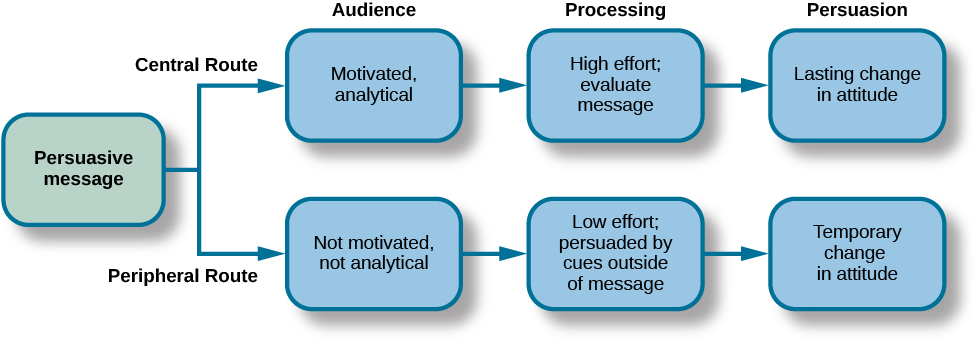
The central route is logic driven and uses data and facts to convince people of an argument’s worthiness. For example, a car company seeking to persuade you to purchase their model will emphasize the car’s safety features and fuel economy. This is a direct route to persuasion that focuses on the quality of the information. In order for the central route of persuasion to be effective in changing attitudes, thoughts, and behaviors, the argument must be strong and, if successful, will result in lasting attitude change.
The central route to persuasion works best when the target of persuasion, or the audience, is analytical and willing to engage in processing of the information. From an advertiser’s perspective, what products would be best sold using the central route to persuasion? What audience would most likely be influenced to buy the product? One example is buying a computer. It is likely, for example, that small business owners might be especially influenced by the focus on the computer’s quality and features such as processing speed and memory capacity.
The peripheral route is an indirect route that uses peripheral cues to associate positivity with the message (Petty & Cacioppo, 1986). Instead of focusing on the facts and a product’s quality, the peripheral route relies on association with positive characteristics such as positive emotions and celebrity endorsement. For example, having a popular athlete advertise athletic shoes is a common method used to encourage young adults to purchase the shoes. This route to attitude change does not require much effort or information processing. This method of persuasion may promote positivity toward the message or product, but it typically results in less permanent attitude or behavior change. The audience does not need to be analytical or motivated to process the message. In fact, a peripheral route to persuasion may not even be noticed by the audience, for example in the strategy of product placement. Product placement refers to putting a product with a clear brand name or brand identity in a TV show or movie to promote the product (Gupta & Lord, 1998). For example, one season of the reality series American Idol prominently showed the panel of judges drinking out of cups that displayed the Coca-Cola logo. What other products would be best sold using the peripheral route to persuasion? Another example is clothing: A retailer may focus on celebrities that are wearing the same style of clothing.
Judgemental Heuristics
In Elaboration Likelihood Model, we find that people are persuaded in one of two ways– because they are thinking about it–the central route–or they are not thinking about it–peripheral. There is an entire chapter dedicated to how to research which is the central route so for now, I want to talk about the peripheral route.
Researcher and business speaker, Robert Cialdini, has spent a lot of time researching peripheral routes to persuasion. He suggests that we often take shortcuts in decision-making, he calls it judgmental heuristics. Heuristics is just a fancy way of saying shortcut. We often take shortcuts in making our judgments. For example, we might believe that expensive products are better products and use that to decide which item to buy. Cialdini has identified several different shortcuts that people use when making decisions.
- Authority
- Liking
- Commitment and Consistency
- Social Proof
- Scarcity
- Reciprocation
- Unity
Authority
When my doctor prescribes a medicine, I don’t ask if it’s the best, I just take it. He is the authority after all. When a man in a uniform in the computer store tells me which computer to buy, I believe him, he is the pro. It can be helpful to trust those who know more than you on a topic. The power of authority can be very persuasive.
As a speaker, you can capitalize on the persuasive power of authority by telling a story of your encounter with the product–in this case you have the authority of one who knows. I heard many speeches about the benefits of cold showers, but it was not until I had a student who told me his specific story that I was persuaded enough to try it for myself. Another way you can leverage authority is to cite credible people. You can enhance your own ethos by the way you research and handle your sources. Make sure that you use credible sources and make sure that you mention the title of your sources. For example, Say “Dr. Martin, a heart surgeon at the Mayo Clinic.”
Liking
People are persuaded by those they like–that is obvious. What is not so obvious are the ways that liking can be enhanced–similarity, compliments, and concern. People are more likely to like people who dress like them. If you are giving a speech to a group in ties, you should dress formally. If the group is more of a T-shirt and khakis type, you shouldn’t dress as formally. People like people who are similar. By researching your audience well, you can find ways to look for common ground.
Another way to enhance liking is with a sincere compliment. I’m not talking about a cheesy, overly flattering type. I am also not suggesting that you lie. I am saying that you can find something to like about them and let them know. In her TED Talk, Lizzie Valasquez had a very enthusiastic front row and she looked down and said, “You guys are like the best little section right here.” Finally, people like those who are passionately concerned about an issue. As a speaker, don’t aim to be perfect, aim to be passionate.
Commitment Consistency
Commitment/consistency has to do with finding something that people are already demonstrating a commitment to and then encouraging them to act in a consistent manner. If you see someone carrying a water bottle, you can say, “I see you are committed to health. I notice you take that bottle with you to all your classes. I would like you to think about one more thing that can influence your health.” In this example, you find something that a person is committed to and you encourage them to be consistent.
When you research your audience, find things that they care about and touch on those as you encourage them to be consistent. When I spoke to community groups as a fundraiser, I would look up their mission and it often involved something about helping people so I might say, “I see from your mission that you are community-minded. I would like to share with you one more way that you can carry your mission into this community by helping.”
Social Proof
People look to other people to know how to act. Every time, I buy things online, I look to see how others have evaluated the product first. I ask my friends if they have ever tried the product and what they think. I look to others to help me decide.
If you are doing a persuasive speech on a product, you can ethically persuade using social proof by showing how many stars a product has or you could read a poll about how many people support a measure. You can also interview those who are similar to your audience and then report back your findings. Talking about what Instagram and YouTube influencers believe can be powerful if it is someone the audience cares about.
Each of these judgmental heuristics carries with it the danger of abuse, so it is important to be ethical in your use of persuasion. I would be remiss if I didn’t mention to you that when it comes to social proof, it can become a bandwagon fallacy. Take for example fad diets. Just because they are popular, doesn’t mean they are healthy. Just because everyone thinks it is true, that doesn’t mean that it is true. When persuading using social proof, we want to ethically show why others like something and avoid the bandwagon fallacy which assumes that just because a lot of people like something that it must be good.
Scarcity
I am such a sucker for limited-time-only sales. I’m also a victim of buying something because it is the last one. People hate to miss out on things which is why scarcity as a persuasive tool is so powerful. Scarcity can happen because there is not very much of something, (limited numbers) or there is not very long to get it, (limited time) or the information is restricted (limited information). As a speaker, you can encourage your audience to act immediately because the deadline is coming soon or to buy a product because they are likely to sell out.
People hate to have their options limited. “Don’t tell me I can’t have it because then I want it.” Researchers talk about this in terms of psychological reactance. Psychological reactance is a heightened motivational state in reaction to having our freedoms restricted. This, in part, explains why ammunition sales skyrockets under the threat of gun control measures and why teenagers fall even more madly in love when parents forbid them to date. Leveraging psychological reactance ethically can be tricky, but it can de be done. “There are just 20 more days until the election to research your candidate” or “concert tickets usually sell out the first few hours so if you want to go you have to be ready.” These are honest statements that can encourage the audience to act.
Reciprocity
If you do something for me, I feel obligated to do something for you. This is why I always feel obligated to buy a gift for someone who buys me one or to say something nice to someone who compliments me. One of my students persuaded us to try making gifts instead of buying them. She demonstrated an easy-to-make and thoughtful gift and then she gave us a hand out of the steps and supplies. Attached to the handout was a coupon for the local craft store. The act of giving us a handout and the added free coupon enhanced the likelihood that we would comply. In case you are wondering, yes, I was persuaded. Yes, I took the coupon, bought the supplies, and made family and friends etched glasses for Christmas.
Jane McGonigal in her TED Talk, The Game that Can Give You 10 Extra Years of Life, said: So, here’s my special mission for this talk: I’m going to try to increase the life span of every single person in this room by seven and a half minutes. Literally, you will live seven and a half minutes longer than you would have otherwise, just because you watched this talk.” She is promising to give us something in exchange for our time so we feel the pressure to listen.
Unity
People want to feel a sense of unity with a group. This group can be everything from their favorite sports team to whether they or dog or cat lovers. Finding ways to help the audience feel like a special group or like they are part of something, can be important to persuasion. “Join the club,” “be one of us,” “as Razorback’s we all feel…” are examples of how that is used. Another way to activate the principle of unity is to use insider language (if you are part of the group if not, it comes off as sucking up or cheesy).
Cialdini called these seven the “weapons of influence.” To me, the idea of persuasion as a weapon assumes that it is used to attack or to defend. I prefer to use the metaphor of a tool instead of that of a weapon–allow me to illustrate. I am a gardener, so I use the shovel to dig holes to plant flowers–it works as a tool. If I see poison ivy, I might use the shovel to defend myself by removing the poison ivy. If I see a snake, I might hit it with my shovel, and then the shovel becomes a weapon. These persuasion principles can be that way as well. They can be tools or they can be weapons and it is up to the one holding the tool to decide which was to use this information.
Foot-in-the-door Technique
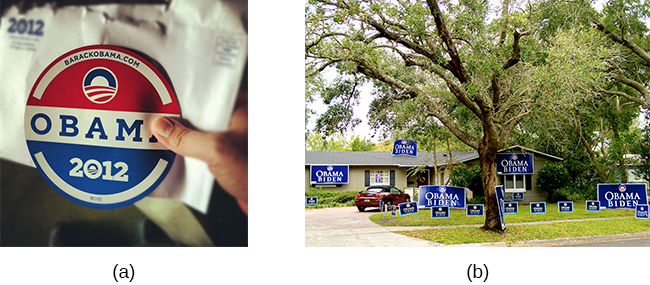
Researchers have tested many persuasion strategies that are effective in selling products and changing people’s attitude, ideas, and behaviors. One effective strategy is the foot-in-the-door technique (Cialdini, 2001; Pliner, Hart, Kohl, & Saari, 1974). Using the foot-in-the-door technique, the persuader gets a person to agree to bestow a small favor or to buy a small item, only to later request a larger favor or purchase of a bigger item. The foot-in-the-door technique was demonstrated in a study by Freedman and Fraser (1966) in which participants who agreed to post small sign in their yard or sign a petition were more likely to agree to put a large sign in their yard than people who declined the first request (See figure \(\PageIndex{6}\)). Research on this technique also illustrates the principle of consistency (Cialdini, 2001): Our past behavior often directs our future behavior, and we have a desire to maintain consistency once we have a committed to a behavior.
A common application of foot-in-the-door is when teens ask their parents for a small permission (for example, extending curfew by a half hour) and then asking them for something larger. Having granted the smaller request increases the likelihood that parents will acquiesce with the later, larger request.
How would a store owner use the foot-in-the-door technique to sell you an expensive product? For example, say that you are buying the latest model smartphone, and the salesperson suggests you purchase the best data plan. You agree to this. The salesperson then suggests a bigger purchase—the three-year extended warranty. After agreeing to the smaller request, you are more likely to also agree to the larger request. You may have encountered this if you have bought a car. When salespeople realize that a buyer intends to purchase a certain model, they might try to get the customer to pay for many or most available options on the car.
Inoculation Theory
At its core, Inoculation Theory employs a biological metaphor, much like our bodies develop immunity against viral attacks, our attitudes can be inoculated against persuasive attempts (Compton). William McGuire, the theory's originator, proposed that exposing individuals to a persuasive message containing weakened arguments against an established attitude helps them develop resistance against stronger, future persuasive attacks (Compton). McGuire observed that people often defend their beliefs by avoiding counterarguments (selective exposure) rather than actively developing support for their beliefs. This selective exposure, he argued, weakens their "immune systems," making them highly vulnerable when later exposed to robust counterarguments (McGuire, p. 184).
To strengthen beliefs and overcome selective exposure, two key components are crucial:
- Threat: This refers to the message recipient's recognition that their existing position on an issue is vulnerable to challenge, acting as a motivating force for a protective response. A common form of threat is forewarning, a direct, explicit warning that one's stance on a topic is susceptible to change.
- Refutational Preemption: This component "provides specific content that receivers can employ to strengthen attitudes against subsequent change" (Pfau et al., p. 188). A typical inoculation message combines forewarning with presenting the challenges and counterarguments opponents might articulate, followed by explicit refutations of those counterarguments.
Consider a public health campaign aimed at inoculating middle school students against peer pressure to smoke. An inoculation message might proceed as follows:
- Forewarning/Threat: "Soon, you might have friends or even social media trying to convince you that smoking is cool or a way to fit in. They might try to challenge your decision not to smoke." (This creates a sense of vulnerability to future social influence.)
- Raising Counterarguments: "You might hear them say things like, 'Just one puff won't hurt,' or 'Everyone else is doing it,' or 'It helps you look mature and independent.'"
- Refutation: "But remember, 'just one puff' is how addiction starts; nicotine is highly addictive, and even a little bit can hook you. And 'everyone else' isn't doing it—the vast majority of teens don't smoke, and smoking actually makes your breath smell, your teeth yellow, and harms your athletic performance. True independence means making healthy choices for yourself, not following the crowd into harmful habits."
For inoculation to effectively build resistance, several factors should be considered:
- Credibility of the Inoculator: The source delivering the inoculation message must be perceived as trustworthy and knowledgeable by the audience.
- Appropriate Threat Level: The forewarning or threat presented must be strong enough to motivate the audience to defend their beliefs, but not so overwhelming that it leads to defensive avoidance or a "boomerang" effect.
- Relevant Counterarguments: The weakened arguments presented in the inoculation message must accurately reflect the types of arguments the audience is likely to encounter from opposing views in the future.
- Effective Refutation: The inoculation message must provide clear, compelling, and easy-to-understand refutations for the counterarguments it raises.
- Timeliness: The inoculation message should be delivered before the recipient is exposed to the actual, strong persuasive attack, allowing sufficient time for resistance to build.
- Active Engagement (Enhances effectiveness): While not always necessary, encouraging the audience to actively participate in the refutation process (e.g., by thinking of their own counterarguments) can further strengthen their resistance.
Psychological Reactance Theory
Have you ever deliberately done the opposite of what a sign or a person told you to do? Perhaps you walked on the grass despite a "Don't Walk on the Grass" sign, or after starting a diet, found yourself consuming an entire family-size bag of potato chips. While many persuasive messages succeed, some trigger a "boomerang effect," where individuals adopt the opposite stance. Brehm's Psychological Reactance Theory offers a framework to understand these oppositional reactions.
Brehm (1966) states: "people become motivationally aroused by a threat to or elimination of a behavioral freedom. This motivational state is what is called psychological reactance. It impels the individual to restore the particular freedom that was threatened or taken away" (p. 72). This "unpleasant motivational arousal" (Steindl et al., p. 205) emerges when individuals perceive a loss or threat to their free behaviors. This feeling is often accompanied by discomfort, hostility, aggression, and anger (Steindl et al., p. 205). When reactance is triggered, individuals may exhibit various behavioral and cognitive responses, including engaging in the restricted behavior, counterarguing the message, denigrating the source of the threat, or acting out in generally hostile or aggressive ways.
Consider a public health campaign aiming to drastically reduce sugary drink consumption among teenagers.
- Controlling Message: A campaign poster might state, "Teenagers are required to eliminate all sugary drinks from their diet immediately. Your health demands this choice."
- Reactance Trigger: The language "are required" and "demands," combined with the absolute prohibition of a common beverage, threatens the teenagers' perceived freedom to choose what they consume. They might feel their autonomy is being directly challenged by an external authority.
- Boomerang Effect: Instead of compliance, some teenagers might experience anger or resentment. They might then deliberately purchase or consume sugary drinks, not necessarily out of increased desire for the drink itself, but as an act of defiance to restore their threatened freedom. This could also manifest as dismissing the campaign's message or the credibility of its source.
- Perceived Threat to Freedom: The individual must believe that a specific, existing behavioral freedom is being threatened or removed. The more important or valued this freedom is to the individual, the stronger the potential for reactance (Steindl et al., p. 207).
- Controlling Language: Forceful, dogmatic, and stifling language is a major catalyst (Quick and Stephenson, p. 256). Phrases such as "you must," "you should," "you ought to," or "you need to" often signal a demand rather than an option, directly threatening autonomy.
- Magnitude of the Threat: The more significant the perceived restriction on freedom, the stronger the reactance is likely to be.
- Implicit vs. Explicit Restrictions: More direct and explicit attempts to control behavior tend to generate more reactance than subtle suggestions or indirect influences.
- Individual Differences & Culture: Culture plays a role. Individualists, or people with an independent self-construct, are more prone to reactance when their personal freedoms are threatened. Conversely, collectivists, or people with an interdependent self-construct, are more affected by threats to their collective freedom (Jonas et al., p. 1078).
The Narrative Paradigm
"A good story is more convincing that a good argument." - Walter Fisher
Once upon a time–1984, to be precise–a USC professor named Walter Fisher published a provocative article. At that time, you see, most communication scholars viewed rhetoric as practical reasoning. "Formal, rational modes of argument should be the measure of effective persuasion," said the Establishment. But Professor Fisher politely disagreed. "Reasoning need not be bound to argumentative prose or be expressed in clear-cut inferential or implicative structures," he said (Fisher, "Narrative" 1).
Whereas most of us would describe humans as homo sapiens, or wise humans, Professor Fisher very much viewed humans as homo narrans: storytelling humans. He believed that when it comes to human nature or what is means to be human, storytelling is as important, possibly more so, than language or reasoning. "Humans as rhetorical beings are as much valuing as they are reasoning animals," said the professor (Fisher, "Toward" 376).
"So what is this 'narrative" you promote?" asked the Establishment. Fisher explained that narration is "a theory of symbolic actions–words and/or deeds–that have sequence and meaning for those who live, create, or interpret them." He saw the narrative paradigm as bringing together the argumentative, persuasive theme and the literary, aesthetic theme (Fisher, "Narrative" 2). Fisher people accepted or reject the “truthfulness” of competing stories. His innovative work explored how individuals consider whether or not stories cohere and hold together internally according to cultural understanding – an idea he named narrative probability – and whether or not a story seems true given other stories people hear, experience and come to believe – a principal he named narrative fidelity. "These may be thought of as tests that we apply – whether instinctively or through conscious reasoning – to decide whether a narrative coheres and offers good reasons for action and belief. A message that is judged by a particular audience to be high in narrative probability and narrative fidelity enhances identification and is more likely to be adopted or adhered to by members of that audience" (Engebretsen and Baker). Fisher's Narrative Paradigm suggests people accept or reject stories based on two criteria:
- Narrative Probability: Does the story make internal sense? Is it consistent, logical, and believable within its own context (e.g., do characters act predictably)?
- Narrative Fidelity: Does the story ring true with other stories the audience knows, experiences, and believes? Does it align with their existing values and worldview, offering "good reasons for action and belief"?
Stories high in both probability and fidelity enhance audience identification and are more likely to be adopted or adhered to (Engebretsen and Baker). Consider a university counseling center using a student's testimonial to encourage peers to seek help, rather than just listing statistics on student stress.
- The Narrative: "Sarah, a junior, felt overwhelmed by her classes and social anxieties. She often skipped meals and isolated herself, convinced she was the only one struggling. One sleepless night, she saw a poster for the counseling center. Hesitantly, she booked an appointment. Through talking and learning coping strategies, Sarah began managing her anxiety. She's now re-engaged in campus life, excelling in her studies, and feels equipped to handle challenges."
- Narrative Probability: This story is internally consistent. A student feeling overwhelmed, isolating, then seeking help and improving, is a believable progression of events within a university setting.
- Narrative Fidelity: This narrative resonates with the experiences of many students (stress, anxiety, isolation) and aligns with common values like self-care, overcoming adversity, and seeking support. It offers a "good reason" for action (getting help improves well-being) that aligns with a student's desire for academic success and social connection.
By sharing Sarah's relatable journey, the counseling center leverages narrative to foster identification and provide compelling "reasons for action" that statistics alone might not convey.
To maximize a story's persuasive power, consider these essential elements:
- Internal Consistency (Probability): Ensure the narrative's plot is logical, characters are consistent, and events unfold believably. Contradictions diminish a story's perceived truthfulness.
- External Resonance (Fidelity): Craft the story so it aligns with the audience's existing knowledge, experiences, and cultural values. It must "feel true" to their understanding of the world.
- Clear Implied Moral/Reason: The narrative should inherently suggest a clear lesson, a call to action, or a reason to believe that resonates with the audience's worldview.
- Relatability: The audience is more likely to be persuaded if they can identify with the characters or the situation presented in the story, making the message personally relevant.
More Theories Related to Persuasion
Although this chapter has addressed eleven of the most popular theories relating to persuasion, there are several others that attempt to explain mechanisms that lead to changes in beliefs, attitudes, or behaviors. These include:
- Attribution Theory
- Theory of Reasoned Action
- Theory of Planned Behavior
- Social Judgement Theory
- Social Influence Theory
- Minority Influence Theory
- Confirmation Bias
Exercises
- Recall a significant decision you made (e.g., a major purchase, choosing a college or a major, etc.) where you invested considerable effort or resources. After the decision, did you find yourself experiencing cognitive dissonance? How did you reduce this discomfort (e.g., by changing your beliefs, rationalizing, or adding new cognitions)? Specifically, can you identify if "justification of effort" played a role in making you feel better about your choice?
- Think about a time you encountered a rule, a policy, or a persuasive message that made you feel like your personal freedom or choice was being explicitly threatened or taken away. Describe the situation and the specific language or approach used. How did this trigger psychological reactance in you, and what was your subsequent reaction (e.g., defiance, anger, doing the opposite of what was intended)?
- Find two different advertisements (from TV, online, or print) that are for similar types of products or services but appear to use different primary routes of persuasion according to the Elaboration Likelihood Model (ELM). Ad 1 (Central Route Focus): Describe the ad's content. What specific logical arguments, facts, or data does it present? Why do you think this ad primarily targets central route processing, and what kind of audience is it likely most effective for?Ad 2 (Peripheral Route Focus): Describe the ad's content. What peripheral cues (e.g., celebrity endorsement, attractive imagery, emotional appeals, catchy music, status symbols) does it use? Why do you think this ad primarily targets peripheral route processing, and what kind of audience is it likely most effective for?
- Imagine you are a peer mentor and want to "inoculate" incoming first-year college students against common misconceptions or negative peer pressure they might face regarding time management and academic responsibility. Threat/Forewarning: How would you establish a "threat" or "forewarning" in your message, making them aware their existing positive attitude towards good grades might be challenged? Counterarguments: Provide 2-3 specific, weakened counterarguments or "excuses" you would present that students might hear from peers (e.g., "Skipping one class won't hurt," "You can always cram the night before"). Refutation: For each counterargument, provide a clear and concise refutation, giving them the "ammunition" to resist future pressure. Explain how your message leverages the principles of Inoculation Theory to build resistance.
References
Albarracin, D., & Wyer Jr, R. S. (2001). Elaborative and nonelaborative processing of a behavior-related communication. Personality and Social Psychology Bulletin, 27(6), 691-705.
Aronson, E., & Mills, J. (1959). The effect of severity of initiation on liking for a group. The Journal of Abnormal and Social Psychology, 59(2), 177.
Brehm, J. W. (1966). A theory of psychological reactance.
Cialdini, R. B. (2001). The science of persuasion. Scientific American, 284(2), 76-81.
Croyle, R. T., & Cooper, J. (1983). Dissonance arousal: physiological evidence. Journal of personality and social psychology, 45(4), 782.
Crowley, A. E., & Hoyer, W. D. (1994). An integrative framework for understanding two-sided persuasion. Journal of Consumer research, 20(4), 561-574.
Eagly, A. H., & Chaiken, S. (1975). An attribution analysis of the effect of communicator characteristics on opinion change: The case of communicator attractiveness. Journal of personality and social psychology, 32(1), 136.
Ehrlinger, J., Gilovich, T., & Ross, L. (2005). Peering into the bias blind spot: People’s assessments of bias in themselves and others. Personality and Social Psychology Bulletin, 31(5), 680-692.
Festinger, L. (1957). Social comparison theory. Selective Exposure Theory, 16(401), 3.
Festinger, L., & Maccoby, N. (1964). On resistance to persuasive communications. The Journal of Abnormal and Social Psychology, 68(4), 359.
Greenwald, A. G., & Ronis, D. L. (1978). Twenty years of cognitive dissonance: Case study of the evolution of a theory. Psychological review, 85(1), 53.
Haugtvedt, C. P., & Wegener, D. T. (1994). Message order effects in persuasion: An attitude strength perspective. Journal of consumer research, 21(1), 205-218.
Heckert, T. M., Latier, A., Ringwald-Burton, A., & Drazen, C. (2006). Relations among student effort, perceived class difficulty appropriateness, and student evaluations of teaching: is it possible to" buy" better evaluations through lenient grading?. College Student Journal, 40(3), 588-597.
Hovland, C. I., & Weiss, W. (1951). The influence of source credibility on communication effectiveness. Public opinion quarterly, 15(4), 635-650.
Kumkale, G. T., & Albarracín, D. (2004). The sleeper effect in persuasion: a meta-analytic review. Psychological bulletin, 130(1), 143.
Miller, N., & Campbell, D. T. (1959). Recency and primacy in persuasion as a function of the timing of speeches and measurements. The Journal of Abnormal and Social Psychology, 59(1), 1.
Petty, R. E., Wegener, D. T., & Fabrigar, L. R. (1997). Attitudes and attitude change. Annual review of psychology, 48(1), 609-647.
Petty, R. E., Cacioppo, J. T., Petty, R. E., & Cacioppo, J. T. (1986). The elaboration likelihood model of persuasion (pp. 1-24). Springer New York.
Pliner, P., Hart, H., Kohl, J., & Saari, D. (1974). Compliance without pressure: Some further data on the foot-in-the-door technique. Journal of Experimental Social Psychology, 10(1), 17-22.
Rhodes, N., & Wood, W. (1992). Self-esteem and intelligence affect influenceability: The mediating role of message reception. Psychological bulletin, 111(1), 156.
Tavris, C., & Aronson, E. (2008). Mistakes Were Made (But Not by Me): Why We Justify Foolish Beliefs, Bad Decisions, and Hurtful Acts.
Van Veen, V., Krug, M. K., Schooler, J. W., & Carter, C. S. (2009). Neural activity predicts attitude change in cognitive dissonance. Nature neuroscience, 12(11), 1469-1474.
Walster, E., & Festinger, L. (1962). The effectiveness of" overheard" persuasive communications. The Journal of Abnormal and Social Psychology, 65(6), 395.
Adapted from:
LibreTexts. (n.d.). 3.03: Theories of Persuasion. In Persuasion, Critical Thinking, and Writing (Chapter 03: A Compendium of Persuasion Theories). Social Sci LibreTexts.
OpenStax. (n.d.). 12.04: Attitudes and Persuasion. In Introductory Psychology 1e (Chapter 12: Social Psychology). OpenStax.