Social Sci LibreTexts

3: Educational Planning

  • Page ID
    107772
  • \( \newcommand{\vecs}[1]{\overset { \scriptstyle \rightharpoonup} {\mathbf{#1}} } \)

    \( \newcommand{\vecd}[1]{\overset{-\!-\!\rightharpoonup}{\vphantom{a}\smash {#1}}} \)

    \( \newcommand{\dsum}{\displaystyle\sum\limits} \)

    \( \newcommand{\dint}{\displaystyle\int\limits} \)

    \( \newcommand{\dlim}{\displaystyle\lim\limits} \)

    \( \newcommand{\id}{\mathrm{id}}\) \( \newcommand{\Span}{\mathrm{span}}\)

    ( \newcommand{\kernel}{\mathrm{null}\,}\) \( \newcommand{\range}{\mathrm{range}\,}\)

    \( \newcommand{\RealPart}{\mathrm{Re}}\) \( \newcommand{\ImaginaryPart}{\mathrm{Im}}\)

    \( \newcommand{\Argument}{\mathrm{Arg}}\) \( \newcommand{\norm}[1]{\| #1 \|}\)

    \( \newcommand{\inner}[2]{\langle #1, #2 \rangle}\)

    \( \newcommand{\Span}{\mathrm{span}}\)

    \( \newcommand{\id}{\mathrm{id}}\)

    \( \newcommand{\Span}{\mathrm{span}}\)

    \( \newcommand{\kernel}{\mathrm{null}\,}\)

    \( \newcommand{\range}{\mathrm{range}\,}\)

    \( \newcommand{\RealPart}{\mathrm{Re}}\)

    \( \newcommand{\ImaginaryPart}{\mathrm{Im}}\)

    \( \newcommand{\Argument}{\mathrm{Arg}}\)

    \( \newcommand{\norm}[1]{\| #1 \|}\)

    \( \newcommand{\inner}[2]{\langle #1, #2 \rangle}\)

    \( \newcommand{\Span}{\mathrm{span}}\) \( \newcommand{\AA}{\unicode[.8,0]{x212B}}\)

    \( \newcommand{\vectorA}[1]{\vec{#1}}      % arrow\)

    \( \newcommand{\vectorAt}[1]{\vec{\text{#1}}}      % arrow\)

    \( \newcommand{\vectorB}[1]{\overset { \scriptstyle \rightharpoonup} {\mathbf{#1}} } \)

    \( \newcommand{\vectorC}[1]{\textbf{#1}} \)

    \( \newcommand{\vectorD}[1]{\overrightarrow{#1}} \)

    \( \newcommand{\vectorDt}[1]{\overrightarrow{\text{#1}}} \)

    \( \newcommand{\vectE}[1]{\overset{-\!-\!\rightharpoonup}{\vphantom{a}\smash{\mathbf {#1}}}} \)

    \( \newcommand{\vecs}[1]{\overset { \scriptstyle \rightharpoonup} {\mathbf{#1}} } \)

    \(\newcommand{\longvect}{\overrightarrow}\)

    \( \newcommand{\vecd}[1]{\overset{-\!-\!\rightharpoonup}{\vphantom{a}\smash {#1}}} \)

    \(\newcommand{\avec}{\mathbf a}\) \(\newcommand{\bvec}{\mathbf b}\) \(\newcommand{\cvec}{\mathbf c}\) \(\newcommand{\dvec}{\mathbf d}\) \(\newcommand{\dtil}{\widetilde{\mathbf d}}\) \(\newcommand{\evec}{\mathbf e}\) \(\newcommand{\fvec}{\mathbf f}\) \(\newcommand{\nvec}{\mathbf n}\) \(\newcommand{\pvec}{\mathbf p}\) \(\newcommand{\qvec}{\mathbf q}\) \(\newcommand{\svec}{\mathbf s}\) \(\newcommand{\tvec}{\mathbf t}\) \(\newcommand{\uvec}{\mathbf u}\) \(\newcommand{\vvec}{\mathbf v}\) \(\newcommand{\wvec}{\mathbf w}\) \(\newcommand{\xvec}{\mathbf x}\) \(\newcommand{\yvec}{\mathbf y}\) \(\newcommand{\zvec}{\mathbf z}\) \(\newcommand{\rvec}{\mathbf r}\) \(\newcommand{\mvec}{\mathbf m}\) \(\newcommand{\zerovec}{\mathbf 0}\) \(\newcommand{\onevec}{\mathbf 1}\) \(\newcommand{\real}{\mathbb R}\) \(\newcommand{\twovec}[2]{\left[\begin{array}{r}#1 \\ #2 \end{array}\right]}\) \(\newcommand{\ctwovec}[2]{\left[\begin{array}{c}#1 \\ #2 \end{array}\right]}\) \(\newcommand{\threevec}[3]{\left[\begin{array}{r}#1 \\ #2 \\ #3 \end{array}\right]}\) \(\newcommand{\cthreevec}[3]{\left[\begin{array}{c}#1 \\ #2 \\ #3 \end{array}\right]}\) \(\newcommand{\fourvec}[4]{\left[\begin{array}{r}#1 \\ #2 \\ #3 \\ #4 \end{array}\right]}\) \(\newcommand{\cfourvec}[4]{\left[\begin{array}{c}#1 \\ #2 \\ #3 \\ #4 \end{array}\right]}\) \(\newcommand{\fivevec}[5]{\left[\begin{array}{r}#1 \\ #2 \\ #3 \\ #4 \\ #5 \\ \end{array}\right]}\) \(\newcommand{\cfivevec}[5]{\left[\begin{array}{c}#1 \\ #2 \\ #3 \\ #4 \\ #5 \\ \end{array}\right]}\) \(\newcommand{\mattwo}[4]{\left[\begin{array}{rr}#1 \amp #2 \\ #3 \amp #4 \\ \end{array}\right]}\) \(\newcommand{\laspan}[1]{\text{Span}\{#1\}}\) \(\newcommand{\bcal}{\cal B}\) \(\newcommand{\ccal}{\cal C}\) \(\newcommand{\scal}{\cal S}\) \(\newcommand{\wcal}{\cal W}\) \(\newcommand{\ecal}{\cal E}\) \(\newcommand{\coords}[2]{\left\{#1\right\}_{#2}}\) \(\newcommand{\gray}[1]{\color{gray}{#1}}\) \(\newcommand{\lgray}[1]{\color{lightgray}{#1}}\) \(\newcommand{\rank}{\operatorname{rank}}\) \(\newcommand{\row}{\text{Row}}\) \(\newcommand{\col}{\text{Col}}\) \(\renewcommand{\row}{\text{Row}}\) \(\newcommand{\nul}{\text{Nul}}\) \(\newcommand{\var}{\text{Var}}\) \(\newcommand{\corr}{\text{corr}}\) \(\newcommand{\len}[1]{\left|#1\right|}\) \(\newcommand{\bbar}{\overline{\bvec}}\) \(\newcommand{\bhat}{\widehat{\bvec}}\) \(\newcommand{\bperp}{\bvec^\perp}\) \(\newcommand{\xhat}{\widehat{\xvec}}\) \(\newcommand{\vhat}{\widehat{\vvec}}\) \(\newcommand{\uhat}{\widehat{\uvec}}\) \(\newcommand{\what}{\widehat{\wvec}}\) \(\newcommand{\Sighat}{\widehat{\Sigma}}\) \(\newcommand{\lt}{<}\) \(\newcommand{\gt}{>}\) \(\newcommand{\amp}{&}\) \(\definecolor{fillinmathshade}{gray}{0.9}\)

    Student Planning Tool


    Online Educational Planning is available through your Insite student portal

    Your Educational Plan will allow you to track your progress toward your declared program at DVC and map out courses necessary to meet your goal. You are encouraged to discuss this plan with a counselor to ensure you have accounted for all necessary requirements! It is important to understand that the Student Planning Tool is strictly linked to DVC program requirements for certificate and associate degree programs (AA/AS and AA-T/AA-T) and DOES NOT necessarily include ALL transfer requirements, therefore it is essential to review your Plan with a counselor to ensure you are on the right track.

    If you are not yet certain about your major that’s ok! Consider what program may best suite you: a certificate, associate degree or transfer. If you have a general idea of what program you wish to pursue you can start focusing on your general education courses and consider taking some exploratory classes next semester to allow you to explore areas of interest.

    Activity 4.5 Educational Plan

    After reading through section 4.5 Choosing a Major and Educational Planning, it is time to make a decision. Take into account the research you have gathered about different majors using the online resources addressed earlier in this section and answer the following questions:

    1. What are your top two career fields you are considering at this time?
    2. What kind of entry-level training/certification is needed to enter each field (industry certification, Associate Degree, Bachelor's Degree or an advanced professional degree)?
    3. What kind of program do you need to complete at Diablo Valley College to pursue the appropriate training to be competitive for each field (certificate, AA/AS, AA-T/AS-T and/or transfer)? Is this program offered at DVC? If not, where is my program offered and what are their admission criteria?
    4. What majors are you considering at this time and how do they connect to your future career path?
    5. Explain how these potential majors are a "good fit" for you based on the information you have gathered through your career assessment results completed in Unit 2 (character strengths, work values, personality preferences, interests, and skills).
    6. If you plan to transfer, what four-year universities are you considering and what are their transfer admission requirements?

    The more you know about the requirements necessary to pursue the career field(s) you are considering, the better you can prepare and make yourself a competitive candidate!

    Develop a Skills-Based Educational Plan to Align with Your Academic Plan
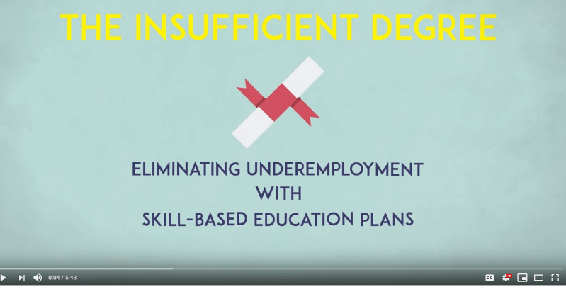
    In this section, we have discussed choosing your major and developing your educational plan to satisfy the necessary requirements for a certificate, AA/AS, AA-T/AS-T and/or transfer goal. At this time, you should have a general idea of what requirements are necessary to achieve your academic goal. Now, we want to further develop your plan by incorporating a skills-based educational plan. To get a better understanding of what a “Skills Based Educational Plan” is, view the YouTube video titled “The Insufficient Degree” and start developing your Skills Based Academic Plan.

    A screenshot of "The Sufficient Degree" video
    Figure 4.4 – Watch “The Sufficient Degree” (link: https://www.youtube.com/watch?v=k4nwQYuR-JM)


    It is now time to develop your Skills Based Academic Plan. After viewing the YouTube Video above, think of the skill necessary for your desired career goal. Consider the knowledge you will need to know for this particular career and how you can start working on acquiring that knowledge now.

    My Career Goal:

    Knowledge Needed

    Learning Method


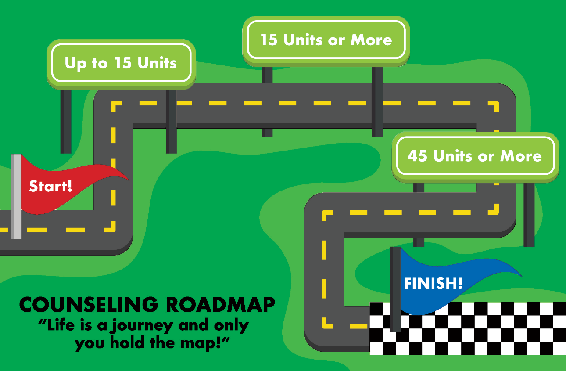
    Take a moment and review the "Counseling Roadmap" illustration on the following page.

    C:\Users\johnson_a\AppData\Local\Microsoft\Windows\INetCache\Content.Outlook\AZ5MTFP4\New-couns-150-Map.png
    Figure 4.5 – Counseling roadmap. (Image by Ian Joslin is licensed under CC BY 4.0)

    . Consider connecting with resources and services on campus as recommended below based on where you are in your journey.

    Counseling Roadmap

    Red flag reading, "Start!"

    If you are at the START you will want to:

    • Turn in transcripts from previous colleges/universities
    • Declare your major
    • Apply for financial aid
    • Take your math and English assessments if you have not yet done so

    Green flag reading, "Up to 15 units"

    If you have Up to 15 units you will want to:

    • Meet with an academic advisor to develop a one-semester plan
    • Familiarize yourself with the Library, the Student Center (including the DVC Bookstore, Counseling Center, Career and Transfer Center, and the Student Life Office)
    • Consider joining a student club or organization

    Green flag reading, "15 Units or More)

    If you have 15 Units or more you will want to:

    • Meet with a counselor to discuss academic major and goals leading to the development of a comprehensive educational plan
    • Continue to network on campus and build relationships with faculty, staff and peers

    Green flag reading, "45 Units or More"

    If you have 45 units or more you will want to:

    • Review transcripts with a counselor 
    • Connect with the Career Center
    • Participate in an internship

    Blue flag reading, "Finish!"

    If you are at the FINISH LINE you will want to:

    • Receive an associate degree and/or certificate
    • Enter the workforce or transfer to a four-year institution

    There is a lot of support on campus to help you each step of the way. Take advantage of the resources available to you and ask for help when necessary. 

    Remember, you are not alone on this journey!


    This page titled 3: Educational Planning is shared under a not declared license and was authored, remixed, and/or curated by Graciela Martinez and Elizabeth Shaker.