

9: Like and Share- Tourism, Dark Tourism, Social Media
- Page ID
- 292432

\( \newcommand{\vecs}[1]{\overset { \scriptstyle \rightharpoonup} {\mathbf{#1}} } \)
\( \newcommand{\vecd}[1]{\overset{-\!-\!\rightharpoonup}{\vphantom{a}\smash {#1}}} \)
\( \newcommand{\dsum}{\displaystyle\sum\limits} \)
\( \newcommand{\dint}{\displaystyle\int\limits} \)
\( \newcommand{\dlim}{\displaystyle\lim\limits} \)
\( \newcommand{\id}{\mathrm{id}}\) \( \newcommand{\Span}{\mathrm{span}}\)
( \newcommand{\kernel}{\mathrm{null}\,}\) \( \newcommand{\range}{\mathrm{range}\,}\)
\( \newcommand{\RealPart}{\mathrm{Re}}\) \( \newcommand{\ImaginaryPart}{\mathrm{Im}}\)
\( \newcommand{\Argument}{\mathrm{Arg}}\) \( \newcommand{\norm}[1]{\| #1 \|}\)
\( \newcommand{\inner}[2]{\langle #1, #2 \rangle}\)
\( \newcommand{\Span}{\mathrm{span}}\)
\( \newcommand{\id}{\mathrm{id}}\)
\( \newcommand{\Span}{\mathrm{span}}\)
\( \newcommand{\kernel}{\mathrm{null}\,}\)
\( \newcommand{\range}{\mathrm{range}\,}\)
\( \newcommand{\RealPart}{\mathrm{Re}}\)
\( \newcommand{\ImaginaryPart}{\mathrm{Im}}\)
\( \newcommand{\Argument}{\mathrm{Arg}}\)
\( \newcommand{\norm}[1]{\| #1 \|}\)
\( \newcommand{\inner}[2]{\langle #1, #2 \rangle}\)
\( \newcommand{\Span}{\mathrm{span}}\) \( \newcommand{\AA}{\unicode[.8,0]{x212B}}\)
\( \newcommand{\vectorA}[1]{\vec{#1}} % arrow\)
\( \newcommand{\vectorAt}[1]{\vec{\text{#1}}} % arrow\)
\( \newcommand{\vectorB}[1]{\overset { \scriptstyle \rightharpoonup} {\mathbf{#1}} } \)
\( \newcommand{\vectorC}[1]{\textbf{#1}} \)
\( \newcommand{\vectorD}[1]{\overrightarrow{#1}} \)
\( \newcommand{\vectorDt}[1]{\overrightarrow{\text{#1}}} \)
\( \newcommand{\vectE}[1]{\overset{-\!-\!\rightharpoonup}{\vphantom{a}\smash{\mathbf {#1}}}} \)
\( \newcommand{\vecs}[1]{\overset { \scriptstyle \rightharpoonup} {\mathbf{#1}} } \)
\(\newcommand{\longvect}{\overrightarrow}\)
\( \newcommand{\vecd}[1]{\overset{-\!-\!\rightharpoonup}{\vphantom{a}\smash {#1}}} \)
\(\newcommand{\avec}{\mathbf a}\) \(\newcommand{\bvec}{\mathbf b}\) \(\newcommand{\cvec}{\mathbf c}\) \(\newcommand{\dvec}{\mathbf d}\) \(\newcommand{\dtil}{\widetilde{\mathbf d}}\) \(\newcommand{\evec}{\mathbf e}\) \(\newcommand{\fvec}{\mathbf f}\) \(\newcommand{\nvec}{\mathbf n}\) \(\newcommand{\pvec}{\mathbf p}\) \(\newcommand{\qvec}{\mathbf q}\) \(\newcommand{\svec}{\mathbf s}\) \(\newcommand{\tvec}{\mathbf t}\) \(\newcommand{\uvec}{\mathbf u}\) \(\newcommand{\vvec}{\mathbf v}\) \(\newcommand{\wvec}{\mathbf w}\) \(\newcommand{\xvec}{\mathbf x}\) \(\newcommand{\yvec}{\mathbf y}\) \(\newcommand{\zvec}{\mathbf z}\) \(\newcommand{\rvec}{\mathbf r}\) \(\newcommand{\mvec}{\mathbf m}\) \(\newcommand{\zerovec}{\mathbf 0}\) \(\newcommand{\onevec}{\mathbf 1}\) \(\newcommand{\real}{\mathbb R}\) \(\newcommand{\twovec}[2]{\left[\begin{array}{r}#1 \\ #2 \end{array}\right]}\) \(\newcommand{\ctwovec}[2]{\left[\begin{array}{c}#1 \\ #2 \end{array}\right]}\) \(\newcommand{\threevec}[3]{\left[\begin{array}{r}#1 \\ #2 \\ #3 \end{array}\right]}\) \(\newcommand{\cthreevec}[3]{\left[\begin{array}{c}#1 \\ #2 \\ #3 \end{array}\right]}\) \(\newcommand{\fourvec}[4]{\left[\begin{array}{r}#1 \\ #2 \\ #3 \\ #4 \end{array}\right]}\) \(\newcommand{\cfourvec}[4]{\left[\begin{array}{c}#1 \\ #2 \\ #3 \\ #4 \end{array}\right]}\) \(\newcommand{\fivevec}[5]{\left[\begin{array}{r}#1 \\ #2 \\ #3 \\ #4 \\ #5 \\ \end{array}\right]}\) \(\newcommand{\cfivevec}[5]{\left[\begin{array}{c}#1 \\ #2 \\ #3 \\ #4 \\ #5 \\ \end{array}\right]}\) \(\newcommand{\mattwo}[4]{\left[\begin{array}{rr}#1 \amp #2 \\ #3 \amp #4 \\ \end{array}\right]}\) \(\newcommand{\laspan}[1]{\text{Span}\{#1\}}\) \(\newcommand{\bcal}{\cal B}\) \(\newcommand{\ccal}{\cal C}\) \(\newcommand{\scal}{\cal S}\) \(\newcommand{\wcal}{\cal W}\) \(\newcommand{\ecal}{\cal E}\) \(\newcommand{\coords}[2]{\left\{#1\right\}_{#2}}\) \(\newcommand{\gray}[1]{\color{gray}{#1}}\) \(\newcommand{\lgray}[1]{\color{lightgray}{#1}}\) \(\newcommand{\rank}{\operatorname{rank}}\) \(\newcommand{\row}{\text{Row}}\) \(\newcommand{\col}{\text{Col}}\) \(\renewcommand{\row}{\text{Row}}\) \(\newcommand{\nul}{\text{Nul}}\) \(\newcommand{\var}{\text{Var}}\) \(\newcommand{\corr}{\text{corr}}\) \(\newcommand{\len}[1]{\left|#1\right|}\) \(\newcommand{\bbar}{\overline{\bvec}}\) \(\newcommand{\bhat}{\widehat{\bvec}}\) \(\newcommand{\bperp}{\bvec^\perp}\) \(\newcommand{\xhat}{\widehat{\xvec}}\) \(\newcommand{\vhat}{\widehat{\vvec}}\) \(\newcommand{\uhat}{\widehat{\uvec}}\) \(\newcommand{\what}{\widehat{\wvec}}\) \(\newcommand{\Sighat}{\widehat{\Sigma}}\) \(\newcommand{\lt}{<}\) \(\newcommand{\gt}{>}\) \(\newcommand{\amp}{&}\) \(\definecolor{fillinmathshade}{gray}{0.9}\)Introduction
If you could not photograph a place, post it, tag it, review it, or prove that you had been there, would you still want to go?
Travel has always involved more than movement. People travel to encounter unfamiliar landscapes, visit sacred places, escape routine, seek adventure, reconnect with heritage, learn about other societies, and sometimes simply to say, I was there. Yet in the twenty-first century, tourism has become inseparable from another kind of movement: the circulation of images, stories, ratings, hashtags, videos, and data.
A traveler standing before a temple in Kyoto, a volcano in Iceland, a lemur in Madagascar, or a memorial in Cambodia is therefore participating in several systems at once. The visit may support jobs and conservation, but it may also contribute to overcrowding or environmental damage. A photograph may preserve a memory, but posting it can transform a quiet location into the next viral destination. A visit to a site of tragedy may encourage remembrance and historical understanding, yet the same site can become a backdrop for entertainment or self-promotion. Tourism connects people and cultures, but it can also reproduce inequalities between those who are able to move freely and those whose homes, histories, and cultures become destinations for someone else's consumption.
These contradictions make tourism an especially revealing way to study globalization.
This chapter approaches tourism not simply as leisure or an industry, but as a global system of movement, representation, power, and exchange. Tourism generates livelihoods and creates opportunities for cultural encounter, but its benefits and costs are unevenly distributed. Destinations compete for international attention while simultaneously trying to protect the landscapes and communities that attract visitors. Governments use tourism to project national identity and soft power. Communities may welcome visitors, resist them, or attempt to reclaim control over how their cultures are represented. And digital platforms increasingly determine which places become visible to millions of potential travelers.
The idea of the tourist gaze is especially important throughout the chapter. Tourism is not only about where we travel; it is also about how we have learned to look. Travelers arrive with expectations shaped by advertising, film, history, travel writing, influencers, and algorithms. A destination may be presented as untouched wilderness, timeless tradition, exotic difference, spiritual refuge, or photogenic spectacle. Yet these images rarely tell the whole story. Behind the postcard may be precarious labor, environmental strain, colonial history, political control, or communities negotiating what happens when their everyday lives become someone else's experience.
That ethical tension becomes particularly visible in dark tourism, or travel connected to places of death, disaster, violence, and historical trauma. Museums, memorials, prisons, battlefields, disaster sites, and landscapes of environmental destruction can serve important educational purposes. They can preserve evidence, honor victims, encourage reflection, and help societies confront difficult histories. But they also raise uncomfortable questions. When does witnessing become voyeurism? Who has the right to tell the story of suffering? What happens when tragedy becomes a tourism product? The chapter's cases from Tuol Sleng and the Apartheid Museum to Hiroshima, Nauru, Iceland, and tours of marginalized urban communities ask students to consider the difference between remembering, witnessing, and consuming.
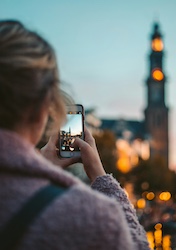
Social media intensifies these questions. The contemporary tourist is no longer only a visitor but also a photographer, reviewer, storyteller, advertiser, and data producer. A single viral image can redirect thousands of visitors toward a neighborhood, beach, shrine, or wilderness area. Algorithms influence which destinations appear desirable, while influencers transform travel experiences into content and personal brands. The result is what this chapter describes as a digital gaze: a world in which places are increasingly experienced not only for what they are, but for how they will appear on a screen.
Yet digital visibility is not automatically democratic. Some places and people receive extraordinary attention while others remain virtually invisible. Communities with fewer resources, less digital access, or stories that do not fit platform aesthetics can disappear from the global imagination. At the same time, local creators can use those same platforms to challenge stereotypes, reclaim narratives, and speak directly to global audiences. Tourism therefore becomes a struggle not only over where people travel, but over who gets to represent a place and whose version of it becomes visible.
Throughout the chapter, we will examine these tensions through dramatically different tourism landscapes, including Madagascar, Turkmenistan, Nauru, Iceland, Japan, Cambodia, South Africa, Brazil, and India. Rather than asking which model of tourism is simply "good" or "bad," we will ask what each reveals about globalization: conservation versus consumption, openness versus control, remembrance versus spectacle, economic opportunity versus exploitation, and connection versus overexposure. The five-country comparison introduced in the chapter already frames tourism through precisely these paradoxes.
As you read, return to one central question:
What changes when a place becomes a destination and what changes again when that destination becomes content?
Answering that question requires looking beyond the traveler. We must also consider the worker, the resident, the environment, the person being photographed, the community whose history is being interpreted, and the algorithms deciding what the rest of the world sees.
Tourism may begin with the desire to encounter somewhere else. This chapter asks what responsibilities come with looking, moving, remembering, photographing, and sharing.
.jpg?revision=1)
- 9.1: 9.1-The Power and Paradox of Tourism in the Global Age
- This page examines the complex significance of global tourism, focusing on its economic, cultural, and environmental effects. It highlights tourism's dual role in connecting and disrupting cultures, revealing tensions between conservation and consumption. Case studies illustrate diverse tourism models and their local impacts. The COVID-19 pandemic has catalyzed a shift towards digital and regenerative tourism, promoting ethical practices.
- 9.2: Consuming Tragedy
- This page explores the complex interplay between tourism, cultural remembrance, and ethics, particularly at dark tourism sites. It highlights the tension between commodifying tragedy and promoting accountability, comparing various examples like genocide museums and disaster zones. The content stresses the importance of responsible travel, advocating for awareness and education to foster global citizenship.
- 9.3: The Social Media Tourist
- This page examines the effects of social media on tourism, particularly through the lens of digital pilgrimage. It contrasts influencers' motivations at Kyoto's Fushimi Inari Taisha while addressing ethical issues, such as algorithmic colonialism and cultural marginalization. The discussion highlights the importance of responsible digital practices in tourism, aligning with UN Sustainable Development Goals.
- 9.4: Tourism, Inequality, and Sustainability
- This page critiques the disconnect between the benefits of tourism for local populations and the environmental burdens they face, particularly in the Global South. It highlights economic opportunities amid social inequity and ecological degradation, using local guides as symbols of these struggles. Key themes include equitable profit distribution, recognition of women's labor rights, and the call for regenerative tourism practices.
- 9.5: Futures of Travel and Reflection
- This page highlights the evolution of tourism towards sustainability in a climate-constrained future, advocating for responsible travel practices and a shift from growth to ethical engagement. It introduces the concept of the "reflective traveler" who navigates ecological boundaries with humility. The text stresses the importance of integrating technology with empathy and inclusivity while addressing post-pandemic priorities.
- 9.6: Summary
- This page outlines a visual narrative on the "Fluid Network of Moral Geographies" in tourism, contrasting static and dynamic systems. It discusses four key currents: tourism's economic impacts, cultural exchanges with authenticity challenges, historical inequalities due to colonialism, and a hopeful vision of global citizenship. The narrative critiques governance roles and emphasizes Sustainable Development Goals (SDGs) that advocate for responsible tourism engagement and equity.
- 9.7: Discussion Questions
- This page examines the impact of social media on tourism's moral geography, highlighting travelers' roles in countering algorithmic biases and ethical considerations of dark tourism. It discusses how mediation affects empathy, the compatibility of degrowth and regenerative tourism with economic reliance in developing areas, and the responsibilities of travelers in mitigating ecological debt and cultural exploitation.
- 9.8: Assignments
- This page details academic assignments in tourism studies that explore social media's influence, ethical considerations, and sustainability.
- 9.9: Key Terms
- This page examines the complex relationship between tourism and its effects on culture and communities, addressing topics like Algorithmic Colonialism and its role in perpetuating inequality. It covers trends such as Dark Tourism and Degrowth Tourism, focusing on sustainability and empowerment of local communities. Overtourism's negative impacts are discussed, along with the role of digital platforms in shaping travel behaviors and ethical considerations in the tourism industry.
- 9.10: References
- This page compiles academic references on tourism, addressing themes like authenticity commodification, climate change's impact, and digital labor. It explores power dynamics, ethics, and representation in tourism, particularly in authoritarian contexts, while considering degrowth and sustainability after COVID-19.
- Objective 1
- Objective 2