

9.4: John Maynard Keynes
- Page ID
- 287973

\( \newcommand{\vecs}[1]{\overset { \scriptstyle \rightharpoonup} {\mathbf{#1}} } \)
\( \newcommand{\vecd}[1]{\overset{-\!-\!\rightharpoonup}{\vphantom{a}\smash {#1}}} \)
\( \newcommand{\dsum}{\displaystyle\sum\limits} \)
\( \newcommand{\dint}{\displaystyle\int\limits} \)
\( \newcommand{\dlim}{\displaystyle\lim\limits} \)
\( \newcommand{\id}{\mathrm{id}}\) \( \newcommand{\Span}{\mathrm{span}}\)
( \newcommand{\kernel}{\mathrm{null}\,}\) \( \newcommand{\range}{\mathrm{range}\,}\)
\( \newcommand{\RealPart}{\mathrm{Re}}\) \( \newcommand{\ImaginaryPart}{\mathrm{Im}}\)
\( \newcommand{\Argument}{\mathrm{Arg}}\) \( \newcommand{\norm}[1]{\| #1 \|}\)
\( \newcommand{\inner}[2]{\langle #1, #2 \rangle}\)
\( \newcommand{\Span}{\mathrm{span}}\)
\( \newcommand{\id}{\mathrm{id}}\)
\( \newcommand{\Span}{\mathrm{span}}\)
\( \newcommand{\kernel}{\mathrm{null}\,}\)
\( \newcommand{\range}{\mathrm{range}\,}\)
\( \newcommand{\RealPart}{\mathrm{Re}}\)
\( \newcommand{\ImaginaryPart}{\mathrm{Im}}\)
\( \newcommand{\Argument}{\mathrm{Arg}}\)
\( \newcommand{\norm}[1]{\| #1 \|}\)
\( \newcommand{\inner}[2]{\langle #1, #2 \rangle}\)
\( \newcommand{\Span}{\mathrm{span}}\) \( \newcommand{\AA}{\unicode[.8,0]{x212B}}\)
\( \newcommand{\vectorA}[1]{\vec{#1}} % arrow\)
\( \newcommand{\vectorAt}[1]{\vec{\text{#1}}} % arrow\)
\( \newcommand{\vectorB}[1]{\overset { \scriptstyle \rightharpoonup} {\mathbf{#1}} } \)
\( \newcommand{\vectorC}[1]{\textbf{#1}} \)
\( \newcommand{\vectorD}[1]{\overrightarrow{#1}} \)
\( \newcommand{\vectorDt}[1]{\overrightarrow{\text{#1}}} \)
\( \newcommand{\vectE}[1]{\overset{-\!-\!\rightharpoonup}{\vphantom{a}\smash{\mathbf {#1}}}} \)
\( \newcommand{\vecs}[1]{\overset { \scriptstyle \rightharpoonup} {\mathbf{#1}} } \)
\(\newcommand{\longvect}{\overrightarrow}\)
\( \newcommand{\vecd}[1]{\overset{-\!-\!\rightharpoonup}{\vphantom{a}\smash {#1}}} \)
\(\newcommand{\ket}[1]{\left| #1 \right>}\)
\(\newcommand{\bra}[1]{\left< #1 \right|}\)
\(\newcommand{\braket}[2]{\left< #1 \vphantom{#2} \right| \left. #2 \vphantom{#1} \right>}\)
\(\newcommand{\braopket}[3]{\left< #1 \vphantom{#2}\vphantom{#3} \right| #2 \vphantom{#1}\vphantom{#3} \left| #3 \vphantom{#1}\vphantom{#2} \right>}\)
\(\newcommand{\qmvec}[1]{\mathbf{\vec{#1}}}\)
\(\newcommand{\op}[1]{\hat{\mathbf{#1}}}\)
\(\newcommand{\expect}[1]{\langle #1 \rangle}\)
\(\newcommand{\dfn}[1]{\emph{\textbf{#1}}}\)

John Keynes
John Maynard Keynes was a British economist whose ideas have profoundly affected 20th Century macroeconomics. He advocated a role for government intervention in the economy to counteract a sustained drop in aggregate demand. His ideas are the basis for the school of thought known as Keynesian economics, and its various offshoots.
In the 1930s, Keynes spearheaded a revolution in economic thinking, overturning the older ideas of Classical economics that held that free markets are stable and will deviate very much from the full-employment rate of output if wages and price are flexible.
Keynes theorized that the government could step into the marketplace and play the role of spender of last resort. Amid a deep economic downturn, the government, via government spending, could shift the aggregate demand curve to the right thereby increasing the level of output. The government, according to Keynes, would not have to provide all the spending to restore the AD curve to its full-employment level of output position. All the government needs to do is provide the initial push of the AD curve and then the multiplier effects will take over and the market economy will move the AD curve without any further government spending. See figure 7.

Figure 7
When reviewing the AD equation one can see how an increase in government spending can shift the AD curve to the right. See figure 8.
\[\underbrace{\uparrow A D}_{\begin{array}{c}
\text { Demand for all } \\
\text { output }
\end{array}}=\underbrace{C+1+\uparrow G+N X}_{\begin{array}{c}
\text { Category of } \\
\text { spending on output }
\end{array}} \nonumber \]
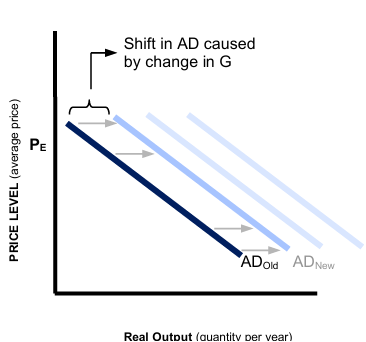
Figure 8
Keynes theorized that government spending on goods and services related to public works projects (like building dams, bridges, etc.) will provide income to market participants and cause additional increases in other kinds of spending (most notably consumption goods and services). See figure 9.
\[\underbrace{\uparrow A D}_{\begin{array}{c}
\text { Demand for all } \\
\text { output }
\end{array}}=\underbrace{\uparrow C+1+ G+N X}_{\begin{array}{c}
\text { Category of } \\
\text { spending on output }
\end{array}} \nonumber \]

Figure 9
If the government could stimulate the largest component of aggregate demand (C) then there might be a chance that the economy will generate enough activity to put everyone to work (i.e., eliminating cyclical unemployment). This is why it is important to understand how individuals treat increases in income to estimate the impact on AD.