The people who study the social world choose the questions that they study and the theories they explore based on the social problems they experience based on their own social location, and based on the social problems occurring in their societies. Because each theorist experiences a unique social identity, they see the world in a unique way. Researchers Jacobson and Mustafa (2019) explain it this way:
"The way that we as researchers view and interpret our social worlds is impacted by where, when, and how we are socially located and in what society. The position from which we see the world around us impacts our research interests, how we approach the research and participants, the questions we ask, and how we interpret the data."
Understanding the social location of scientists and activists helps us to be conscious of our own bias related to who creates knowledge, and to work to change it.
Early Sociological Theorists
French Jewish sociologist Émile Durkheim studied the social problem of suicide. He used structural functionalist theory, a sociological approach which maintains that social stability is necessary for a strong society, and adequate socialization and social integration are necessary for social stability. Society’s social institutions, such as the family or the economy, perform important functions to help ensure social stability. He explored the social breakdown caused by the Industrial Revolution and urbanization.
The rate of suicide was increasing in France, where he lived. At that time, the Holy Roman Catholic Church described suicide as a mortal sin against God and the church. People who committed suicide were not allowed to be buried on church grounds. In contrast, Durkheim proposed several reasons that people decide to commit suicide. In his book Le Suicide (pictured below), Durkheim argued that industrialization created change so fast that people couldn’t adjust quickly enough. He also said that suicides were increasing because relationships between people were breaking down. These theories helped explain the increase in suicides during industrialization. You have the option of learning more about Émile Durkheim if you wish.

This photo displays the title page of Émile Durkheim’s book on suicide. His work is foundational in sociology because it explores the patterns related to suicide instead of blaming the actions of an individual.
“Image of the book cover of Suicide” by Zyephyrus, Wikimedia Commons is in the Public Domain
English social theorist Harriet Martineau studied the social problems of poverty and slavery. Unusual for the time, she was an educated woman. Because she was both white and wealthy she was able to study and research. She traveled to the American South and interviewed people to understand more about contradictions between American ideals of freedom and liberty, and the lived reality of slavery. She also examined women’s roles, women’s rights, and family life as a field of sociological study. If you’d like, you can learn more about Harriet Martineau.
German sociologist Max Weber studied the social problems of capitalism and bureaucracy. He agreed with Marx about the importance of the economic inequality driving social disruption. However, he argued economics alone was insufficient to explain revolution. He added the idea that people’s beliefs and values contributed to the choices that they made. Most specifically, he said that the value of hard work in Protestantism contributed to the spread of capitalism. If you’d like, you can learn more about Max Weber.
Each of these theorists was responding to social concerns of the time in which they lived, whether they were experiencing social upheaval, war, economic depression, or economic stability. As we can see from the figure below, Marx, Durkheim, and Weber were responding to social forces related to the Industrial Revolution. Martineau examined changes in women’s roles related to the Industrial Revolution and the American Civil War.

This visual describes Pre-World War II sociological thinkers. How did the social location of the sociologist impact what they studied and what they learned?
“Key Sociological Thinkers: Industrial Revolution to the Great Depression” by Michaela Willi Hooper and Kimberly Puttman, Open Oregon Educational Resources, is licensed under CC BY 4.0; images Harriet Martineau by Richard Evans, Karl Marx by John Jabez Edwin Mayal, Anna Julia Cooper by C.M. Bell, Jane Addams by George de Forest Brush, Ida B. Wells Barnett by Mary Garrity, W.E.B. Du Bois by James E. Purdy, and Eugene Kinckle Jones in The Messenger are in the Public Domain
Though many of the most recognized classical theorists of sociology came from European white cultural backgrounds during the nineteenth century, plenty of Black, Indigenous, and other people of color were creating social theory and adding to our understanding of social problems. Their voices were silenced, unlike the so-called "founding fathers" of sociology, Karl Marx, Max Weber, and Émile Durkheim.
For instance, Anna Julia Cooper (1858–1964) and Ida B. Wells (1862–1931) explored the experiences of Black people during and after slavery. In fact, the roots of intersectional feminism (discussed below) can be found in their work. In their own ways, Cooper and Wells-Barnett brought a sociological consciousness to their response to the Black experience and focused on the toxic interaction between difference and power in US society (Madoo and Niebrugge 1998).
Cooper and Wells-Barnett looked at society through the lenses of race, gender, and class. Although they worked separately, they created a Black feminist sociology together. They both pointed out that “domination rests on emotion, a desire for absolute control” (Madoo and Niebrugge 1998:169). Their point was that societal domination is not just about making a profit or otherwise increasing one’s financial status. Rather, there is an emotional factor within societal domination. Cooper (1892) provides an example by noting the extra expense paid by railroad companies in providing a separate car for people of color.
Though Wells-Barnett was a journalist, she made contributions to sociological thought by way of her activism against lynching. She researched and published accounts of lynching that showed the out-of-control aggression of white Americans towards Black people (Madoo and Niebrugge 1998). After examining the various excuses used by Southern whites for their attacks on Black people, Wells-Barnett ([1895] 2018) wrote that there would be no need for her research, “If the Southern people in defense of their lawlessness, would tell the truth and admit that colored men and women are lynched for almost any offense, from murder to a misdemeanor” (p. 11). If you want to learn more, read about Anna Julia Cooper and Ida B. Wells-Barnett.
Other people of color contributed to sociological thought and social activism in sociology's earlier years. For instance, Eugene Kinkle Jones was the first person of color on the executive committee for the National Conference of Social Work. He advocated for better housing, access to healthcare, and economic opportunities for Black people (Wright et al 2021). W. E. B. Du Bois was one of the first sociologists to publish scholarly work that discussed race and racism.
Du Bois provided a critical intervention into sociological theory and his writings critiqued the absence of racial analysis from previous social theory. Du Bois was the first Black American to earn a PhD at Harvard, which he did in 1895. He studied economics, history, sociology, and political theory. Du Bois is an influential sociologist because he takes a systemic sociological approach to the experience of race, he describes how the experience of White people and Black people are qualitatively different, and he collects and displays data that support his theories.
First, Du Bois argues that the economic and social inequality experienced by formerly enslaved people was caused by systemic issues rather than by individual character traits. This is a sociological approach to explaining a social problem. He debates Booker T. Washington, who believes that formerly enslaved people need education and training to fix any issues in their lives. Du Bois writes: "[Washington’s] doctrine has tended to make the whites, North and South, shift the burden of the Negro problem to the Negro’s shoulders and stand aside as critical and rather pessimistic spectators; when in fact the burden belongs to the nation, and the hands of none of us are clean if we bend our energies to righting these great wrongs" (Du Bois 1903: Section III). Du Bois says that the nation, the United States, is responsible to make changes that will create equality for formerly enslaved people.
Quote
Daily the Negro is coming more and more to look upon law and justice, not as protecting safeguards, but as sources of humiliation and oppression. The laws are made by men who have little interest in him; they are executed by men who have absolutely no motive for treating the black people with courtesy or consideration; and, finally, the accused law-breaker is tried, not by his peers, but too often by men who would rather punish ten innocent Negroes than let one guilty one escape.
– W.E.B. Du Bois in The Souls of Black Folk
Second, Du Bois describes how Black people experience themselves differently than White people. One of his most influential contributions to sociological theory came from his discussion of the veil and double consciousness. He writes that the Black American is “born with a veil, and gifted with second-sight in this American world – a world which yields him no true self-consciousness, but only lets him see himself through the revelation of the other world” (1903:3). He points out that Black Americans have a double consciousness. They see themselves, and they see how white Americans see them.
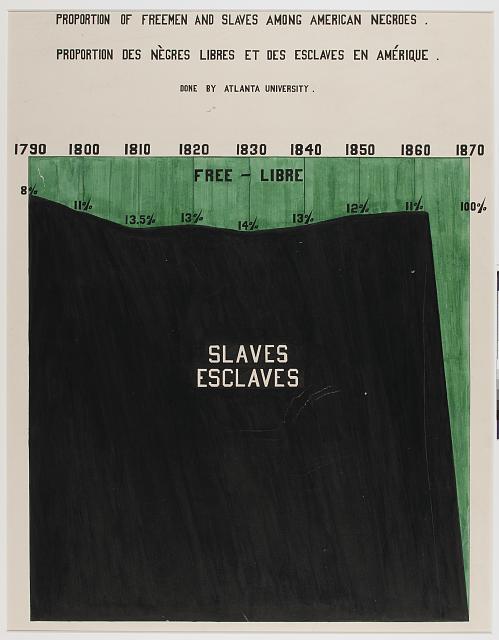
Finally, Du Bois established the first school of American sociology at Atlanta University. With his team, he also created some of the first data visualizations in American sociology to illustrate the conditions of life for Black Americans. The infographic in the figure below shows the percent of Black enslaved people and free people between 1790 and 1870, when slavery became illegal. These studies and infographics were part of his groundbreaking sociological analysis of poverty among Black Americans. His words are still quoted today among advocates of racial justice and his analysis continues to inform our experiences and conversations around race. To learn more about Du Bois, read this Smithsonian article.
All of these social theorists and activists contributed in significant ways to how we understand the reasons for social problems. They called out classism, racism, patriarchy, nativism, and other systems of power as reasons for social inequality. However, sociological thought continues to respond to the problems of modern society.
Modern and Emerging Sociological Theorists
After the Second World War, sociologists expanded on previous sociological thought. They developed a variety of theoretical frameworks that explore race, class, and gender. They explored the intersections between these classifications of power and oppression. While the classical theories remain useful, the new set of theories digs deeper into why structures and practices of inequality persist. They also leverage new understandings of systems thought. We discuss several examples of modern and emerging theories below.

These modern sociologists propose theories that explain racism, sexism, classism and other overlapping experiences of oppression. How do these theories relate to current social problems?
“Modern Sociologists” by Michaela Willi Hooper and Kimberly Puttman, Open Oregon Educational Resources, is all rights reserved due to photo restrictions; “C. Wright Mills” by Institute for Policy Studies is licensed under CC BY 2.0, “Joe Feagin” by Louwanda is licensed under CC BY-SA 3.0, “Angela Davis” by Columbia GSAPP is licensed under CC BY 2.0, “Gloria Anzaldua” by K. Kendall is licensed under CC BY 2.0, “Patricia Hill Collins” by Valter Campanato/Agência Brasil is licensed under CC BY BR 3.0, “Judith Butler” by University of California Berkeley is Public Domain, CC0 1.0
Feminism. In early sociology, sociologists often studied the experiences of white wealthy men and generalized what they discovered to “all people.” Du Bois made it clear that race matters. Similarly, early women sociologists asserted that gender matters. Sociologists like Martineau, Wells, and Cooper examined women’s lives to see how they were different from men’s lives. They also looked at how race mattered specifically to women. Although we know today that binary structures of gender do not fully capture the human experience, the sociologists at that time were revolutionary in differentiating women’s and men’s experiences.
In the 1970s, as women began to enter college in greater numbers and more researchers were female, they created a new theoretical approach in sociology. Feminist theory is a theoretical perspective initially stating that women are uniquely and systematically oppressed and challenging ideas of gender roles. Today it has expanded to include gender oppression more broadly, as well as the intersections of gender with race, class, sexuality, disability, and other areas of social location. Despite the variations between different types of feminist approaches, four characteristics are common to the feminist theory:
- Gender is a central focus or subject matter of the perspective.
- Gender relations are viewed as a problem: the site of social inequities, strains, and contradictions.
- Gender relations are sociological and historical in nature and subject to change and progress.
- Feminism is about an emancipatory commitment to change: the conditions of life that are oppressive for women need to be transformed (Little 2014).
One of the sociological insights that emerged with the feminist perspective in sociology is that “the personal is political” (Hanisch 1969). In other words, how women live their lives from washing dishes, to caring for children, to deciding not to have children, to the experience of sexual violence give them a unique political perspective. Until women sociologists looked at women’s lives, their experiences were invisible or unimportant. You are welcome to read more about the personal as political.
White British-born Canadian sociologist Dorothy Smith’s development of standpoint theory was a key innovation in sociology that enabled women’s experiences and issues to be seen and addressed in a systematic way (Smith 1977). Scientists of the time argued that science was logical and objective. In standpoint theory, Smith argued that where you stand, or your point of view, influences what you notice (Smith 1977). Women and other marginalized people see systems of oppression more clearly because they experience them. Smith recognized from the consciousness-raising groups initiated by feminists in the 1960s and 1970s that academics, politicians, and lawyers ignored many of the immediate concerns expressed by women about their personal lives. You have the option to learn more about Dorothy Smith and consciousness-raising if you’d like.

Canadian sociologist Dr. Dorothy Smith developed the standpoint theory, the idea that where you stand in society influences what you see. How does where you stand influence what you see in the social world?
“Photo” of Dorothy Smith by Schmendrick2112 via Wikimedia Commons is licensed under CC BY-SA 4.0
Part of this limitation was caused by the way sociology was traditionally done by men. Smith argued that instead of beginning sociological analysis from the abstract point of view of institutions or systems, women’s lives could be more effectively examined if one began from the “actualities” of their lived experience in the immediate local settings of “everyday/everynight” life. She asked, “What are the common features of women’s everyday lives?”
From this standpoint, Smith observed that women’s position in modern society is acutely divided by the experience of dual consciousness. One consciousness was centered in family. Then they had to cross a dividing line as they went out in the world, dealing with work or the institutions of schools, hospitals, and governments. Women had to use a second consciousness to navigate this. These institutions didn’t see women’s real and personal understandings of the world (Smith 1977).
The standpoint of women is grounded in relationships between people because they have to care for families. Society however, is organized through “relations of ruling,” which translate the substance of actual lived experiences into rules and laws. Power and rule in society, especially the power and rule that limit and shape the lives of women, operate as if there is one objective reality, rather than differences in people’s lived experiences. Smith argued that the abstract concepts of sociology, at least in the way that it was taught at the time, only contributed to the problem. This theory, while it seems obvious now, was revolutionary at the time. And, though groundbreaking, it had its limits.
The feminist perspective within social theory has changed throughout the years. From the 1800s until the mid-twentieth century, the central focus or subject matter was differences between women and men. Race and class were generally ignored. Black feminists pointed out that previous forms of feminist theory were mostly concerned with the issues of white middle-class and wealthy women. This was a critical intervention into the perspective of feminist theory.
Intersectionality. Black feminist founders of sociological thought such as Anna Julia Cooper and Ida B. Wells (discussed above) planted the seeds for the emergence of influential sociological theory from the 1980s and 1990s, which centered on the experiences of Black and Indigenous women of color. Intersectionality, as you read in the prior page, is a perspective and a theory that analyzes and interrogates the ways race, class, gender, sexuality, other areas of social location, and their systems of power overlap and work together. The video What is Intersectional Feminism? below describes this approach.
Though the concept of intersectionality is most often attributed to critical race legal scholar Kimberlé Crenshaw (pictured above), within sociology Patricia Hill Collins is recognized for providing complex and detailed analyses of the concept. Her theorization of the outsider within perspective shows how Black women “have a clearer view of oppression than other groups” whose identities are different (1986:20). Hill Collins (1986) details how Black women participate in social systems but not as insiders, given their oppression. Participating in a social system that oppresses them, Black women have a unique standpoint that offers more information. They can see more clearly how our social structures of race and gender work intersectionally.
Hill Collins’ (1986) theory of interlocking oppressions points out philosophical foundations that underlie multiple systems of oppression. It is common in sociology to explain inequality in terms of race, class, or gender alone. With some additional complexity, sociologists discuss issues of oppression related to race and class or age and gender, for example. Though, Hill Collins argues that these additive approaches missed the point. Instead, Collins explains that oppression exists as a matrix of domination, a concept which says that society has multiple interlocking levels of domination that stem from the societal configuration of race, class, and gender (Andersen and Hill Collins 1992). Patriarchy and ableism work together to make disabled women and nonbinary people invisible. Systemic racism, cissexism, and classism interlock to oppress low-income transgender people of color. This Black feminist analysis sees the holistic experience of interlocking and simultaneous oppressions and challenges people to see wholeness instead of difference (Hill Collins 1986).
These same oppositional differences are seen in the work of Chicana theorist and activist Gloria Anzaldúa (1942–2004). Anzaldúa theorizes the idea of the borderlands, or la frontera (see the video below). The borderlands is a terrain, both literal and imagined, where we live. Living in the borderlands involves the simultaneous occurrence of contradictions. Anzaldúa (1987) writes that when you live in the borderlands you are a “forerunner of a new race, half-and-half – both woman and man – neither – a new gender (p. 216). She uses various writing styles including poetry, as well as various languages to write her theory. In this way, she challenges the dominant way of composing scholarship. Her transitions between languages and dialects were groundbreaking. They served to question the dominance of certain languages (such as English) and ways of speaking (such as “proper” English).
Together these Black and Indigenous theorists of color advanced scholarly understandings of difference and oppression. Many of them also used nontraditional methods to articulate their ideas, often using personal experience or placing value on emotion. This contrasts with historical ways of doing theory that emphasized objectivity and reason. Objectivity refers to the idea of conducting research with no interference by aspects of the researcher’s identity or personal beliefs. Contemporary scholars believe it is impossible to ever be completely objective. Another similarity between these theorists is the links they made between composing scholarly work and doing activism out in the world. They worked to bridge the two and advocate for a reciprocal relationship so that what was happening in the world directly impacted scholarly work.
Racial Formation Theory. To better understand race and racism, social scientists examine racial power dynamics in the United States and throughout the world. Sociologists have long understood race to be a social construct. Race is a product of social thought rather than a material or biological reality. Yes, people have different levels of melanin in their bodies, but that is as far as any biological notion of race goes. One sociological theory of race, racial formation theory, describes race as an ongoing, ever-evolving construction with historical and cultural roots (Omi and Winant 1986). The long-lasting economic inequality caused by slavery and systemic racism combines with all of the racial stereotypes circulating in media and popular thought to create our current racial formation.
Racial formation refers to the categories of race we currently have in this country and all of the meanings popularly attached to them. The United States counts race differently in different decades. In 1790, the census counted free white women and men, other free people, and slaves. In 2010, the categories expanded to include white, Black, American Indian/Alaska Native, Asian, Hawaiian/Pacific Islander, Other, and Hispanic. By 2020, though the categories didn’t change much, people could select more than two options. These census changes help us to more accurately reflect our multiracial and diverse population (Marks and Rios-Vargas 2021).
While understanding the socially constructed nature of race is important, American social theorist Joe R. Feagin (2006) criticizes racial formation theory for failing to include an understanding of how slavery generated huge profits for white Americans, who then passed that money on to their future generations. Feagin’s view of systemic racism insists on understanding the long-lasting impacts of slavery and recognizing White-on-Black oppression as firmly embedded within US society. Feagin (2006) writes, “For a long period now, white oppression of Americans of color has been systemic – that is, it has been manifested in all societal institutions” (p. xiii). If you’d like to learn more, you can read about Joe R. Feagin.
Critical Race Theory. Other theories of racism emerged in the 1980s. You may have seen the words 'critical race theory' on social media or in your local newspaper. Critical Race Theory (CRT) is the theory that systemic racism is embedded in US institutions, rather than just in behavior of individuals (recall our discussion of individual v. institutional discrimination). The NAACP defines Critical Race Theory in the quote below.
Quote
Critical race theory, or CRT, is an academic and legal framework that denotes that systemic racism is part of American society – from education and housing to employment and healthcare. Critical race theory recognizes that racism is more than the result of individual bias and prejudice. It is embedded in laws, policies and institutions that uphold and reproduce racial inequalities. According to CRT, societal issues like Black Americans’ higher mortality rate, outsized exposure to police violence, the school-to-prison pipeline, denial of affordable housing, and the rates of the death of Black women in childbirth are not unrelated anomalies.
– NAACP Legal Defense Fund 2023
Ibram X. Kendi describes Critical Race Theory, including its misconceptions and politcalization, in the video that follows.
CRT emerged in the 1980s out of a concern by legal scholars of color that the measures installed by the civil rights movement to alleviate racial injustice were no longer addressing the problem, or never did. Critical race theorists take a systemic view of racism. They see racism not as a quirk within our society but as an everyday occurrence within many, if not all, parts of life (Delgado and Stefancic 2017). They raise questions about the law’s ability to address systemic racial inequality.
One discussion about CRT revolves around what to teach children in K-12 schools. Some white people worry that white children are being made to feel guilty for being white. However, this is a misunderstanding of the theory. It’s not about guilt. It’s about structural racism, the totality of ways in which societies foster racial discrimination through mutually reinforcing systems of housing, education, employment, earnings, benefits, credit, media, health care, and criminal justice (Bailey et al 2017).
The American Sociological Association supports teaching CRT because understanding how race impacts inequality is fundamental to changing racist laws, policies and practices (ASA 2023). Advocates for racial justice affirm the importance of discussing race and racism with children in school settings. To learn more, check out the blog Critical Race Theory: ‘Diversity’ Is Not the Solution, Dismantling White Supremacy Is.
Queer Theory. By calling this theoretical paradigm queer, scholars reject the stigmatizing effects of labeling. Instead, they embrace the word queer – once derogatory – and reclaimed it for their own purposes, as with queer politics. Queer theory is an interdisciplinary approach to sexuality and gender that identifies Western society’s rigid splitting of gender into women's and men's roles and questions how we have been taught to think about sexuality and gender. The perspective highlights the need for more flexible and fluid notions of sexuality and gender that allow for change, negotiation, and freedom. One concrete example would be allowing individuals to write in their gender on forms or leave it blank.
French social theorist Michel Foucault (1978) traced the history of the concept of sexuality and saw that powerful forces encouraged its development as part of an effort to reveal and eliminate any deviant forms of sexual expression. Foucault’s work on sexuality raises many questions: Why are we asked to identify as a specific sexuality? Wouldn’t we be freer if sexuality wasn’t categorized (e.g., homosexual/ heterosexual)? Of course, many LGBTQ+ activists would argue otherwise, given the power of self-identification and advocacy for rights and respect, but this perspective does raise important questions about sexual liberation. You may learn more about Michel Foucault.
Another well-known queer theorist, Judith Butler, also critiqued categorizations, but their objections include gender identities. As with Foucault, Butler felt that these categories were limiting. Butler is recognized among sociologists for developing the theory of gender performativity. This theory describes gender as a way of appearing to others through clothing, nonverbal communication, make-up, as so on, instead of an inner feeling or identity. Thus, gender is a matter of learned performance and can be reconstructed (Wilchins 2004). In the video below, Butler is asked to reflect upon gender performativity decades after proposing the theory.
In this approach, sociologists understand that gender is something we do, not only something we are. Like symbolic interactionists, they say that gender expression is an intentional choice made in everyday interactions, though it is bound by social forces that constrain those choices. This theory opens the doors for us to re-think what we want gender to mean or for us to do away with the concept of gender altogether and replace it with something else. Theorists who use queer theory strive to question the ways society perceives and experiences sex, gender, and sexuality, creating a new scholarly understanding. Visit Judith Butler's UC Berkeley page for more information about their work.