Social Sci LibreTexts

1.2: Cognitivism

  • Page ID
    277734
  • This page is a draft and under active development. Please forward any questions, comments, and/or feedback to the ASCCC OERI (oeri@asccc.org).

    \( \newcommand{\vecs}[1]{\overset { \scriptstyle \rightharpoonup} {\mathbf{#1}} } \)

    \( \newcommand{\vecd}[1]{\overset{-\!-\!\rightharpoonup}{\vphantom{a}\smash {#1}}} \)

    \( \newcommand{\dsum}{\displaystyle\sum\limits} \)

    \( \newcommand{\dint}{\displaystyle\int\limits} \)

    \( \newcommand{\dlim}{\displaystyle\lim\limits} \)

    \( \newcommand{\id}{\mathrm{id}}\) \( \newcommand{\Span}{\mathrm{span}}\)

    ( \newcommand{\kernel}{\mathrm{null}\,}\) \( \newcommand{\range}{\mathrm{range}\,}\)

    \( \newcommand{\RealPart}{\mathrm{Re}}\) \( \newcommand{\ImaginaryPart}{\mathrm{Im}}\)

    \( \newcommand{\Argument}{\mathrm{Arg}}\) \( \newcommand{\norm}[1]{\| #1 \|}\)

    \( \newcommand{\inner}[2]{\langle #1, #2 \rangle}\)

    \( \newcommand{\Span}{\mathrm{span}}\)

    \( \newcommand{\id}{\mathrm{id}}\)

    \( \newcommand{\Span}{\mathrm{span}}\)

    \( \newcommand{\kernel}{\mathrm{null}\,}\)

    \( \newcommand{\range}{\mathrm{range}\,}\)

    \( \newcommand{\RealPart}{\mathrm{Re}}\)

    \( \newcommand{\ImaginaryPart}{\mathrm{Im}}\)

    \( \newcommand{\Argument}{\mathrm{Arg}}\)

    \( \newcommand{\norm}[1]{\| #1 \|}\)

    \( \newcommand{\inner}[2]{\langle #1, #2 \rangle}\)

    \( \newcommand{\Span}{\mathrm{span}}\) \( \newcommand{\AA}{\unicode[.8,0]{x212B}}\)

    \( \newcommand{\vectorA}[1]{\vec{#1}}      % arrow\)

    \( \newcommand{\vectorAt}[1]{\vec{\text{#1}}}      % arrow\)

    \( \newcommand{\vectorB}[1]{\overset { \scriptstyle \rightharpoonup} {\mathbf{#1}} } \)

    \( \newcommand{\vectorC}[1]{\textbf{#1}} \)

    \( \newcommand{\vectorD}[1]{\overrightarrow{#1}} \)

    \( \newcommand{\vectorDt}[1]{\overrightarrow{\text{#1}}} \)

    \( \newcommand{\vectE}[1]{\overset{-\!-\!\rightharpoonup}{\vphantom{a}\smash{\mathbf {#1}}}} \)

    \( \newcommand{\vecs}[1]{\overset { \scriptstyle \rightharpoonup} {\mathbf{#1}} } \)

    \( \newcommand{\vecd}[1]{\overset{-\!-\!\rightharpoonup}{\vphantom{a}\smash {#1}}} \)

    \(\newcommand{\avec}{\mathbf a}\) \(\newcommand{\bvec}{\mathbf b}\) \(\newcommand{\cvec}{\mathbf c}\) \(\newcommand{\dvec}{\mathbf d}\) \(\newcommand{\dtil}{\widetilde{\mathbf d}}\) \(\newcommand{\evec}{\mathbf e}\) \(\newcommand{\fvec}{\mathbf f}\) \(\newcommand{\nvec}{\mathbf n}\) \(\newcommand{\pvec}{\mathbf p}\) \(\newcommand{\qvec}{\mathbf q}\) \(\newcommand{\svec}{\mathbf s}\) \(\newcommand{\tvec}{\mathbf t}\) \(\newcommand{\uvec}{\mathbf u}\) \(\newcommand{\vvec}{\mathbf v}\) \(\newcommand{\wvec}{\mathbf w}\) \(\newcommand{\xvec}{\mathbf x}\) \(\newcommand{\yvec}{\mathbf y}\) \(\newcommand{\zvec}{\mathbf z}\) \(\newcommand{\rvec}{\mathbf r}\) \(\newcommand{\mvec}{\mathbf m}\) \(\newcommand{\zerovec}{\mathbf 0}\) \(\newcommand{\onevec}{\mathbf 1}\) \(\newcommand{\real}{\mathbb R}\) \(\newcommand{\twovec}[2]{\left[\begin{array}{r}#1 \\ #2 \end{array}\right]}\) \(\newcommand{\ctwovec}[2]{\left[\begin{array}{c}#1 \\ #2 \end{array}\right]}\) \(\newcommand{\threevec}[3]{\left[\begin{array}{r}#1 \\ #2 \\ #3 \end{array}\right]}\) \(\newcommand{\cthreevec}[3]{\left[\begin{array}{c}#1 \\ #2 \\ #3 \end{array}\right]}\) \(\newcommand{\fourvec}[4]{\left[\begin{array}{r}#1 \\ #2 \\ #3 \\ #4 \end{array}\right]}\) \(\newcommand{\cfourvec}[4]{\left[\begin{array}{c}#1 \\ #2 \\ #3 \\ #4 \end{array}\right]}\) \(\newcommand{\fivevec}[5]{\left[\begin{array}{r}#1 \\ #2 \\ #3 \\ #4 \\ #5 \\ \end{array}\right]}\) \(\newcommand{\cfivevec}[5]{\left[\begin{array}{c}#1 \\ #2 \\ #3 \\ #4 \\ #5 \\ \end{array}\right]}\) \(\newcommand{\mattwo}[4]{\left[\begin{array}{rr}#1 \amp #2 \\ #3 \amp #4 \\ \end{array}\right]}\) \(\newcommand{\laspan}[1]{\text{Span}\{#1\}}\) \(\newcommand{\bcal}{\cal B}\) \(\newcommand{\ccal}{\cal C}\) \(\newcommand{\scal}{\cal S}\) \(\newcommand{\wcal}{\cal W}\) \(\newcommand{\ecal}{\cal E}\) \(\newcommand{\coords}[2]{\left\{#1\right\}_{#2}}\) \(\newcommand{\gray}[1]{\color{gray}{#1}}\) \(\newcommand{\lgray}[1]{\color{lightgray}{#1}}\) \(\newcommand{\rank}{\operatorname{rank}}\) \(\newcommand{\row}{\text{Row}}\) \(\newcommand{\col}{\text{Col}}\) \(\renewcommand{\row}{\text{Row}}\) \(\newcommand{\nul}{\text{Nul}}\) \(\newcommand{\var}{\text{Var}}\) \(\newcommand{\corr}{\text{corr}}\) \(\newcommand{\len}[1]{\left|#1\right|}\) \(\newcommand{\bbar}{\overline{\bvec}}\) \(\newcommand{\bhat}{\widehat{\bvec}}\) \(\newcommand{\bperp}{\bvec^\perp}\) \(\newcommand{\xhat}{\widehat{\xvec}}\) \(\newcommand{\vhat}{\widehat{\vvec}}\) \(\newcommand{\uhat}{\widehat{\uvec}}\) \(\newcommand{\what}{\widehat{\wvec}}\) \(\newcommand{\Sighat}{\widehat{\Sigma}}\) \(\newcommand{\lt}{<}\) \(\newcommand{\gt}{>}\) \(\newcommand{\amp}{&}\) \(\definecolor{fillinmathshade}{gray}{0.9}\)

    How We Think

    Cognitivism focuses on the internal processes involved in learning, such as thinking, memory, problem-solving, and understanding. It sees the mind as an active participant in learning, not just a passive recipient of stimuli.

    Jean Piaget

    Jean Piaget was a Swiss developmental psychologist known for his groundbreaking work on the cognitive development of children. He proposed that children progress through four stages of cognitive development—sensorimotor, preoperational, concrete operational, and formal operational—each marked by distinct ways of thinking and understanding the world. Piaget’s experiments focused on how children actively construct their knowledge through interactions with their environment. One of his most famous studies involved the conservation task, where he demonstrated that young children lack the understanding that quantities remain the same despite changes in shape or appearance. This experiment, among others, illustrated that children's cognitive abilities develop in stages and that they are not simply miniature adults but think in fundamentally different ways at different ages. Piaget's work revolutionized the field of developmental psychology, emphasizing that cognitive development is a process of maturation and discovery rather than passive learning.

    Interactive Element

    Watch the following video to see how a 4.5-year-old child navigates the conservation tasks brought forth by Piaget. Take notice of how numbers, length, liquid, mass, and area are viewed through the child's lens.

    Lev Vygotsky

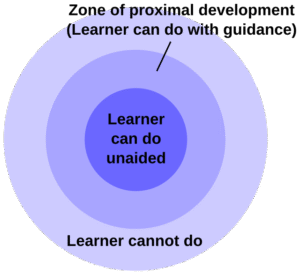
    Zone of proximal development Illustration of the zone of proximal development, the central ring where a child can complete a task with adult guidance, but not without it. This represents the borders of their current capability.

    Lev Vygotsky, a Russian psychologist, is best known for his sociocultural theory of cognitive development, which emphasizes the crucial role of social interaction and cultural context in shaping a child's learning. Vygotsky argued that cognitive development is deeply influenced by the environment and that children learn through guided interactions with more knowledgeable individuals, such as parents, teachers, and peers. One of his key concepts is the "Zone of Proximal Development" (ZPD), which refers to the difference between what a child can do independently and what they can achieve with support. Vygotsky believed that learning occurs most effectively within this zone, where instruction and collaboration help the child reach higher levels of understanding. Additionally, he emphasized the importance of language as a tool for thinking and learning, suggesting that it not only facilitates communication but also shapes cognitive processes. Vygotsky’s theory has had a lasting impact on education, advocating for collaborative learning and the importance of cultural tools in shaping intellectual development.

    Jerome Bruner

    Jerome Bruner was a key figure in the development of cognitive psychology, contributing significantly to our understanding of how individuals process information and learn. Bruner emphasized the importance of active learning, proposing that learners construct their own understanding through interaction with the environment, a view that contrasts with more passive learning models. In his work, he identified three modes of representation, inactive, iconic, and symbolic, through which children acquire knowledge. Bruner’s research highlighted the importance of discovery learning, where learners explore concepts and problem-solving methods on their own, promoting deeper understanding and cognitive development. His work laid the foundation for modern educational practices, emphasizing the role of language, culture, and social interaction in shaping cognitive growth. Jerome Bruner coined the term "scaffolding" in the 1960s, based on Vygotsky's work and studies of early language learning. Scaffolding in education refers to the instructional support provided by a teacher or more knowledgeable peer to help a learner accomplish tasks they cannot yet do independently. The term describes a dynamic process where the teacher offers guidance, encouragement, and resources at the appropriate level of difficulty, gradually reducing support as the learner gains competence and confidence. The goal of scaffolding is to bridge the gap between the learner's current abilities and their potential capabilities, helping them achieve tasks within their "Zone of Proximal Development" (ZPD). As the learner becomes more capable, the teacher removes the scaffolding, allowing the learner to perform tasks independently. Scaffolding promotes active learning, problem-solving, and cognitive development by making learning more manageable and accessible. Bruner believed that appropriate social interactional frameworks were necessary for learning to take place.

    Interactive Element

    Take a moment to watch the following video and gather information on how Bruner's 3 steps of learning are applied.

    Cognitivism is reflected in practices that encourage problem-solving, critical thinking, and exploration. For example, teachers might use activities like group discussions, collaborative projects, or concept mapping to support cognitive development.


    This page titled 1.2: Cognitivism is shared under a CC BY-SA 4.0 license and was authored, remixed, and/or curated by Kerry Diaz & Tenessa Sanchez.